The consequences of the Soviet invasion of Afghanistan (Edexcel GCSE History): Revision Notes
📚Revision Notes
The consequences of the Soviet invasion of Afghanistan
Background: A changing context in 1985
The year 1985 marked a crucial turning point in Cold War relations when Mikhail Gorbachev rose to leadership of the Soviet Union. By this time, the Soviet Union was experiencing severe difficulties, and Gorbachev understood that significant reforms were necessary. Meanwhile, US President Ronald Reagan initially saw this as an opportunity to maintain pressure on the communist system while potentially ending the Cold War on favourable terms for the West.
Note
Gorbachev's rise to power in 1985 came at a time when the Soviet Union faced multiple internal and external pressures, making him more open to reform and negotiation than previous Soviet leaders.
Reagan's initially aggressive stance
When Reagan first took office, he adopted an uncompromising position against Soviet communism. His approach was characterised by several key elements that intensified Cold War tensions:
Reagan famously branded the Soviet Union as an "evil empire", demonstrating his moral opposition to communist ideology. He deliberately restarted the arms race, believing that American technological and economic superiority could force the Soviets into unsustainable military spending. During the 1980s, American technology advanced rapidly, particularly in computing systems, while the USA invested heavily in developing sophisticated new missile technology.
Important
Reagan's strategy of economic warfare through the arms race was designed to exploit the Soviet Union's economic weaknesses and force them to spend beyond their means on military technology they couldn't match.
The Soviet Union's mounting difficulties
The consequences of the Afghanistan invasion became clear as part of a broader pattern of Soviet decline. Multiple crises were weakening the Soviet system simultaneously:
The Soviet economy struggled to compete with American prosperity, partly because enormous resources were devoted to military expenditure rather than improving living standards. Citizens across the Eastern Bloc endured very poor living conditions compared to their Western counterparts. The war in Afghanistan, which began with the 1979 invasion, continued to drain Soviet resources and morale throughout the 1980s.
Perhaps most significantly, the Soviet Union lacked the technological expertise that America was developing, particularly in computing. This technology gap meant the Soviets could not match the USA's advancement in missile technology, putting them at a strategic disadvantage.
Note
The Soviet invasion of Afghanistan proved to be a costly mistake that drained resources while providing no strategic benefit, earning it the nickname "the Soviet Union's Vietnam."
The Geneva Summit: A diplomatic breakthrough
In November 1985, Gorbachev and Reagan held their first face-to-face meeting at the Geneva Summit. This encounter proved more successful than many had expected, with both leaders establishing a personal rapport that would prove crucial for future negotiations.
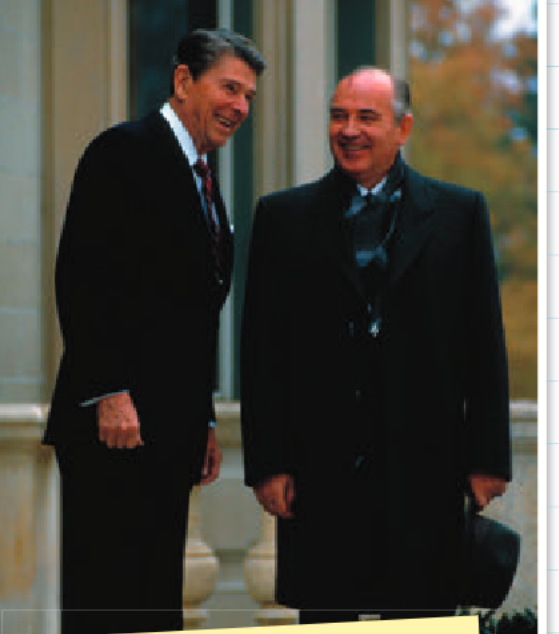
The two men discovered they could work together effectively, and both agreed to continue meeting in the future. This marked the beginning of a new phase in superpower relations.
Important
The Geneva Summit was a watershed moment in Cold War history - the first time in over six years that American and Soviet leaders had met face-to-face, breaking the diplomatic ice between the superpowers.
Reagan's transformation in approach
Several factors contributed to Reagan's willingness to negotiate with Gorbachev rather than maintain his previous confrontational stance:
Public opinion in many countries, especially across Europe, opposed the continuation of the arms race. People were concerned about the risks of nuclear escalation and wanted their leaders to pursue diplomatic solutions. Gorbachev himself became surprisingly popular in Western nations, with "Gorbymania" spreading through Western Europe and even reaching the United States.
Reagan developed a personal liking for Gorbachev and recognised him as someone with whom America could conduct business. The influence of British Prime Minister Margaret Thatcher, who was both a close ally of Reagan and an early supporter of Gorbachev, also played a role. Thatcher famously described Gorbachev as someone "she could do business with," and her endorsement carried weight with Reagan.
Note
"Gorbymania" was a real phenomenon in the West, where Gorbachev was often more popular than in his own country. His charismatic personality and reformist image made him the first Soviet leader that Western populations could relate to and support.
The broader significance of changing attitudes
The shift in both leaders' approaches had profound consequences for international relations and the Cold War's eventual conclusion:
Most importantly, these changing attitudes represented a genuine easing of Cold War tensions after decades of hostility. The personal relationship between Reagan and Gorbachev led to increased cooperation between the USA and Soviet Union on various international issues.
This new spirit of cooperation made possible significant arms control agreements, including the Intermediate-Range Nuclear Forces (INF) Treaty and the Strategic Arms Reduction Treaty (START I). These agreements represented concrete steps towards reducing the nuclear threat that had dominated international relations since the 1940s.
Timeline of key events
- 1979: Soviet invasion of Afghanistan begins
- 1981: Reagan becomes US President, adopts tough anti-Soviet stance
- 1985: Gorbachev becomes Soviet leader
- November 1985: Geneva Summit - first Reagan-Gorbachev meeting
- 1987: INF Treaty signed
- 1991: START I Treaty completed
Summary
Key Points to Remember:
- The Soviet invasion of Afghanistan was part of a broader crisis that weakened the USSR economically and militarily by the mid-1980s
- Gorbachev's rise to power in 1985 coincided with Reagan's willingness to move from confrontation to negotiation
- The Geneva Summit in November 1985 established crucial personal relations between the superpowers' leaders
- Reagan's change from calling the USSR an "evil empire" to working with Gorbachev reflected changing public opinion and strategic realities
- These shifting attitudes directly led to major arms control agreements and the eventual end of the Cold War