The significance of the Soviet invasion of Afghanistan (Edexcel GCSE History): Revision Notes
📚Revision Notes
The significance of the Soviet invasion of Afghanistan
The start of the "Second Cold War" (1979-1984)
The Soviet invasion of Afghanistan in 1979 marked a crucial turning point that triggered what historians call the "Second Cold War". This period, lasting until 1984, saw relations between the USA and Soviet Union deteriorate dramatically after a brief period of détente in the early 1970s.
Note
The term "Second Cold War" distinguishes this period of renewed tensions from the initial Cold War that began after World War II, highlighting how the brief détente of the early 1970s had given way to even more intense superpower rivalry.
When Ronald Reagan became US president in 1981, he transformed America's approach to the Cold War. Reagan believed the USA had a "mission from God" to defeat communism and win the Cold War decisively. This represented a major shift from previous policies of containment to a more aggressive stance aimed at rolling back Soviet influence.
Comparing the superpowers in 1979
The United States' position
By 1979, America had recovered significantly from its defeat in Vietnam, where it had failed to prevent the spread of communism. The country was experiencing rapid technological advancement, particularly in computer and information technology. America was becoming increasingly determined not just to contain communism, but to actively reverse its spread. The US government was prepared to provide substantial funding to anti-communist forces operating in Central America and Southern Africa.
The Soviet Union's challenges
The Soviet Union faced numerous internal problems that would prove crucial in the conflict's outcome. Living standards remained poor throughout the country, while the leadership was ageing rapidly. Leonid Brezhnev died in 1982 and was replaced first by Andropov, then Chernenko - all three leaders were over 70 years old.
Important
The Soviet economy was struggling, being only 20% the size of the American economy, and their technology was becoming increasingly outdated. This massive economic disparity would prove decisive in the Cold War's outcome.
Additionally, the USSR was dealing with growing anti-communist protest movements in Eastern Europe, particularly the Solidarity trade union in Poland demanding democratic reforms.
How relations deteriorated further
The Soviet invasion of Afghanistan became the catalyst for several factors that worsened US-Soviet relations:
Note
Key Factors in Deteriorating Relations:
Olympic boycotts: Both superpowers used the Olympic Games as political weapons, with boycotts in 1980 and 1984 demonstrating the depth of their hostility.
Reagan's anti-communist stance: The new president's election brought a much more confrontational approach to Soviet relations.
Arms race intensification: Military expenditure increased dramatically, with both sides developing new missile systems and the USA launching the Strategic Defence Initiative.
Ongoing proxy conflict: The war in Afghanistan continued to drain Soviet resources while America supported the Afghan mujahideen.
Arms control breakdown: The SALT 2 arms control negotiations collapsed completely.
KAL007 incident: In September 1983, Soviet forces shot down Korean Air Lines flight 007, killing all 269 people aboard, including Koreans, Americans and other civilians. The USA condemned this attack, claiming the aircraft had been conducting surveillance missions.
Reagan's Strategic Defence Initiative (SDI)
Previously, nuclear strategy had been based on Mutually Assured Destruction (MAD) - the idea that if both superpowers could destroy each other completely in a nuclear war, neither would dare start one. However, Reagan wanted to win the Cold War rather than simply maintain the balance of terror.
In March 1983, Reagan launched the Strategic Defence Initiative, nicknamed "Star Wars". This ambitious programme aimed to create a system of satellites, lasers and mirrors in space capable of destroying Soviet intercontinental nuclear missiles before they could reach American territory.
Important
Revolutionary Change in Nuclear Strategy
The SDI programme represented a fundamental shift from the existing MAD doctrine. Instead of accepting mutual destruction as a deterrent, Reagan sought to make nuclear weapons "impotent and obsolete" by creating a defensive shield around America.
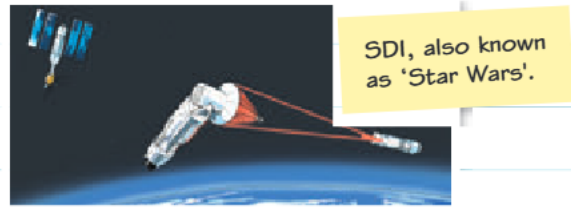
The SDI programme had significant consequences for superpower relations. The Soviet Union argued it violated the 1967 Outer Space Treaty and would give America a decisive advantage in any nuclear conflict. This "Star Wars" system severely damaged East-West relations, and in December 1983, Soviet negotiators walked out of arms control talks in Geneva in protest.
The broader impact of Afghanistan
The Soviet invasion of Afghanistan proved to be a decisive factor in the Cold War's final phase. It not only triggered the Second Cold War but also demonstrated the Soviet Union's military limitations and economic vulnerabilities. The conflict became the USSR's "Vietnam" - a costly, prolonged war that drained resources and damaged Soviet prestige internationally.
Example
Historical Parallel: Afghanistan as the Soviet Vietnam
Just as the Vietnam War had drained American resources and damaged US prestige in the 1960s-70s, the Afghanistan conflict had the same effect on the Soviet Union:
- Economic drain: Costly military operations in difficult terrain
- International isolation: Loss of support from non-aligned nations
- Domestic opposition: Growing war-weariness among Soviet citizens
- Military limitations: Inability to defeat guerrilla forces despite superior technology
The invasion also provided the United States with an opportunity to support anti-Soviet forces directly, marking a shift from defensive containment to offensive strategy. American support for the Afghan mujahideen helped turn Afghanistan into a prolonged conflict that ultimately contributed to the Soviet Union's economic and political decline.
Timeline of key events
- 1979: Soviet invasion of Afghanistan begins
- 1980: US boycotts Moscow Olympics
- 1981: Ronald Reagan becomes US president
- 1982: Brezhnev dies, Andropov becomes Soviet leader
- 1983: Reagan announces SDI programme (March)
- 1983: KAL007 shot down (September)
- 1983: Soviet negotiators walk out of Geneva arms talks (December)
- 1984: Soviet Union boycotts Los Angeles Olympics
Summary
Key Points to Remember:
- The Soviet invasion of Afghanistan in 1979 triggered the "Second Cold War" lasting until 1984
- Reagan's presidency marked a shift from containment to actively winning the Cold War
- The USSR faced serious economic problems and ageing leadership while fighting in Afghanistan
- SDI/"Star Wars" represented a major change in nuclear strategy away from MAD
- Multiple incidents including Olympic boycotts and the KAL007 shooting worsened relations dramatically