The origins of the Cold War, 1941-58 (Edexcel GCSE History): Revision Notes
📚Revision Notes
The Soviet invasion of Hungary, 1956
Background to the crisis
In 1956, Soviet leader Nikita Khrushchev became increasingly worried about the direction of reforms being introduced by Hungarian Prime Minister Imre Nagy. These changes posed a significant threat to Soviet control over Eastern Europe, as Hungary was a key member of the Warsaw Pact - the Soviet Union's military alliance with its satellite states.
Note
The Warsaw Pact, formed in 1955, was the Soviet Union's response to NATO. It created a formal military alliance between the USSR and its Eastern European satellite states, including Hungary, Poland, East Germany, Czechoslovakia, Romania, Bulgaria, and Albania.
Nagy's government had begun implementing policies that challenged communist authority and threatened to weaken Soviet influence in the region. Khrushchev feared that if Hungary successfully broke away from Soviet control, other satellite states might follow suit, potentially leading to the collapse of the entire Eastern European communist bloc.
The situation became more serious when violence erupted in October 1956. Hungarian citizens, supported by some communist party members, began fighting against the state security forces known as the AVH. This unrest spread from Budapest to other Hungarian cities, creating a major crisis for Soviet leadership.
The invasion unfolds
On 4 November 1956, Khrushchev made the decisive move to crush the Hungarian uprising by sending a massive force of 200,000 Soviet troops into Hungary. This military intervention was designed to remove Nagy from power and restore strict communist control over the country.
Important
The scale of the Soviet response demonstrated how seriously Moscow viewed the Hungarian uprising. The deployment of 200,000 troops represented one of the largest military operations in Europe since World War II, showing that the USSR would use overwhelming force to maintain control over its satellite states.
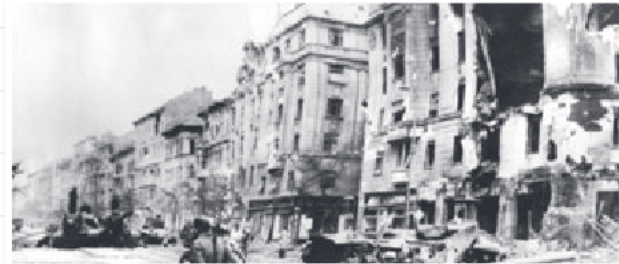
The invasion resulted in significant destruction across Hungarian cities, particularly in Budapest. The Soviet forces faced resistance from Hungarian fighters who remained loyal to Nagy and the revolutionary cause, but the overwhelming military superiority of the Soviet army made the outcome inevitable.
Immediate consequences of the invasion
The human cost of the Soviet intervention was severe. Reports indicate that between 3,000 and 5,000 Hungarians lost their lives during the invasion, while approximately 1,000 Soviet troops also died in the fighting. These casualties demonstrated the fierce resistance put up by Hungarian revolutionaries despite being vastly outnumbered.
Nagy and his government were quickly overthrown by the Soviet forces. To send a clear message to other potential rebels across Eastern Europe, Khrushchev ordered Nagy's arrest, trial, and execution. This harsh punishment was intended to deter similar uprisings in other satellite states such as Poland and East Germany.
Example
The Fate of Imre Nagy
Nagy's punishment followed a deliberate pattern designed to intimidate other potential rebels:
Step 1: Arrest - Nagy was captured and held by Soviet forces
Step 2: Secret trial - He was tried for treason against the communist state
Step 3: Execution - Nagy was executed in 1958, two years after the uprising
Step 4: Public announcement - His death was announced to send a clear warning across Eastern Europe
Following Nagy's removal, the Soviets appointed Janos Kadar as the new Hungarian leader. Kadar introduced what became known as the Fifteen Point Programme, which aimed to re-establish firm communist rule while offering slightly more moderate policies than those seen in other Eastern European states. This approach helped Hungary achieve better living standards compared to other Soviet satellite nations, though it remained under strict communist control.
International response and limitations
The Hungarian crisis exposed the limitations of Western power during the Cold War period. While the United Nations condemned Soviet actions and some countries boycotted the 1956 Olympics in protest, more substantial support was not forthcoming.
The United States provided limited assistance to Hungary, offering money, medical aid, and accepting around 80,000 Hungarian refugees who fled the country. However, America could not provide military support without risking a nuclear confrontation with the Soviet Union - a possibility that was simply too dangerous to contemplate during this tense period of the Cold War.
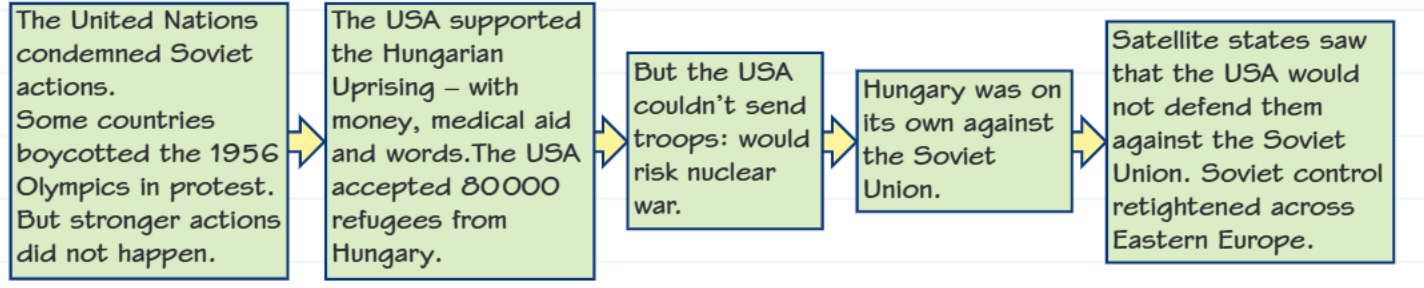
This lack of meaningful Western military support left Hungary isolated in its struggle against Soviet power. The crisis demonstrated to other satellite states that they could not rely on American military protection if they chose to rebel against Soviet control.
Important
The Nuclear Dilemma
The Hungarian crisis highlighted a crucial limitation of the Cold War era: while both superpowers possessed nuclear weapons, this actually restricted their ability to intervene directly in each other's spheres of influence. The fear of nuclear escalation meant that the US could not provide military aid to Hungary without risking global catastrophe.
Long-term impact on the Cold War
The Hungarian invasion had significant consequences for Cold War relations and Soviet control over Eastern Europe. The events showed that the Soviet Union was prepared to use overwhelming military force to maintain its sphere of influence, regardless of international condemnation.
For other Eastern European countries, the message was clear: attempts to break away from Soviet control would be met with brutal suppression. This realisation led to a tightening of Soviet control across the region, as satellite states understood that they were truly on their own if they challenged Moscow's authority.
The crisis also highlighted the practical limitations of the policy of containment pursued by the United States. While America was prepared to prevent the spread of communism to new areas, it was unwilling to risk nuclear war to roll back existing Soviet control in Eastern Europe.
Timeline of key events
- October 1956: Violence erupts in Budapest and spreads across Hungary as citizens rise against communist rule
- 4 November 1956: Soviet Union sends 200,000 troops to invade Hungary and crush the uprising
- November 1956: Imre Nagy's government is overthrown and he is arrested
- 1956-1958: Janos Kadar consolidates power and introduces the Fifteen Point Programme
- 1958: Imre Nagy is executed following his trial for treason
Summary
Key Points to Remember:
- The invasion was massive: 200,000 Soviet troops were deployed to crush the Hungarian uprising in November 1956
- Human cost was severe: Between 3,000-5,000 Hungarians died, along with around 1,000 Soviet soldiers
- Western support was limited: The US provided aid and accepted 80,000 refugees but could not risk nuclear war by sending troops
- The message was clear: The invasion showed other satellite states that rebellion would be brutally suppressed
- Soviet control tightened: The crisis led to stricter control across Eastern Europe as the limits of Western support became apparent