Cominform, Comecon and NATO (Edexcel GCSE History): Revision Notes
📚Revision Notes
Cominform, Comecon and NATO
Introduction
The period between 1947-1949 saw the creation of three major international organisations that would shape the Cold War for decades. These organisations - Cominform, Comecon, and NATO - reflected the growing division between East and West, as both superpowers sought to strengthen their influence over their respective allies.
Note
These three organisations represent the institutionalisation of the Cold War divide. While Cominform and Comecon were Soviet creations designed to control Eastern Europe, NATO emerged as the Western response to Soviet expansion, creating the framework for decades of bipolar confrontation.
Cominform (1947)
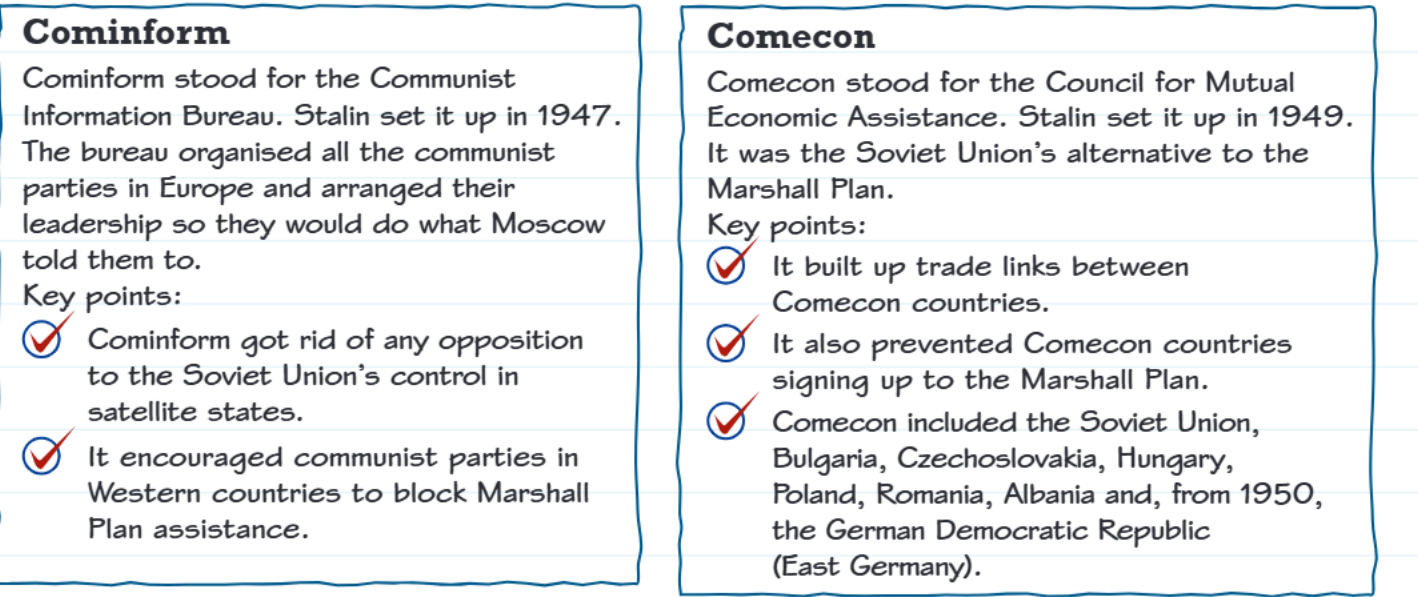
Stalin established the Communist Information Bureau in September 1947 as his response to growing Western cooperation through the Marshall Plan. This organisation served as a powerful tool for Soviet control over European communist movements.
The primary purpose of Cominform was to coordinate the activities of communist parties across Europe under Moscow's direct authority. Stalin used it to ensure that satellite states would follow Soviet policies without question, effectively eliminating any independent opposition to Soviet control within these countries.
Important
Cominform was essentially Stalin's method of ensuring ideological unity across the communist world. Any deviation from Moscow's line - as seen with Yugoslavia's Tito in 1948 - resulted in immediate expulsion from the communist bloc.
Cominform played a crucial role in blocking the Marshall Plan's expansion into Eastern Europe. The organisation encouraged communist parties in Western countries like France and Italy to oppose American economic assistance, viewing it as a threat to communist ideology and Soviet influence.
Comecon (1949)
The Council for Mutual Economic Assistance was established by Stalin in January 1949 as the Soviet Union's economic answer to the Marshall Plan. This organisation aimed to create strong economic ties between communist countries while preventing them from seeking Western aid.
Comecon's main function was to build comprehensive trade relationships between member states, including the Soviet Union, Bulgaria, Czechoslovakia, Hungary, Poland, Romania, and Albania. East Germany joined in 1950, completing the Eastern European economic bloc.
Note
Comecon represented Stalin's recognition that economic cooperation was essential for maintaining political control. By creating an alternative to Western economic systems, he could offer his satellite states the promise of prosperity while keeping them isolated from capitalist influence.
By creating this alternative economic system, Stalin effectively prevented Eastern European countries from participating in the Marshall Plan. This economic isolation helped maintain Soviet political control over the region while building a communist economic sphere separate from Western capitalism.
NATO (1949)
The North Atlantic Treaty Organisation was formed in April 1949 as a direct response to Soviet actions in Eastern Europe, including the Berlin Blockade and the development of Soviet atomic weapons. This Western military alliance represented a fundamental shift in international relations.
NATO was built around the principle of collective security, meaning that an attack on one member would be considered an attack on all members. The founding members included the United States, Britain, Canada, Holland, Belgium, France, Denmark, and Norway, with West Germany joining in 1955.
Important
Article 5 of the NATO treaty established the collective defence principle: "an armed attack against one or more of them shall be considered an attack against them all." This represented the first peacetime military alliance in American history.
The alliance was specifically designed to counter potential Soviet military aggression against Western Europe. This marked the first time the United States had entered a peacetime military alliance, demonstrating the seriousness of the perceived Soviet threat.
Consequences and significance
The establishment of these three organisations had profound consequences for European politics and the development of the Cold War. Europe became divided into two distinct spheres of influence: Western Europe aligned with the United States through NATO and economic cooperation, while Eastern Europe fell under Soviet control through Cominform and Comecon.
This division became known as the Iron Curtain, a term that perfectly captured the impermeable barrier between the two blocs. The Soviet Union responded to NATO's formation and West Germany's membership by creating the Warsaw Pact in 1955, establishing a communist military alliance to mirror NATO.
Important
The creation of these competing organisations fundamentally changed the nature of international relations. Europe was no longer a collection of independent nation-states but two rival blocs locked in ideological and military competition.
The creation of these competing alliances meant that Europe was now divided by two military blocs facing each other across the Iron Curtain, setting the stage for decades of tension, arms races, and proxy conflicts around the world.
Timeline of key events
- September 1947: Stalin establishes Cominform to control European communist parties
- January 1949: Comecon created as Soviet economic alternative to Marshall Plan
- April 1949: NATO formed by Western allies for collective security
- 1950: East Germany joins Comecon, completing Eastern European economic bloc
- 1955: West Germany joins NATO, prompting Soviet creation of Warsaw Pact
Remember!
Summary
Key Points to Remember:
- Cominform (1947) was Stalin's tool to control European communist parties and oppose the Marshall Plan through political coordination
- Comecon (1949) served as the Soviet economic alternative to Western aid, building trade links between communist countries
- NATO (1949) created a Western military alliance based on collective security against Soviet expansion
- These organisations divided Europe into two competing spheres of influence separated by the Iron Curtain
- The Warsaw Pact (1955) was formed as the Soviet military response to NATO, completing the division of Europe into opposing blocs