Soviet control in Hungary (Edexcel GCSE History): Revision Notes
📚Revision Notes
Soviet control in Hungary
Background and context
After Stalin's death in 1953, new Soviet leader Nikita Khrushchev suggested that Soviet control over Eastern European countries might become less strict. However, when Hungary began showing signs of wanting independence from Soviet influence, the USSR quickly tightened its grip. The Soviets feared that if Hungary successfully broke away from the Warsaw Pact, other Eastern European nations might follow suit and the entire communist bloc could collapse.
Note
This fear of a "domino effect" was central to Soviet thinking - the loss of one satellite state could trigger the collapse of their entire Eastern European empire, undermining Soviet security and international influence.
The harsh reality of Soviet rule
Hungary experienced severe hardship under Stalin's control, which lasted from the late 1940s until his death in 1953. The Soviet system imposed on Hungary created widespread suffering and resentment among the Hungarian people.
The economic impact was devastating - Hungary's food supplies and industrial products were systematically shipped to Russia, leaving Hungarians with shortages of basic necessities. This economic exploitation weakened Hungary's economy and reduced living standards significantly.
Political opposition was completely crushed. The Soviet-backed government ruthlessly eliminated any form of dissent or criticism. Leading this oppressive regime was Matyas Rakosi, a Hungarian communist who was completely loyal to Stalin. Rakosi proudly called himself "Stalin's best pupil" but earned the nickname "the Bald Butcher" due to his brutal methods of maintaining control.
Note
Rakosi's nickname "the Bald Butcher" reflected the Hungarian people's view of his ruthless leadership style. His complete loyalty to Stalin made him the perfect enforcer of Soviet policies, regardless of the cost to ordinary Hungarians.
Under this system, communist rule became deeply unpopular among ordinary Hungarians, setting the stage for future unrest and resistance.
Destalinisation and changing Soviet policy
When Stalin died in 1953, Khrushchev became the new Soviet leader and introduced a policy called destalinisation. In 1956, during his famous "secret speech", Khrushchev hinted that Soviet control over satellite states would become more relaxed.
Destalinisation represented a significant shift in Soviet ideology. The Soviet Union stopped viewing itself as a dictatorship and instead became what they called a one-party state, governed by the Politburo with Khrushchev as its leader. This change gave hope to many Hungarians that the end of Stalin's era would bring greater freedom to Hungary.
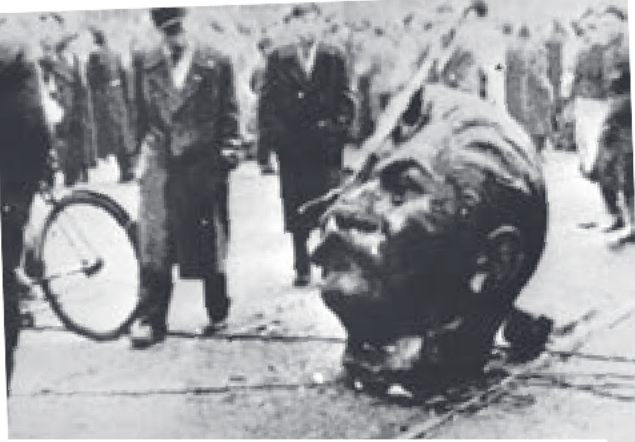
The policy change had immediate effects in Hungary. Poor harvests in 1952 and continuing bread shortages sparked demonstrations against communist control. Protesters began pulling down statues of Stalin and attacking local communist officials. In response to this unrest, Khrushchev appointed a more moderate Prime Minister, Imre Nagy, hoping this would calm the situation.
Important
Many Hungarians mistakenly believed that Stalin's death and the policy of destalinisation meant that communism in Hungary would soon end, especially as Soviet troops had already been withdrawn from neighbouring Austria. This false hope would prove dangerous when the Soviets later reasserted control.
Nagy's reform programme
Imre Nagy had very different ideas about Hungary's future compared to the previous leadership. His reform programme was ambitious and directly challenged Soviet control over Hungary.
Nagy's key reforms included three major changes that would fundamentally transform Hungary's relationship with the Soviet Union:
Note
Nagy's Three Key Reforms:
First reform: Hungary would leave the Warsaw Pact entirely and become a neutral country, similar to Austria. This would mean Hungary would no longer be part of the Soviet military alliance system.
Second reform: Nagy planned to hold genuinely free elections, which would likely end the single-party communist government that had ruled Hungary since the late 1940s. This democratic reform would give Hungarians real choice in their government for the first time in years.
Third reform: Nagy sought protection from the United Nations to guarantee Hungary's independence and prevent Soviet interference in Hungarian affairs.
However, these reforms created a serious problem for the Soviet Union. If Nagy succeeded in implementing his programme and Hungary successfully broke free from Soviet control, other countries in Eastern Europe might follow Hungary's example.
Important
The Soviet Dilemma: If Nagy's reforms succeeded, this could lead to the complete collapse of the Warsaw Pact, which was essential to Soviet security and influence in Europe. The Soviets could not allow this precedent to be set.
Timeline of key events
- 1953: Stalin dies; Khrushchev becomes Soviet leader; destalinisation begins
- 1952-1956: Poor harvests and bread shortages create unrest in Hungary
- 1956: Khrushchev gives "secret speech" hinting at relaxed control
- October 1956: Hungarian demonstrations intensify; statues of Stalin pulled down; Nagy appointed as Prime Minister
- October 1956: Nagy announces reform programme including leaving Warsaw Pact
Summary
Key Points to Remember:
- Stalin's death in 1953 marked the beginning of destalinisation, but Soviet control over Hungary remained strong when independence movements emerged
- Matyas Rakosi, known as "Stalin's best pupil" and "the Bald Butcher," brutally suppressed Hungarian opposition and shipped Hungary's resources to Russia
- Destalinisation transformed the Soviet Union from a dictatorship into a one-party state, giving false hope to many Hungarians about gaining freedom
- Imre Nagy's reforms in October 1956 directly threatened Soviet control by proposing to leave the Warsaw Pact, hold free elections, and seek UN protection
- The Soviet dilemma: allowing Hungary's independence could trigger the collapse of the entire Warsaw Pact system in Eastern Europe