The beginning of the Cold War (Edexcel GCSE History): Revision Notes
📚Revision Notes
The beginning of the Cold War
The Grand Alliance formation (1941)
During World War II, three major powers with very different political systems came together to fight against Nazi Germany. This unlikely partnership became known as the Grand Alliance, established in 1941.
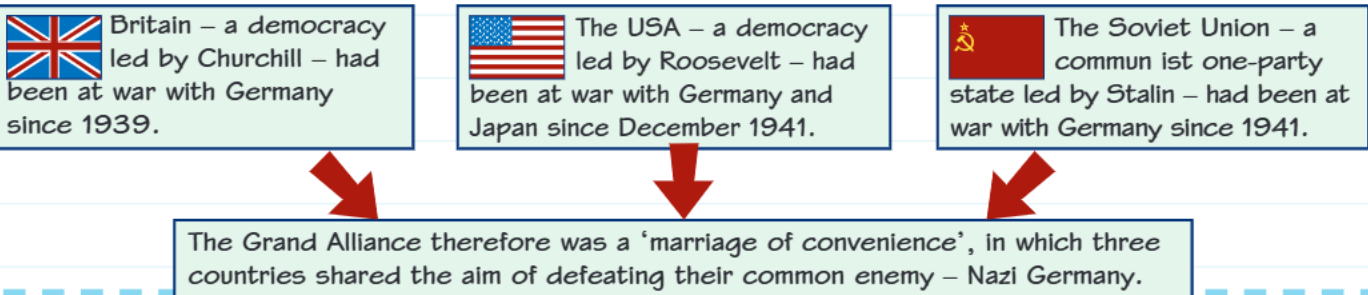
The alliance brought together three nations with contrasting ideologies but a shared enemy. Britain, led by Winston Churchill, had been fighting Germany since 1939 and operated as a democracy. The United States, under Franklin D. Roosevelt's leadership, joined the war against Germany and Japan in December 1941, also maintaining democratic principles. The Soviet Union, a communist one-party state under Joseph Stalin's control, had been at war with Germany since 1941.
Note
This cooperation was essentially a "marriage of convenience" - three countries with different political beliefs united by their common goal of defeating Nazi Germany. This concept would prove crucial to understanding why the alliance eventually broke down once their shared enemy was defeated.
However, as the war progressed and victory seemed certain, the underlying tensions between these different systems would begin to surface.
The major wartime conferences
The Tehran Conference (November-December 1943)
The first major meeting between the three Allied leaders produced several important agreements that would shape the post-war world. The Western Allies (Britain and USA) committed to opening a second front against Germany by launching an invasion of Nazi-occupied Europe. This would relieve pressure on the Soviet forces fighting on the Eastern Front.
Important
Key Tehran Conference Outcomes:
- The Soviet Union agreed to join the war against Japan once Germany had been defeated
- Poland's borders would shift westward - losing territory to the Soviet Union but gaining land from Germany
- The principle was established that an international organisation should be created to handle disputes peacefully
Perhaps most significantly for the future, the conference established the principle that an international organisation should be created to handle disputes between nations peacefully. This laid the groundwork for what would become the United Nations.
The Yalta Conference (February 1945)
By early 1945, with Germany's defeat imminent, the three leaders met again to plan for the post-war world. Several crucial decisions were made regarding Germany's future. The defeated nation would be significantly reduced in size, divided among the victorious powers, and forced to pay reparations for war damages.
The conference endorsed the Atlantic Charter's principles for rebuilding Europe, emphasising that liberated countries should have democratic elections to choose their own governments. The United Nations was formally agreed upon as the new international peacekeeping body.
Important
Growing Tensions at Yalta: However, tensions were already emerging. While the Soviet Union confirmed it would declare war on Japan after Germany's defeat, Stalin also secured agreement that Poland would fall within the Soviet "sphere of influence," though it was supposed to be run on broader democratic principles.
The Potsdam Conference (July-August 1945)
The final major wartime conference took place after Germany's surrender but revealed growing divisions among the former allies. A Council of Foreign Ministers was established to coordinate the rebuilding of Europe, and the conference confirmed that Nazi war criminals would be prosecuted for their crimes.
Note
Germany's Division Becomes Reality: Germany's division became more concrete, with the country split into four zones controlled by Britain, France, the USA, and the Soviet Union. Berlin, though located deep within the Soviet zone, was also divided among the four powers. Additionally, the Soviet Union was granted 25% of the industrial output from the other three occupied zones.
Timeline of key events
- 1941: Grand Alliance formed between Britain, USA, and Soviet Union
- November-December 1943: Tehran Conference
- February 1945: Yalta Conference
- May 1945: Germany surrenders; tensions increasing between former allies
- July-August 1945: Potsdam Conference
The emergence of tensions
While the three powers successfully collaborated to defeat Germany, cracks in their relationship became increasingly apparent by May 1945. The fundamental differences in their political systems and visions for post-war Europe began to create friction.
Note
Leadership Change Impact: A significant change occurred when President Roosevelt died, bringing Harry S. Truman to power. Unlike Roosevelt, Truman was much more suspicious and distrustful of Soviet intentions. This shift in American leadership would prove crucial in the developing Cold War relationship.
The conferences had established frameworks for cooperation, but disagreements over Germany's future and the political arrangements in Eastern Europe were already creating the foundations for future conflict between the former allies.
Summary
Key Points to Remember:
- The Grand Alliance was a "marriage of convenience" between three ideologically different powers united against Nazi Germany
- Three major conferences (Tehran 1943, Yalta February 1945, Potsdam July-August 1945) shaped post-war arrangements
- Key agreements included dividing Germany, establishing the UN, and determining Eastern European political arrangements
- Roosevelt's death in 1945 brought Truman to power, who was more suspicious of Soviet intentions
- By May 1945, tensions were already emerging that would lead to the Cold War