Brown v. Topeka, 1954 (Edexcel GCSE History): Revision Notes
📚Revision Notes
Brown v. Topeka, 1954
Introduction and background
The Brown v. Topeka case represents one of the most significant legal challenges to racial segregation in American history. In 1952, the NAACP (National Association for the Advancement of Coloured People) brought together five separate legal challenges to segregated education and presented them to the Supreme Court as a unified case known as "Brown versus the Board of Education, Topeka, Kansas."
Note
The strategic decision to combine five separate cases into one unified challenge strengthened the legal argument and demonstrated that educational segregation was a widespread national problem, not just isolated incidents.
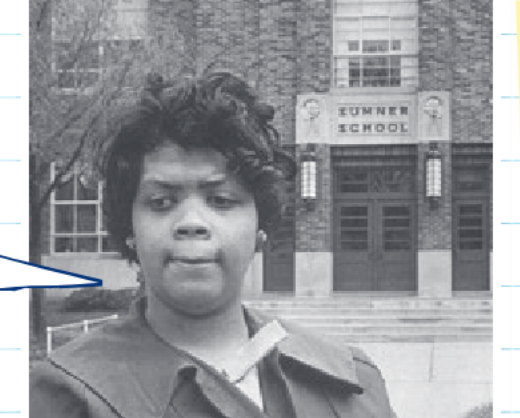
The legal challenge was built around the experiences of African American students like Linda Brown, who faced the daily reality of educational segregation. Linda Brown became the face of this landmark case when her experiences of having to attend a segregated school, despite living closer to a white school, were used to demonstrate the inequalities of the "separate but equal" system.
The heart of the legal challenge
Linda Brown's personal experience highlighted the core issues with segregated education. As a Black American student, she was forced to travel past her local white school to reach the nearest Black school. This situation made her feel "separate and not equal to white kids," which became a central argument in the legal case.
The challenge directly attacked the principle of "separate but equal" that had been established in 1896. At that time, the Supreme Court had ruled that racial segregation was constitutional provided that facilities were "separate but equal." However, by the 1950s, it was clear that Black schools were typically underfunded compared to white schools and had significantly poorer facilities.
Note
The reality of segregated education revealed that while facilities were indeed separate, they were far from equal. Black schools often lacked basic resources, experienced teachers, and proper facilities that were readily available to white schools.
Timeline of key events
1952: The NAACP filed school segregation cases with the Supreme Court, arguing that segregated schools violated the 14th Amendment, which includes provisions about citizenship and equal protection under the law.
December 1952: Judges heard initial arguments in the case, with Earl Warren becoming the new Chief Justice during this period.
May 1954: The Supreme Court made its historic ruling that segregated education was unconstitutional. Importantly, the Court decided not to set a specific time limit for schools to desegregate.
July 1954: The ruling specifically targeted the Deep South, including states like Alabama, Georgia, Louisiana, Mississippi, and South Carolina, where White Citizens' Councils were established to resist desegregation.
May 1955: A follow-up court ruling demanded that desegregation in schools should happen "with all deliberate speed."
1957: By this time, 723 school districts had begun the process of desegregating their education systems.
Note
Earl Warren's appointment as Chief Justice was crucial to the case's outcome. His leadership helped achieve a unanimous 9-0 decision, which gave the ruling greater moral authority and legal weight.
Short-term significance
The immediate impact of the Brown v. Topeka ruling was both groundbreaking and controversial. The decision successfully overturned the 1896 Plessy v. Ferguson ruling, which had previously allowed public facilities, including schools, to remain segregated as long as they were theoretically equal.
However, the ruling also triggered significant resistance. There was a notable white backlash against the decision, and membership in organisations like the Ku Klux Klan actually increased as some white Americans opposed integration. Black students, teachers, and their families often faced serious threats and hostility when attempting to attend previously segregated schools.
Important
The implementation of Brown v. Topeka was met with fierce resistance. Black families who attempted to enrol their children in previously white schools often faced death threats, economic boycotts, and physical violence. This resistance demonstrated that legal victory did not immediately translate to social change.
Many quality schools that had served Black American communities were unfortunately closed down as part of the integration process. Additionally, several Southern states actively sought ways to avoid implementing the court's ruling, showing the deep-seated resistance to change.
Long-term significance
The Brown v. Topeka case had far-reaching effects that extended well beyond education. It significantly raised awareness of civil rights issues throughout the Southern states and became a source of inspiration for future desegregation campaigns and civil rights activism.
The ruling encouraged other challenges to segregation in different areas of American life. It also led to demographic changes, with some white Americans choosing to move away from areas where Black Americans lived to avoid integrated communities, a process that would later be called "white flight."
Most importantly, the case established a legal precedent that separate facilities were inherently unequal, providing a foundation for the broader civil rights movement that would continue throughout the 1950s and 1960s.
Summary
Long-term Impact of Brown v. Topeka:
- Created legal precedent for challenging all forms of segregation
- Inspired the broader civil rights movement of the 1950s and 1960s
- Demonstrated that constitutional rights could be enforced through the courts
- Established the principle that "separate" could never be "equal"
Key vocabulary
Desegregation: The process of ending racial segregation and promoting racial integration in schools and other public facilities.
Segregation: The practice of separating people based on race, particularly in schools, housing, and public facilities.
14th Amendment: Part of the US Constitution that guarantees equal protection under the law and defines citizenship rights.
NAACP: The National Association for the Advancement of Coloured People, a civil rights organisation that fought for racial equality through legal challenges.
Key Points to Remember
Summary
Essential Takeaways from Brown v. Topeka:
- Brown v. Topeka (1954) overturned the "separate but equal" principle that had existed since 1896
- Linda Brown's personal experience of educational inequality became the human face of this legal challenge
- The case led to immediate resistance but also inspired future civil rights campaigns
- By 1957, over 700 school districts had begun desegregating their schools
- The ruling established that separate educational facilities were inherently unequal, setting a crucial legal precedent for the civil rights movement