The early 1950s (Edexcel GCSE History): Revision Notes
📚Revision Notes
Civil rights in the early 1950s

The situation for Black Americans in the early 1950s
During the 1950s, African Americans across the United States faced treatment as inferior citizens. This was particularly severe in the Southern states, where they encountered widespread segregation, discrimination, and systematic efforts to deny them basic rights including voting. Organisations like the NAACP and CORE worked tirelessly to challenge these injustices and advance civil rights for Black people.
Note
The 1950s marked a critical period in American civil rights history, as institutional racism was deeply embedded in both law and social practice, particularly in the South where the legacy of slavery continued to shape society decades after the Civil War.
Segregation and discrimination in the Southern states
The Southern states maintained a system of racial segregation designed to keep Black and white Americans separated in all aspects of public life. This affected transportation, education, restaurants, and other public spaces.
Jim Crow laws
These racist laws were specifically created to enforce segregation between Black and white Americans. The legal foundation for these laws rested on the principle of "separate but equal" - meaning segregation was considered lawful provided that services remained equal for both races.
Important
However, the reality was very different from this legal theory. Services and facilities for Black Americans were consistently inferior to those available for white people. This created a system where segregation was legal but genuine equality never existed.
Examples of segregated facilities
Public facilities that were segregated included:
- Cinemas and entertainment venues
- Public toilets and restrooms
- Schools and educational institutions
- Public transportation systems
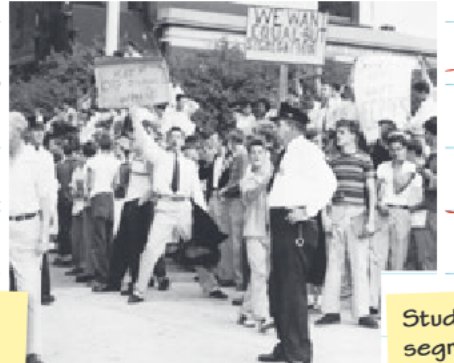
Students organised protests to maintain school segregation in Baltimore, Maryland in 1955, showing how deeply entrenched these discriminatory practices had become in American society.
Discrimination and violence in the Southern states
Beyond legal segregation, African Americans faced serious personal dangers and systemic bias throughout Southern society.
Social attitudes and violence
The majority of white citizens in the South viewed Black people as "racially inferior". This attitude was reinforced and sometimes enforced through violence. Racist white officials in positions of power, including police officers and judges, may have belonged to extremist groups like the Ku Klux Klan.
Important
When Black people became victims of assault or murder, these crimes were frequently not investigated properly or prosecuted effectively. This created an environment where violence against African Americans often went unpunished.
Legal system bias
The justice system itself was discriminatory. Black people were prohibited from serving on juries in courts of law, ensuring that they could not participate in the legal process that affected their own community members.
Voting rights restrictions
Multiple tactics were employed to prevent African Americans from exercising their right to vote, despite this being constitutionally guaranteed.
Physical intimidation and violence
White gangs used physical force to stop Black Americans from voting. Sometimes they would attack people who simply attempted to register to vote, creating fear that discouraged political participation.
Important
The use of violence to prevent voting was a direct attack on democratic principles and constitutional rights, yet it was rarely prosecuted by local authorities who often supported or participated in these activities.
Legal barriers
Several Southern states, including Georgia and Virginia, created laws making it more difficult for Black people to vote:
Note
These legal barriers were designed to appear constitutional while effectively disenfranchising Black Americans through seemingly neutral requirements that were impossible to meet or historically exclusive.
- Literacy tests: These required Black Americans to pass reading and writing tests before they could vote, often with impossibly difficult requirements
- Grandfather clause: This rule allowed voting only if a person's ancestors had previously voted. Since enslaved people had been banned from voting, their descendants were automatically excluded from this right
- Economic pressure: White employers sometimes fired Black workers who registered to vote or actually voted
Civil rights organisations
Two major organisations led the fight for civil rights during this period, each using different approaches to challenge discrimination.
NAACP (National Association for the Advancement of Coloured People)
Established in 1909, the NAACP became a crucial organisation in the struggle for civil rights. They focused their efforts on using the legal system and courts to fight for change. The organisation defended Black people who had been wrongly convicted of crimes and worked to overturn the "separate but equal" doctrine through legal challenges.
Example
NAACP Legal Strategy Example:
The NAACP's approach involved:
- Identifying discriminatory laws and practices
- Finding suitable plaintiffs willing to challenge these laws in court
- Building strong legal cases based on constitutional principles
- Taking cases through the court system to higher levels when necessary
CORE (Congress of Racial Equality)
Founded in 1942, CORE had a smaller membership compared to the NAACP. They specialised in non-violent direct action techniques and trained local activists in these methods. CORE primarily operated in Northern states, and during its early years, most members were white and middle-class individuals.
Example
CORE Direct Action Methods:
CORE's techniques included:
- Training activists in non-violent protest methods
- Organising sit-ins and peaceful demonstrations
- Teaching strategies for maintaining discipline during confrontations
- Building interracial coalitions to support civil rights causes
Both organisations achieved greater success in Northern states, where they had more white support and faced less hostile opposition. They worked towards racial integration rather than accepting segregation.
Timeline of key developments
- 1909: NAACP established to fight for civil rights through legal channels
- 1942: CORE founded, focusing on non-violent direct action
- Early 1950s: Widespread segregation and discrimination continue across the South
- 1955: Student protests in Baltimore, Maryland demonstrate ongoing resistance to integration
Summary
Key Points to Remember:
- African Americans in the 1950s faced systematic discrimination, especially in Southern states where Jim Crow laws enforced racial segregation
- The "separate but equal" principle was used to justify segregation, but facilities for Black Americans were consistently inferior to those for white people
- Multiple barriers prevented Black Americans from voting, including violence, literacy tests, and the grandfather clause
- The NAACP (founded 1909) used legal strategies while CORE (founded 1942) focused on non-violent direct action to advance civil rights
- Both organisations had more success in Northern states where they encountered greater white support and less violent opposition