Progress in civil rights, 1960-62 (Edexcel GCSE History): Revision Notes
📚Revision Notes
Progress in civil rights, 1960-62
The early 1960s marked a crucial period in the American civil rights movement, as activists worked to transform Supreme Court victories into real change on the ground. This period saw determined efforts to test whether desegregation rulings were actually being implemented, leading to dramatic confrontations that would force federal intervention.
Note
This period represents a shift from legal victories to practical implementation, showing how civil rights activists had to fight not just for court rulings, but for their actual enforcement in daily life.
Testing Supreme Court rulings
The civil rights movement had achieved important legal victories by 1960, but activists discovered that winning in court was only the first step. The reality was that many public facilities remained segregated despite federal rulings.
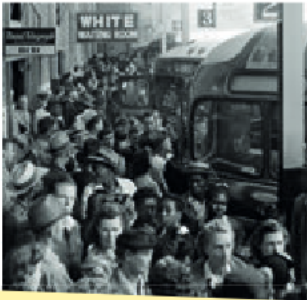
In 1956, the Supreme Court had ruled that state transport systems must end segregation. However, this victory came with significant limitations - bus station toilets and waiting rooms were not covered by this ruling and remained segregated throughout the South. Civil rights campaigners realised they needed to push for broader implementation of desegregation.
Important
There was a crucial gap between legal victories and practical reality. Even after Supreme Court rulings, segregation continued in many areas because there was no effective enforcement mechanism.
A breakthrough came in December 1960 when the Supreme Court specifically ordered the desegregation of bus station facilities. This ruling closed the loophole that had allowed segregated waiting areas to continue operating. However, activists understood that legal victories meant little without practical enforcement.
The Congress of Racial Equality (CORE) recognised that segregation persisted in many areas despite court orders. Their strategy was to organise direct action campaigns that would test whether desegregation was actually happening in practice. CORE activists knew that by highlighting the gap between legal rulings and daily reality, they could create negative media coverage that would pressure the federal government to act more decisively.
The Freedom Riders campaign, 1961
The most significant testing campaign began in 1961 with the Freedom Riders. This direct action campaign aimed to challenge segregated interstate bus travel and force the federal government to enforce Supreme Court rulings.
The Freedom Riders campaign began on May 4, 1961, when thirteen brave activists - both black and white Americans - started their journey from Washington DC to the Deep South. Their plan was deliberately provocative: they would travel together on buses, use the same facilities, and sit wherever they chose, directly challenging the segregated system.
Example
The Anniston Bus Attack - May 14, 1961
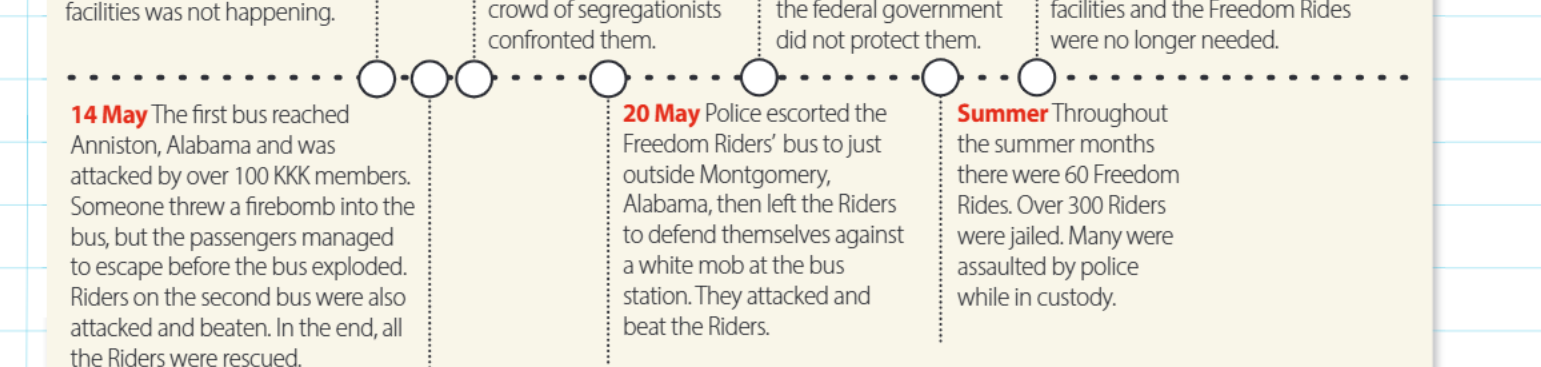
When the first Freedom Riders bus reached Anniston, Alabama, over 100 Ku Klux Klan members surrounded it. The attackers:
- Threw a firebomb into the bus
- Forced passengers to escape through smoke
- Beat the passengers as they emerged
- Left the bus to completely explode
Despite this terrifying attack, the passengers survived and the campaign continued, showing the incredible courage of the Freedom Riders.
Despite this terrifying attack, the campaign continued. On May 17, the Student Nonviolent Coordinating Committee (SNCC) organised ten new riders to travel from Nashville, Tennessee, to Birmingham, Alabama. The replacement riders showed incredible courage, knowing full well the dangers they faced.
The situation escalated further on May 20 when police escorted the Freedom Riders' bus to just outside Montgomery, Alabama, and then abandoned them. A white mob was waiting at the bus station, and they attacked and severely beat the Riders. This pattern of police abandonment and mob violence became a recurring theme throughout the campaign.
Note
The success of the Freedom Riders campaign can be measured in impressive numbers: 60 total Freedom Rides were conducted throughout the summer of 1961, with over 300 riders jailed for their participation. This massive scale showed the commitment of the civil rights movement to direct action.
The federal government finally intervened on November 1, when officials threatened to use federal officers to enforce desegregation if states continued to refuse compliance. This marked a turning point, as Southern states began to desegregate bus facilities rather than face direct federal intervention.
James Meredith and university desegregation, 1962
While the Freedom Riders challenged transport segregation, another crucial battle was fought over higher education. James Meredith's attempt to enrol at the University of Mississippi became a defining moment that required unprecedented federal intervention.
Meredith had previously applied to the University of Mississippi but had been rejected because of his race. Recognising this as clear discrimination, the NAACP decided to support his case through the legal system. They brought a successful court case arguing that Meredith's exclusion was unconstitutional.
Important
Even after the Supreme Court ordered the University of Mississippi to admit Meredith, university officials chose to ignore the federal ruling. This created a constitutional crisis where a state institution was directly defying federal law.
The situation came to a head on September 30, 1962, when federal officials escorted Meredith onto the campus. The response was explosive - approximately 3,000 segregationists gathered to attack them. President Kennedy was forced to call for peace as rioting broke out across the campus and surrounding area.
Example
The University of Mississippi Crisis - 1962
The scale of resistance to James Meredith's enrolment:
- 3,000 segregationists attacked federal officials and Meredith
- Violent rioting across campus and surrounding areas
- Federal troops had to be deployed to restore order
- Meredith needed armed guards throughout his studies
- Despite everything, he successfully graduated
Despite this massive opposition, Meredith successfully registered on October 1, 1962, and continued to need armed guards while he completed his university studies. His graduation represented a crucial victory for civil rights, proving that federal power could overcome even the most violent resistance when applied with determination.
Timeline of major events, 1960-62
- 1956: Supreme Court rules that state transport must desegregate
- December 1960: Supreme Court orders desegregation of bus station facilities
- May 4, 1961: Thirteen Freedom Riders begin journey from Washington DC
- May 14, 1961: KKK firebombs Freedom Riders' bus in Anniston, Alabama
- May 17, 1961: SNCC organises replacement riders from Nashville to Birmingham
- May 20, 1961: Police abandon Freedom Riders in Montgomery, mob attacks
- Summer 1961: 60 Freedom Rides conducted, over 300 riders gaoled
- November 1, 1961: Federal government threatens to use officers to enforce desegregation
- 1962: James Meredith applies to University of Mississippi
- September 30, 1962: 3,000 segregationists attack as Meredith is escorted to campus
- October 1, 1962: Meredith successfully registers and begins studies
Summary
Key Points to Remember:
-
Supreme Court victories required practical enforcement: Legal rulings meant nothing without activists willing to test them and federal officials willing to enforce them.
-
The Freedom Riders campaign involved massive sacrifice: 60 rides, over 300 people gaoled, and countless individuals beaten, yet the campaign succeeded in forcing bus facility desegregation.
-
Federal intervention was essential for progress: Both the Freedom Riders and James Meredith cases required federal officials and troops to overcome violent segregationist resistance.
-
Segregationists used extreme violence to maintain racism: From KKK firebombings to 3,000-person mobs, opponents of civil rights were willing to use deadly force to preserve segregation.
-
Direct action campaigns created the pressure needed for change: By highlighting the gap between legal rights and daily reality, activists forced the federal government to take stronger action.