Racial beliefs and policies (Edexcel GCSE History): Revision Notes
📚Revision Notes
Nazi racial beliefs and policies
The foundation of Nazi ideology
The Nazi Party built their vision of a strong German state around the concept of creating a population of 'racially pure' Germans, whom they called Aryans. Hitler's belief in what he termed a 'racial hierarchy' became the driving force behind how different groups of people were treated in Nazi Germany. This ideology wasn't just theoretical - it directly shaped government policies that would have devastating consequences for millions of people.
Important
Nazi racial ideology was not based on scientific fact, despite being presented as such. It was a deliberate system designed to justify discrimination and persecution of targeted groups.
The Nazi racial hierarchy
The Nazis developed a detailed system for ranking different racial and ethnic groups, which they used to justify discrimination and persecution. This hierarchy was presented as scientific fact, though it had no basis in actual science.
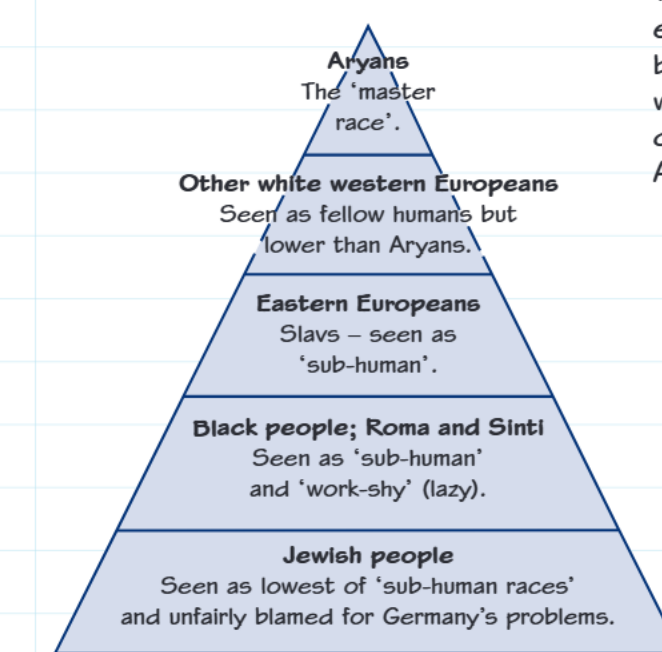
At the top of this system were the Aryans, who the Nazis claimed were the 'master race'. According to Nazi beliefs, Aryans were characterised by being blonde-haired, blue-eyed, tall, and athletic. Below them came other white Western Europeans, who were seen as fellow humans but considered lower than Aryans. Eastern Europeans and Slavs occupied the middle tier and were labelled as 'sub-human'. Near the bottom were Black people, Roma and Sinti people, who were also classified as 'sub-human' and described with derogatory terms like 'work-shy' and 'lazy'. At the very bottom of the hierarchy were Jewish people, who were seen as the lowest of the so-called 'sub-human races' and were unfairly blamed for Germany's problems.
Note
This racial classification system had absolutely no scientific validity and was created purely to support Nazi political goals and justify their treatment of different populations.
Building the Aryan population
The Nazis didn't just want to persecute those they considered inferior - they actively tried to increase the number of people they classified as Aryans. The most significant programme designed for this purpose was called Lebensborn, which translates to 'fountain of life'.
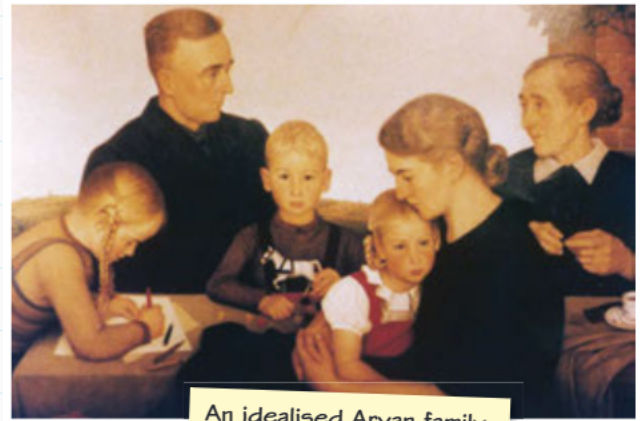
The Lebensborn programme specifically encouraged the birth of children who met the Nazi definition of 'racially pure'. It provided support for women who had children with members of the SS (Schutzstaffel), Hitler's elite paramilitary organisation. The SS was central to the Nazi concept of the 'master race', as they recruited only Aryans and were only permitted to marry Aryan women. This programme represented the Nazis' attempt to systematically engineer what they considered to be a superior population.
Note
The Lebensborn programme demonstrates how Nazi ideology extended beyond persecution to actively attempting to manipulate population demographics according to their racist beliefs.
Persecution of 'Untermenschen'
The term 'Untermenschen' meant 'inferior people' or 'sub-humans' in Nazi terminology. This dehumanising language was used to describe Slavs, Roma and Sinti people (often called 'gipsies'), Black people, and Jewish people. The use of this term helped the Nazis justify increasingly harsh treatment of these groups.
The persecution began with legal restrictions. In 1935, the Nuremberg Laws prohibited Aryans from marrying Roma and Sinti, Black people, or Jewish people. These laws also made it illegal for people with mixed ethnic backgrounds to identify as German citizens.
Important
The Nuremberg Laws of 1935 marked a crucial turning point where Nazi racial ideology became enshrined in German law, legally codifying discrimination and setting the stage for more severe persecution.
The treatment of different groups became progressively more severe throughout the 1930s. After 1933, many Roma and Sinti were arrested and sent to concentration camps. By 1938, all Roma and Sinti were required to register with authorities and were banned from travelling freely. In 1939, they were told they would face deportation to other countries.
Slavs faced constant reminders that they were not considered to fit the Nazi 'Aryan ideal', though initially they experienced less severe persecution than other groups targeted by the regime.
Other 'undesirable' groups
The Nazi persecution extended beyond their racial categories to include various other groups they considered threats to their vision of German society.
Gay men faced particularly harsh treatment. They were sent to prison or concentration camps, and many were forced to undergo 'voluntary' castration after laws relating to homosexuality were made more strict. This represents how the Nazis used both legal and medical means to persecute those who didn't fit their social ideals.
Disabled people were another major target of Nazi policies. People with visual impairments, deaf and hard of hearing individuals, and those with epilepsy were sterilised under a new law introduced in 1933 called 'The Law for the Prevention of Hereditarily Diseased Offspring'. This law reflected the Nazi belief that disability was inherited and should be eliminated from the population. In the most extreme cases, severely disabled babies were killed.
Note
The persecution of disabled people under Nazi policies foreshadowed many of the methods and justifications that would later be used in the Holocaust, making it a crucial part of understanding how Nazi ideology developed.
Political opponents and people the Nazis labelled as 'work-shy' (including vagrants and those considered lazy) were also sent to concentration camps. This shows how the Nazi definition of 'undesirable' included not just racial and religious groups, but also political dissidents and those who didn't contribute to society in ways the Nazis approved of.
Timeline of key events
- 1933: The Law for the Prevention of Hereditarily Diseased Offspring introduced; Roma and Sinti begin to be arrested
- 1935: Nuremberg Laws ban intermarriage between Aryans and other groups
- 1938: All Roma and Sinti required to register and banned from travelling
- 1939: Roma and Sinti told they face deportation
Summary
Key Points to Remember:
- Nazi racial ideology created a hierarchy with Aryans at the top and Jewish people at the bottom, used to justify systematic persecution
- The Lebensborn programme actively tried to increase the 'racially pure' population through encouraging births between SS members and Aryan women
- 'Untermenschen' was the dehumanising term used for groups considered inferior, including Slavs, Roma and Sinti, Black people, and Jewish people
- The 1935 Nuremberg Laws legally banned intermarriage between different racial groups according to Nazi classifications
- Nazi persecution extended beyond racial groups to include disabled people, gay men, political opponents, and others deemed 'undesirable'