The standard of living (Edexcel GCSE History): Revision Notes
📚Revision Notes
The standard of living in Nazi Germany
Overview of Nazi economic impact
The Nazi regime implemented various economic policies between 1933 and 1939 that had mixed effects on the German people's quality of life. While some aspects of living standards improved, particularly for certain groups, other segments of society faced significant disadvantages and restrictions.
Note
The Nazi economic impact presents a complex picture where apparent improvements often came with hidden costs and restrictions. This mixed legacy makes it essential to examine both positive and negative aspects when evaluating living standards during this period.
Nazi workers' organisations
Hitler recognised the importance of maintaining worker satisfaction to secure political support. Rather than relying on traditional trade unions, the Nazi regime established new organisations designed to control workers while appearing to improve their lives. These organisations formed a comprehensive system of worker control that replaced independent labour representation with state-controlled alternatives.
German Labour Front (DAF)
The Deutsche Arbeitsfront replaced all existing trade unions after 1933. Every German worker was required to become a member of this organisation. The DAF operated several important schemes that directly affected workers' daily lives and future prospects.
Important
The replacement of trade unions with the DAF represented a fundamental shift in worker rights. While presented as an improvement, this change actually eliminated workers' ability to negotiate wages and working conditions independently, concentrating all labour control under Nazi authority.
Strength through Joy (KdF)
This programme aimed to boost worker productivity by providing happiness and satisfaction through leisure activities. The KdF organised low-cost or completely free entertainment for hardworking employees, including concerts, holidays, and cultural events. The scheme was designed to reward loyal workers while encouraging others to work harder to earn these privileges.
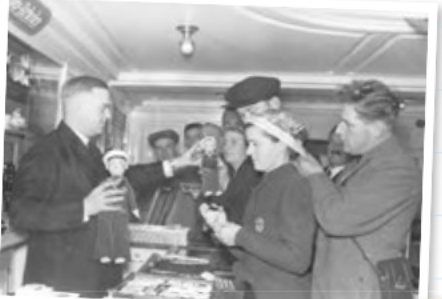
The photograph shows German workers enjoying a KdF-organized trip to Italy in 1937, demonstrating how the regime used leisure activities to maintain worker loyalty and satisfaction.
Example
KdF Programme Benefits
The Strength through Joy programme offered German workers unprecedented access to leisure activities:
- Subsidised theatre tickets and concerts
- Organised hiking and sports activities
- Holiday trips to popular destinations like Italy and the Baltic Sea
- Cultural events that were previously accessible only to the wealthy
These benefits helped create worker loyalty while serving as powerful propaganda tools.
Beauty of Labour (SdA)
This initiative focused on improving workplace conditions to make German workers more productive and content. The SdA worked to reduce noise levels in factories, provided workplace canteens, and even constructed swimming pools for workers. However, workers themselves were often required to help build these improvements during their spare time, making the programme less popular than intended.
The Volkswagen scheme
One of the most ambitious KdF projects was promoting car ownership among ordinary Germans. Hitler commissioned Porsche to design an affordable family vehicle, resulting in the Volkswagen Beetle. Workers could participate by paying 5 marks weekly towards purchasing their own car. However, this scheme largely failed - by 1939, virtually no participants had saved enough money to actually receive a vehicle, and many funds were redirected towards rearmament instead.
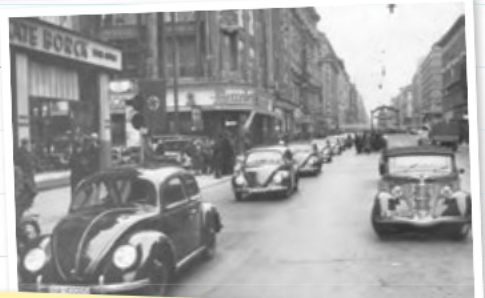
This 1939 parade of Volkswagen Beetles served as propaganda, suggesting widespread car ownership that hadn't actually materialised for most German workers.
Important
The Volkswagen scheme exemplified Nazi propaganda tactics - it promised tangible benefits to workers but failed to deliver on these promises. Most of the money collected from workers was diverted to military rearmament rather than car production, leaving participants without their promised vehicles.
Assessment of living standards by 1939
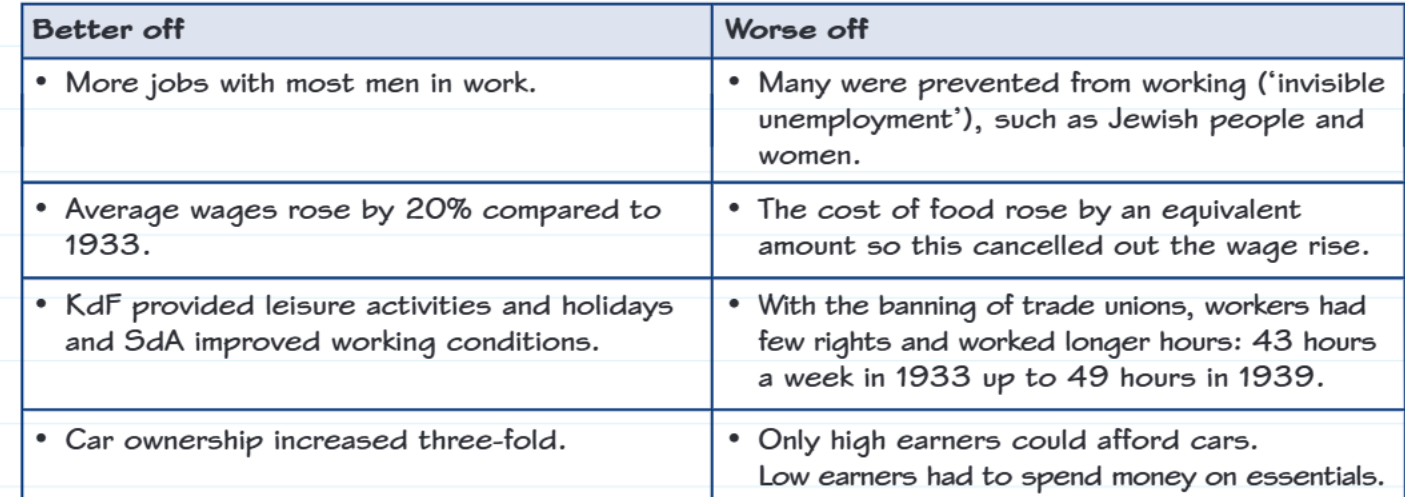
By 1939, the impact of Nazi economic policies created distinct winners and losers among the German population. Understanding these contrasting experiences is crucial for evaluating the regime's overall economic legacy.
Improvements experienced by many Germans
Several positive changes occurred for significant portions of the population during this period. Employment increased substantially, with most men finding work opportunities. Average wages grew by approximately 20% compared to 1933 levels, providing many families with increased purchasing power. The KdF programme successfully provided leisure activities and holidays that many workers previously couldn't afford, while SdA initiatives did improve some workplace conditions. Additionally, car ownership expanded three times over, though this remained limited to wealthier citizens.
Note
The employment improvements were particularly significant for male workers, who benefited from large-scale public works projects and rearmament programmes. Many families experienced their first stable income in years, contributing to initial support for the Nazi regime.
Disadvantages and hidden costs
However, these apparent improvements came with serious drawbacks that affected many Germans negatively. The concept of "invisible unemployment" emerged, where certain groups - particularly Jewish people and women - were systematically prevented from working, artificially improving employment statistics. Rising food costs essentially cancelled out wage increases for many families, leaving their actual purchasing power unchanged. The banning of trade unions meant workers lost important rights and protections, resulting in longer working hours that increased from 43 hours weekly in 1933 to 49 hours by 1939. Finally, only high earners could actually afford cars, while lower-income families had to prioritise spending on essential needs.
Important
The concept of "invisible unemployment" reveals how Nazi statistics were manipulated to create false impressions of economic success. By excluding Jewish people and women from employment figures, the regime artificially improved unemployment statistics while simultaneously restricting opportunities for significant portions of the population.
Timeline of key developments
The following timeline illustrates the progression of Nazi economic policies and their impact on worker living standards:
- 1933: Trade unions banned and replaced with DAF; working week averaged 43 hours
- 1937: German workers participate in first KdF trip to Italy, demonstrating the programme's propaganda value
- 1939: Working hours increased to 49 hours per week; Volkswagen scheme fails to deliver cars to workers; wage increases offset by rising food costs
Summary
Summary
Key Points to Remember:
- Nazi economic policies created a mixed picture - some improvements alongside significant drawbacks and restrictions
- Workers' organisations like DAF, KdF, and SdA were designed more for political control than genuine worker welfare
- "Invisible unemployment" hid the true economic impact by excluding Jewish people and women from employment statistics
- While wages rose 20%, increased food costs and longer working hours meant many workers weren't actually better off
- The Volkswagen scheme exemplified Nazi propaganda - promising benefits that were never delivered to ordinary workers