Hitler becomes Führer (Edexcel GCSE History): Revision Notes
📚Revision Notes
Hitler becomes Führer
Background tensions in 1934
By 1934, Hitler had been Chancellor for over a year, but his position was not yet completely secure. Several key events occurred during this year that would ultimately lead to Hitler declaring himself Führer and establishing complete dictatorial control over Germany.
Note
Despite being Chancellor, Hitler's power was still threatened from within his own party. The events of 1934 would prove crucial in eliminating these internal threats and consolidating his absolute control over Germany.
The main threat to Hitler's power came from within his own party - specifically from Ernst Röhm, the leader of the SA (Sturmabteilung), and the SA organisation itself. This created a dangerous internal conflict that Hitler would need to resolve decisively.
The threat of Röhm and the SA
The SA posed a significant challenge to Hitler's authority for several interconnected reasons:
Size and military threat: The SA had grown to become much larger than the German army, creating concern among military leaders who feared that Röhm wanted to replace the traditional army with his paramilitary forces.
Political disagreements: Röhm opposed many of Hitler's policies and was becoming increasingly vocal about his dissatisfaction with the direction of the Nazi Party.
Leadership ambitions: The leaders of the Schutzstaffel (SS) wanted to reduce the size of the SA in order to increase their own power and influence within the Nazi hierarchy.
Internal discontent: Many SA members felt undervalued and angry because they remained unemployed despite the Nazi Party's rise to power, though they remained loyal to Röhm personally.
Important
The SA's size and Röhm's growing opposition created a direct threat to Hitler's authority. This internal party conflict had to be resolved before Hitler could consolidate complete power over Germany.
The role of the SS
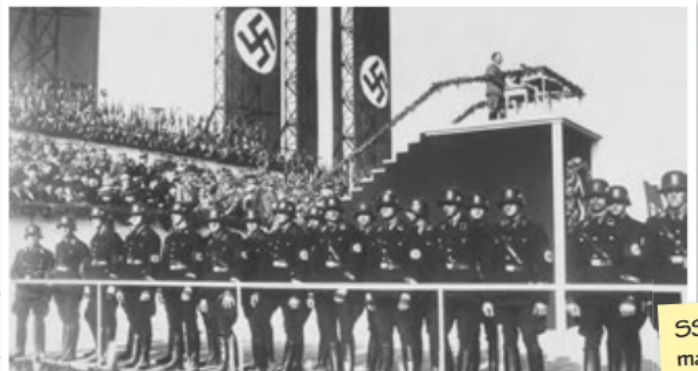
The SS had been established by Hitler in 1925 to serve as his personal bodyguards. Originally run by Schreck and later by Himmler, they were a carefully selected elite group that appeared menacing in their distinctive black uniforms. The SS would play a crucial role in Hitler's consolidation of power.
Note
The SS's loyalty directly to Hitler, rather than to the broader Nazi Party, made them the perfect instrument for eliminating internal threats like the SA leadership.
The Night of the Long Knives (30 June 1934)
Hitler decided to eliminate the threat posed by Röhm and the SA through a carefully planned purge known as the Night of the Long Knives.
Example
The Purge Process: How Hitler Eliminated the SA Threat
Step 1 - The Setup: Hitler invited Röhm and 100 SA leaders to a meeting in the town of Bad Wiessee on 30 June 1934. This meeting was presented as a normal party gathering.
Step 2 - The Betrayal: When the SA leaders arrived, they were immediately arrested by SS troops and taken to Munich where they were executed.
Step 3 - Expanding the Purge: The killings extended beyond just SA leadership. Von Papen's staff were arrested and his home was surrounded, effectively removing him from political influence.
Step 4 - Eliminating Other Threats: The purge continued with the murder of von Schleicher, a former Chancellor who posed a potential threat to Hitler.
Public awareness: Many ordinary Germans did not fully understand the scale of the killings or recognise how significantly the power of the SA had been reduced through this brutal action.
Death of Hindenburg and Hitler's rise to Führer
President Hindenburg was the only person in Germany who held senior authority over Hitler. His death in August 1934 created the opportunity Hitler needed to complete his rise to absolute power.
Important
The Power Consolidation: Within hours of Hindenburg's death, a Law Concerning the Head of State merged the offices of Chancellor and President, creating a new position of Führer that concentrated all executive power in Hitler's hands.
The meaning of Führer: The term "Führer" means "leader," and Hitler used extensive propaganda to ensure he appeared all-powerful. The "Heil Hitler" Nazi salute required people to swear personal loyalty to Hitler individually, while propaganda portrayed him as having superhuman and heroic qualities.
Army oath of allegiance
On the same day that Hindenburg died, Hitler announced that the German army would swear a new oath of allegiance. Critically, this oath was to Hitler personally, not to Germany as a nation or to the German constitution.
Important
Personal Loyalty Over National Service: This personal oath meant that German military personnel were bound by their military honour to obey Hitler's commands, regardless of whether those commands served Germany's best interests. This personal loyalty would prove crucial in maintaining Hitler's control over the armed forces throughout his dictatorship.
Timeline of key events
- 1925: SS established as Hitler's bodyguards
- 30 June 1934: Night of the Long Knives - SA leadership purged
- August 1934: President Hindenburg dies
- August 1934: Law merges Chancellor and President roles, creating Führer position
- August 1934: Army swears personal oath to Hitler
Summary
Key Points to Remember:
- The Night of the Long Knives (30 June 1934) eliminated Hitler's main internal threat - the SA and Röhm
- Hindenburg's death in August 1934 allowed Hitler to merge the Chancellor and President roles into one position: Führer
- The army swore personal loyalty to Hitler, not to Germany, giving him complete control over the military
- The SS played a key role in Hitler's rise, carrying out the purge that removed the SA threat
- By the end of 1934, Hitler had transformed from Chancellor to dictator with absolute power over Germany