Why the Republic was unpopular (Edexcel GCSE History): Revision Notes
📚Revision Notes
Why the Weimar Republic was unpopular
Introduction
The Weimar Republic faced immediate and severe challenges from its birth in 1918. The harsh terms imposed by the Treaty of Versailles created enormous resentment among the German people, who blamed their new democratic leaders for accepting such punitive conditions. This widespread anger and the economic burden of the treaty severely undermined the republic's legitimacy and popularity from the very beginning.
Note
The Weimar Republic was Germany's first attempt at democratic government, but it was born out of military defeat and immediately faced unprecedented challenges that would plague it throughout its existence.
The burden of defeat - November criminals
The German people felt betrayed by their political leaders who signed the Treaty of Versailles in 1919. These leaders became known as the "November Criminals" because they had agreed to the armistice in November 1918, effectively surrendering Germany's position in the war. Many Germans viewed these politicians as traitors who had sold out their country rather than continue fighting.
Important
The term "November Criminals" became a powerful propaganda tool used by extremist groups to attack democratic politicians and undermine support for the Weimar Republic throughout its existence.
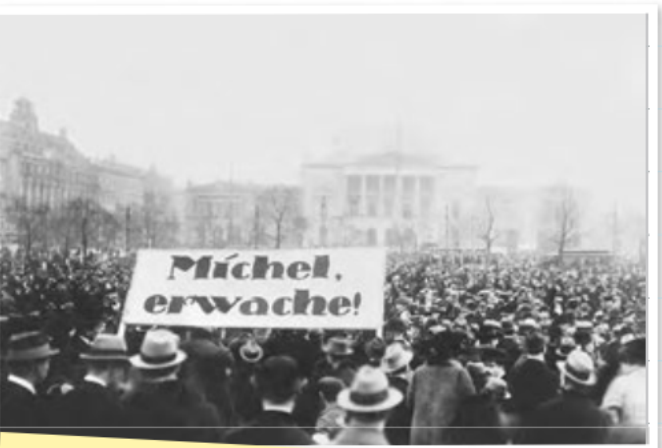
The image above shows a political rally with banners reading "Michel, erwache!" (Michel, wake up!), demonstrating the political tensions and calls for German national awakening during this turbulent period.
The Treaty of Versailles and its impact
War guilt and reparations
The most damaging aspect of the treaty was Article 231, known as the war guilt clause. This forced Germany to accept complete responsibility for causing the First World War. As a consequence of this blame, the Allied powers demanded massive compensation payments called reparations.
The financial burden was enormous - Germany had to pay £6,600 million in yearly instalments to repair the damage caused in Allied countries. This created immediate economic hardship and placed the new republic under tremendous financial strain from day one.
Important
The reparations payments were so large that they represented approximately 2% of Germany's entire national income each year - an impossible burden that would contribute to economic instability and political extremism.
Military restrictions and humiliation
The treaty severely limited Germany's ability to defend itself, which many Germans saw as both humiliating and dangerous:
- The German army was restricted to just 100,000 men - a tiny force for such a large nation
- The navy could only maintain 6 battleships, 6 cruisers, 12 destroyers, and 12 torpedo boats, with submarines completely banned
- All military aircraft were destroyed and Germany was forbidden from having an air force
- No military forces were allowed in the Rhineland region bordering France, creating a demilitarised zone
These restrictions left Germany feeling vulnerable and stripped of its military pride, creating deep resentment among the population.
Note
For comparison, France maintained an army of over 600,000 men during this period, making Germany's 100,000-man limit seem particularly restrictive and humiliating to the German people.
Territorial losses
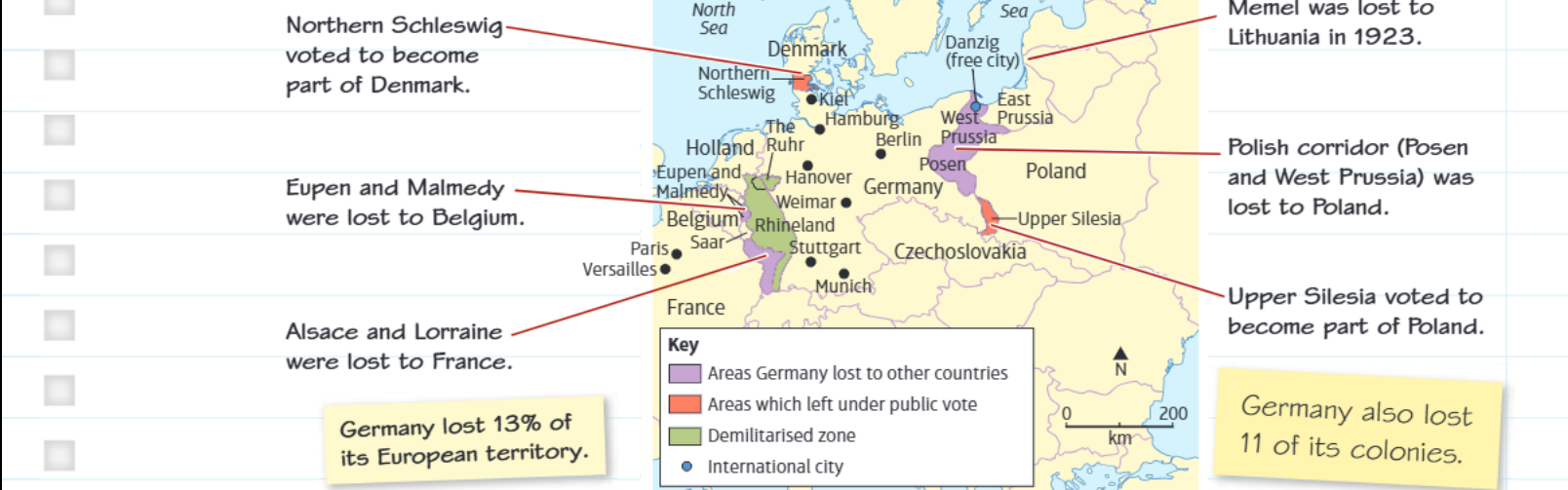
The map above shows the extent of Germany's territorial losses following the Treaty of Versailles. The impact was devastating:
Germany lost 13% of its European territory, including:
- Alsace-Lorraine returned to France
- Eupen-Malmedy given to Belgium
- Northern Schleswig voted to join Denmark
- The Polish Corridor and West Prussia given to Poland, cutting off East Prussia from the rest of Germany
- Upper Silesia voted to become part of Poland
- Memel was later lost to Lithuania in 1923
Beyond Europe, Germany lost all 11 of its overseas colonies. These territorial losses meant millions of ethnic Germans now lived under foreign rule, creating lasting resentment and political instability.
The 'stab in the back' theory
Many Germans refused to accept that their army had been truly defeated in battle. Instead, they believed in the "stab in the back" theory - the idea that Germany's military had been betrayed by politicians at home rather than beaten by enemy forces.
This myth suggested that the German army could have continued fighting and potentially won the war, but was forced to surrender by weak political leaders who "stabbed them in the back." This theory was particularly popular because German soil had never been invaded during the war, making it easier for people to believe their forces hadn't been genuinely defeated.
Important
The "stab in the back" theory was historically inaccurate - Germany's military leaders had privately acknowledged defeat and recommended surrender. However, this myth became a powerful political weapon that extremist parties would use to attack democratic government and justify future aggression.
The "stab in the back" theory became a powerful political weapon used to attack the Weimar Republic and its democratic leaders, further undermining support for the new government.
Key timeline of events
- November 1918: Germany signs armistice, ending fighting in WWI
- January 1919: Weimar Republic officially established
- June 1919: Treaty of Versailles signed
- 1919-1923: Reparations payments begin, causing economic hardship
- 1923: Memel territory lost to Lithuania
Summary
Key Points to Remember:
- The Treaty of Versailles created immediate economic and political challenges that made the Weimar Republic unpopular from its foundation
- Germans blamed the "November Criminals" for accepting the harsh peace terms rather than continuing to fight
- The massive reparations payments of £6,600 million placed enormous strain on Germany's economy
- Military restrictions and territorial losses humiliated Germans and made them feel vulnerable and resentful
- The "stab in the back" theory convinced many Germans that their army hadn't been truly defeated, undermining faith in democratic leaders who had accepted surrender