Electronic Structure (OCR GCSE Chemistry A, Combined (Gateway Science Suite)): Revision Notes
📚Revision Notes
1.1.10 Electronic Structure
Energy Levels:
- Electrons in an atom occupy energy levels. These are also called shells or orbits. Each electron in an atom is found in a particular energy level.
- The lowest energy level (innermost shells) fills with electrons first.
- Each energy level can only hold a certain number of electrons before it becomes full.
- The first energy level can hold a maximum of two electrons, the second energy level a maximum of eight, and so on.
Electrons in the first three energy levels for elements with atomic numbers 1 to 20 are distributed as follows:
| Energy level or shell | Maximum number of electrons |
|---|---|
| First | 2 |
| Second | 8 |
| Third | 8 |
Important
Important Note: You need to be able to write the electronic structure of any of the first twenty elements.
Writing an Electronic Structure
The electronic structure of an atom is written using numbers to represent the electrons in each energy level.
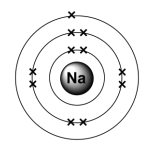
For example, for sodium, this is 2,8,1 – showing that there are:
- 2 electrons in the first energy level.
- 8 electrons in the second energy level.
- 1 electron in the third energy level.
Note
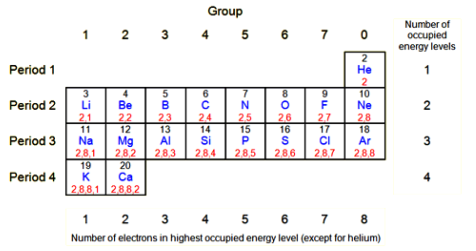
You can work out the electronic structure of an atom from its atomic number or its position in the periodic table.
- Start at hydrogen (H), and count the elements needed to reach the element you are interested in.
- For sodium, it takes:
- 2 elements to reach the end of the first period (row).
- 8 elements to reach the end of the second period.
- 1 element to reach sodium in the third period.
Note
The diagram of the periodic table shows how this works, with the number of electrons in the highest occupied energy level for each element.