The Periodic Table (OCR GCSE Chemistry A, Combined (Gateway Science Suite)): Revision Notes
📚Revision Notes
1.2.6 Group 7: The Halogens
Physical and Chemical Properties
Physical Properties:
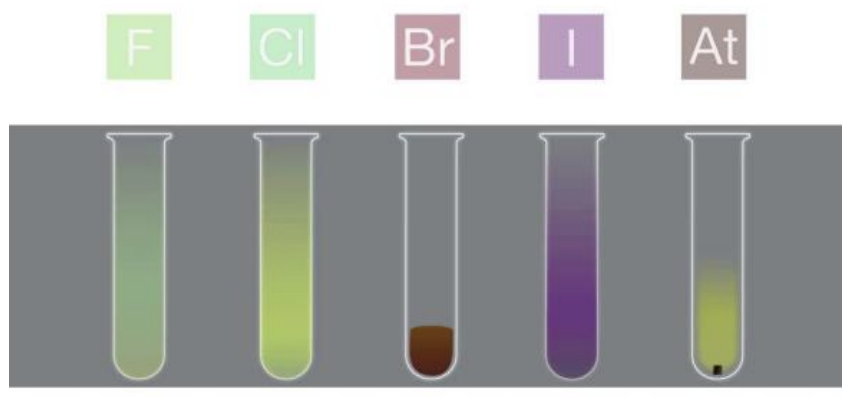
- Chlorine: Yellow-green gas
- Bromine: Orange-red liquid; produces orange vapour
- Iodine: Shiny grey solid; produces purple vapour
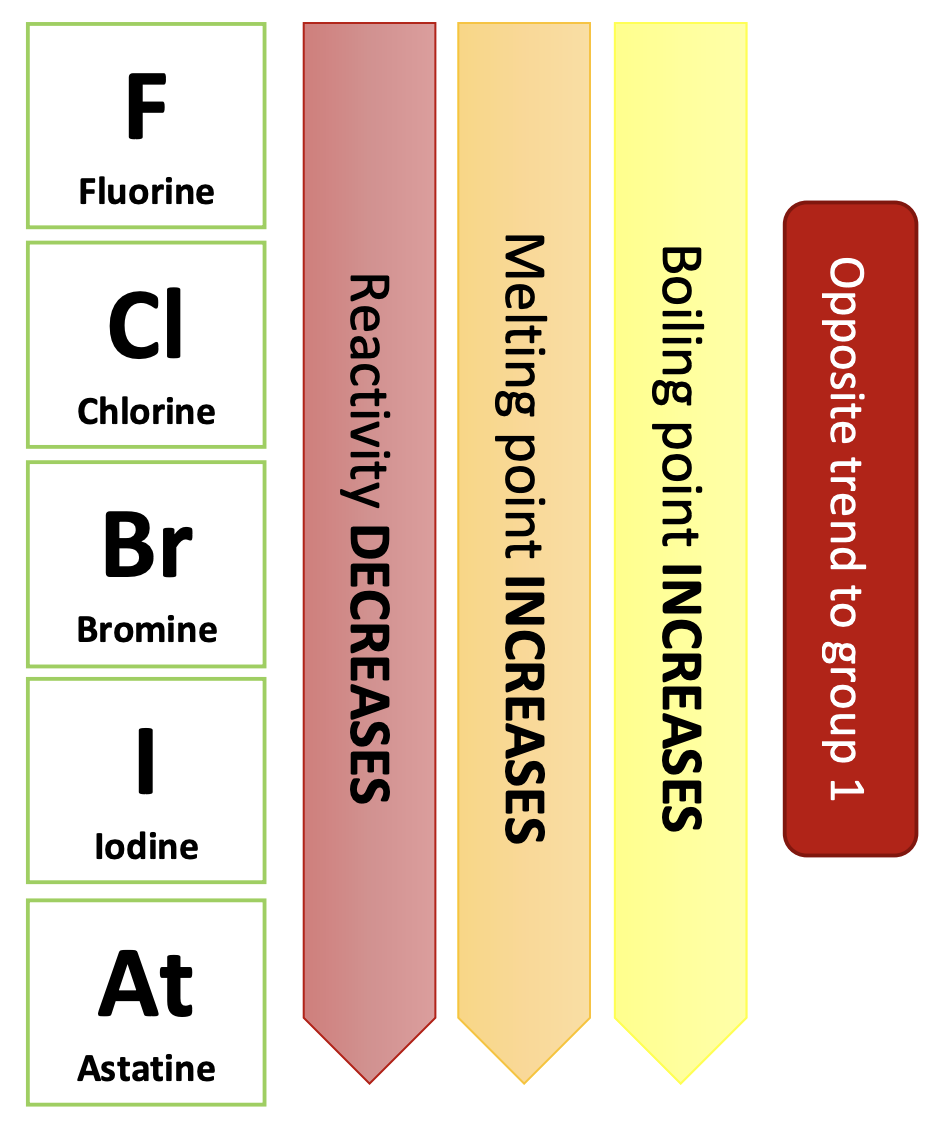
- The halogens become less reactive as you move down the group.
- Halogens have poisonous vapours.
Trends in Group 7:
- Reactivity DECREASES down the group.
- Melting point INCREASES down the group.
- Boiling point INCREASES down the group.
- (Opposite trend to Group 1)
Reactivity:
- All Group 7 elements have 7 electrons in their outer shell. This makes them very reactive, as they bond by gaining an electron to form a stable, full outer shell.
- Reactivity decreases down the group because the 7 outer electrons are further from the nucleus. With less attraction, it is harder to gain an electron.
Chemical Properties
Note
Reactions of Halogens with Alkali Metals: General Equation:
Example (Potassium and Chlorine):
All metal halides (salts) formed are white solids.

Note
Reactions of Halogens with Iron: Halogens and their reaction with iron wool
- Fluorine: Reacts with almost anything instantly. Very few scientists handle fluorine because it is so dangerous.
- Chlorine: Reacts with heated iron wool very quickly.
- Bromine: Must be warmed and the iron wool heated. The reaction is faster.
- Iodine: Must be heated strongly, and so does the iron wool. The reaction is slow.
The Properties and Uses of Halogens and Halides
The halogens have uses both as elements and compounds.
Chlorine
Chlorine is a disinfectant: It kills bacteria (see iodine below). It is used to kill bacteria in drinking water and swimming pools.
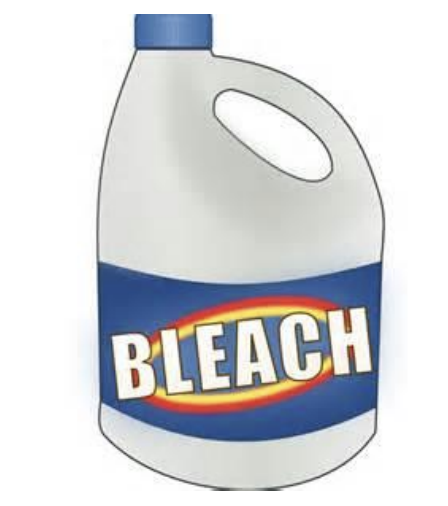
Chlorine dissolved in sodium hydroxide solution is bleach: It forms sodium chlorate(I) - NaOCl. Domestic bleach contains about 5% NaOCl(aq)_{(aq)}(aq).
Chlorine dissolved in water forms:
Chloric(I) acid is also bleach.
Chlorine is used in the manufacture of many chemicals including insecticides, CFCs, and the polymer PVC.
Iodine
Iodine can also be used as an antiseptic to kill bacteria:
- There is a difference between an antiseptic and a disinfectant.
- Both kill germs, but a disinfectant is stronger than an antiseptic.
- An antiseptic is safe to use on the skin to help prevent infection, but a disinfectant can damage skin cells.
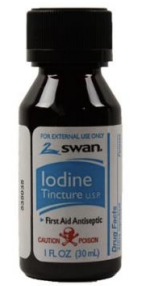
Iodine dissolved in alcohol (ethanol) was commonly used as an antiseptic in the past. It was called "Tincture of iodine."
Iodine plays an important role in the body (see potassium iodide below).
Fluorides
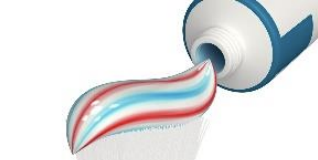
Fluorides are added to toothpaste and in some places added to drinking water.
It has been shown that fluorides can reduce dental decay (damage to teeth), especially in young children.
Bromides and Iodides
Silver bromide and silver iodide are sensitive to light and are used in photographic film.
- Silver bromide is almost white, and when light falls on it, it splits up into silver metal and bromine.
- The silver metal appears as a black mark on the film, producing a black and white (monochrome) negative.

Potassium Iodide
Potassium iodide (KI) is added to sodium chloride (common salt) to prevent a lack of iodine in the diet.
Sodium Chloride
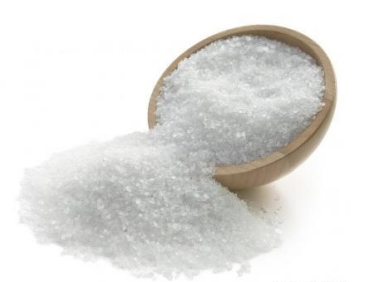
Sodium chloride (NaCl) is common salt.
Salt is used in the food industry as a flavouring and as a preservative.
Salt is also mixed with grit and spread on roads to prevent roads freezing in cold conditions.
Sodium chloride solution is used in a water softener to regenerate the ion exchange column.
Electrolysis of sodium chloride solution is used to make chlorine gas, hydrogen gas, and sodium hydroxide.