Calculating Rates of Reactions (OCR GCSE Chemistry A, Combined (Gateway Science Suite)): Revision Notes
📚Revision Notes
6.1.1 Calculating Rates of Reactions
What is the Rate of Reaction?
Note
The rate of a chemical reaction tells us how quickly the reaction happens. It measures how fast the reactants are used up or how quickly the products are formed during a reaction.
Note
Rates of reaction are important because they help us understand how efficient a reaction is, which is particularly useful in industrial processes
Note
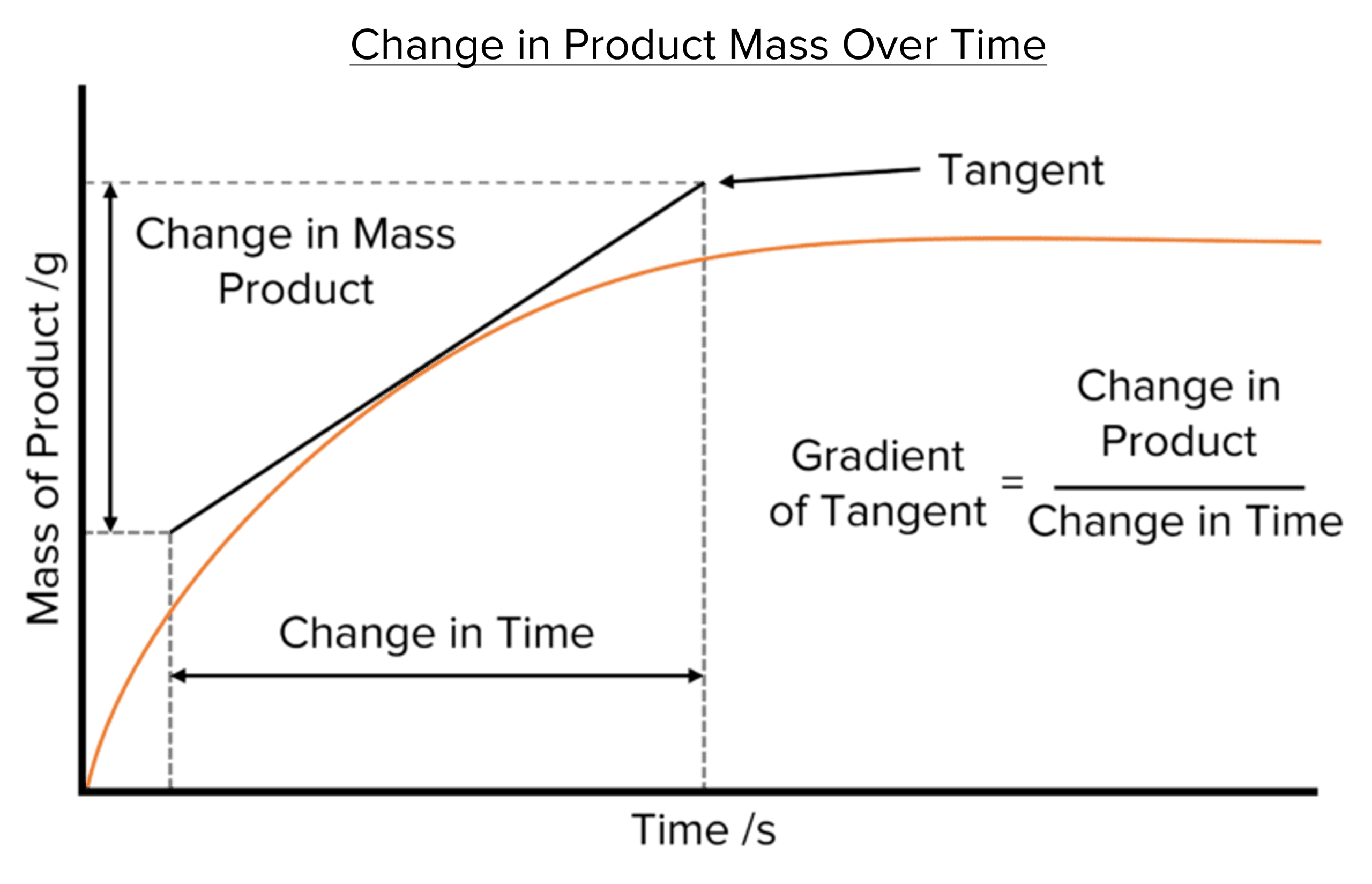
Calculating Mean Rate of Reaction The mean rate of reaction can be calculated using one of two formulas:
-
Using Reactants
-
Using Products:
Note
A higher rate indicates a faster reaction, while a lower rate suggests a slower reaction.
Units:
- The amount of reactant used or product formed is usually measured in grammes (g) or cubic centimetres (cm³).
- Time is measured in seconds (s).
- Therefore, the rate is expressed in units like g/s or cm³/s.
Example
Example Question: Calculating the Mean Rate of Reaction A chemical reaction between magnesium and hydrochloric acid produces hydrogen gas. During an experiment, 0.12 grammes of magnesium were completely consumed in 45 seconds, producing 100 cm³ of hydrogen gas.
Tasks:
- Calculate the mean rate of reaction using the amount of reactant (magnesium) consumed.
- Calculate the mean rate of reaction using the amount of product (hydrogen gas) formed.
- Determine which calculation indicates a higher rate of reaction and explain why. Given Data:
-
Amount of magnesium used = 0.12 g
-
Amount of hydrogen gas formed = 100 cm³
-
Time taken = 45 s Units:
-
Rate using magnesium: g/s
-
Rate using hydrogen gas: cm³/s
Answers
- Rate using magnesium: 0.00267 g/s
- Rate using hydrogen gas: 2.22 cm³/s
- Higher rate of reaction: The rate using hydrogen gas (2.22 cm³/s) is higher because it reflects the volume of gas produced, which occurs more quickly and in greater quantity compared to the mass of magnesium consumed.