Reactions of Acids with Metals (OCR GCSE Chemistry A, Combined (Gateway Science Suite)): Revision Notes
📚Revision Notes
4.2.1 Reactions of Acids with Metals
Note
When metals react with acids, a chemical reaction occurs that produces a salt and hydrogen gas. The reactivity of the metal determines how quickly and vigorously this reaction occurs.
General Reaction of Metals with Acids
Note
The general word equation for the reaction between a metal and an acid is:
Note
For example:
- Magnesium (Mg) reacts with hydrochloric acid (HCl) to produce magnesium chloride (MgCl₂) and hydrogen gas (H₂):
- Zinc (Zn) reacts with sulfuric acid (H₂SO₄) to produce zinc sulphate (ZnSO₄) and hydrogen gas (H₂):
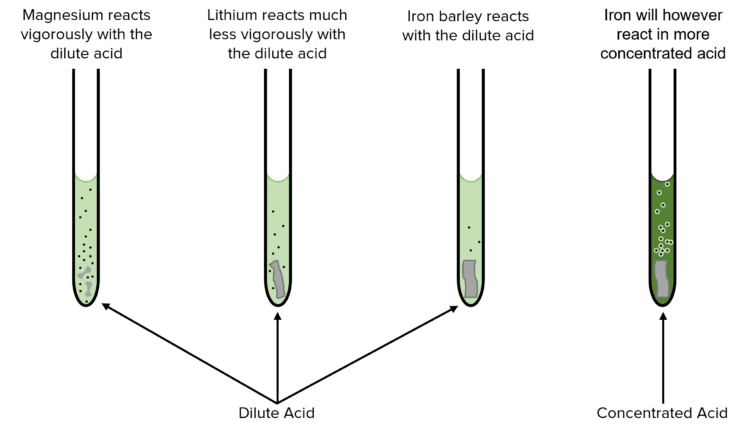
Reactivity and Reaction Speed
- Highly reactive metals, such as sodium or magnesium, react quickly and often violently with acids, releasing large amounts of hydrogen gas and heat.
- Less reactive metals, such as copper or silver, react much more slowly, if at all, with dilute acids.
Note
The Reactivity Series helps predict these reactions. Metals that are higher in the series will react more readily with acids, while those lower in the series will react less readily.
Practical Applications
Understanding the reactions of metals with acids is important in various practical applications, such as:
- Industrial production of hydrogen gas.
- Corrosion prevention, where knowledge of reactivity helps in selecting materials that resist acidic environments.
- Metal extraction processes, where acids are used to dissolve metals from their ores.