Required Practical: Investigating Temperature Changes (OCR GCSE Chemistry A, Combined (Gateway Science Suite)): Revision Notes
📚Revision Notes
5.1.2 Required Practical: Investigating Temperature Changes
Note
This experiment aims to investigate how changing the concentration of an acid affects the temperature change during a reaction. By using an insulated cup, the experiment measures the temperature changes as reactants are mixed, providing insights into the energy changes that occur.
Method
Note
Method:
- Prepare the Hydrochloric Acid:
- Measure 25 cm³ of hydrochloric acid.
- Heat the acid to 25°C.
- Set Up the Reaction:
- Pour the heated hydrochloric acid into a polystyrene cup. The insulation provided by the cup helps minimise heat loss to the surroundings, ensuring a more accurate measurement of temperature change.
- Add 1 g of powdered magnesium to the cup.
- Monitor the Temperature:
- Place a lid over the cup, ensuring that a thermometer is inserted through the lid so that its bulb is fully immersed in the reaction mixture.
- Place the cup inside a beaker filled with cotton wool to further insulate the reaction mixture.
- Measure and record the temperature every 30 seconds for 5 minutes. Record the highest temperature reached during the reaction.
- Repeat the Experiment:
- Repeat steps 1 to 5, each time increasing the concentration of the hydrochloric acid by 0.2 g/dm³.
- Start with a concentration of 0.2 g/dm³ and increase it up to 1.0 g/dm³.
- Analyse the Results:
- Compare how the temperature change varies with different concentrations of hydrochloric acid.
- Determine the relationship between the concentration of the acid and the energy change of the reaction.
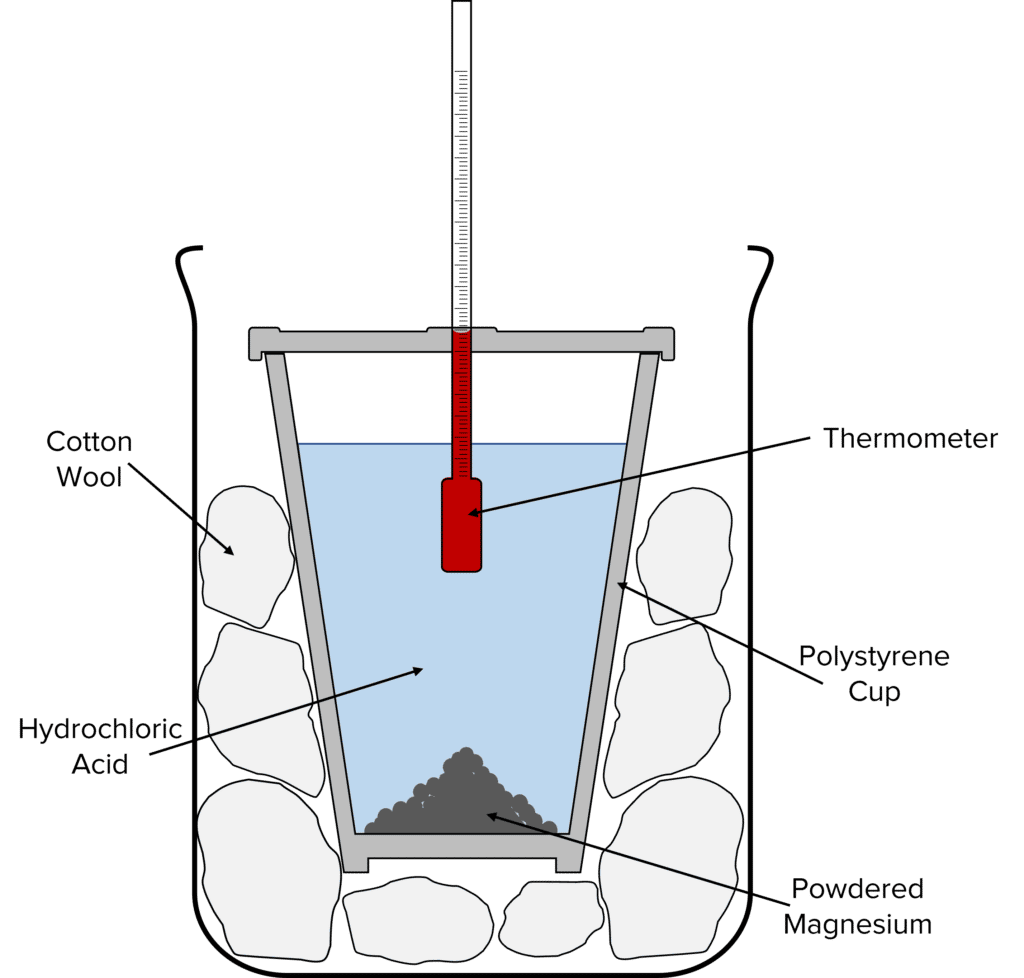
Explanation
This practical experiment allows you to explore the effect of acid concentration on the temperature change during a chemical reaction. The temperature change is directly related to the energy released or absorbed during the reaction:
- Exothermic Reaction: If the temperature increases, the reaction is exothermic, meaning it releases energy.
- Endothermic Reaction: If the temperature decreases, the reaction is endothermic, meaning it absorbs energy.