Titrations (OCR GCSE Chemistry A (Gateway Science Suite)): Revision Notes
📚Revision Notes
4.2.8 Titrations
Note
Titrations are a crucial technique in chemistry used to determine the concentration of a solution, typically an acid or a base, by reacting it with a solution of known concentration. This method is commonly employed to find out how much of a strong base is needed to neutralise a strong acid or vice versa. The data gathered from a titration can then be used to calculate the exact concentration of the unknown solution.
Note
The Titration Process
- Preparation of the Analyte:
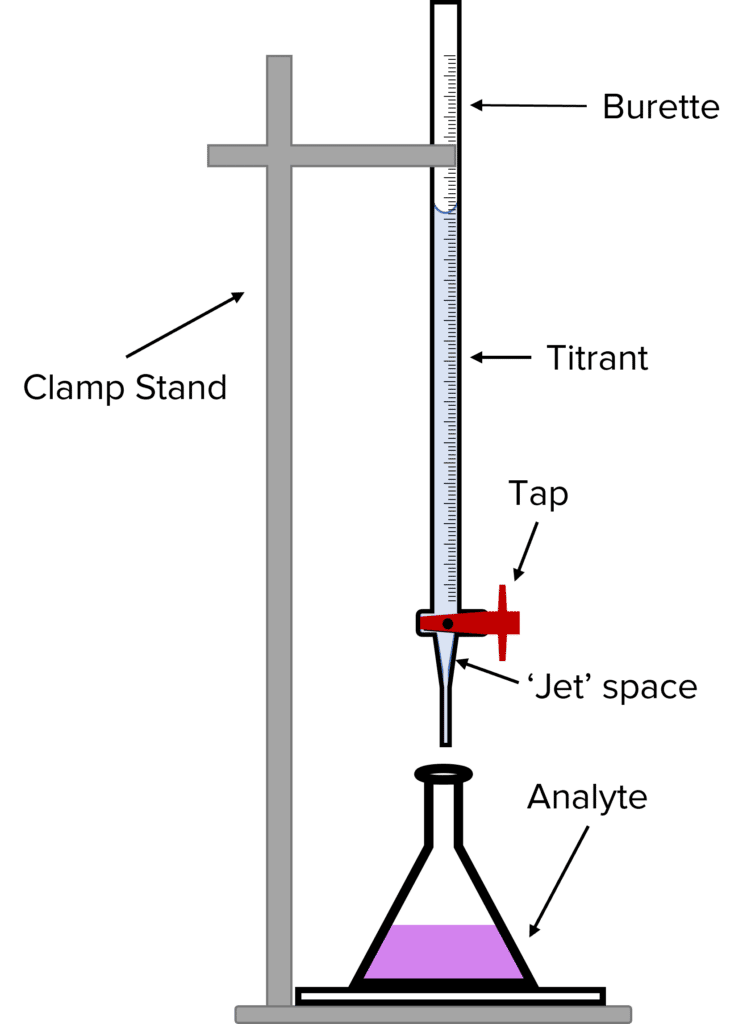
- The substance whose concentration you want to determine is called the analyte. A known volume of this analyte is measured and placed into a conical flask.
- An indicator is added to the analyte. The indicator is a substance that changes colour when the analyte has been completely neutralised, signalling the endpoint of the titration.
- Preparation of the Burette:
- The burette is the instrument used to deliver the titrant (the solution of known concentration) into the analyte. Before starting, the burette should be rinsed with the titrant to ensure accuracy.
- After rinsing, fill the burette with the titrant, ensuring that the jet space (the section below the tap) is filled with the solution. This prevents inaccurate volume readings.
- Adjust the burette so that the bottom of the meniscus (the curve seen at the liquid's surface) is exactly at the 0 cm³ mark.
- Running the Titration:
- Open the tap of the burette to allow the titrant to slowly flow into the analyte in the conical flask.
- Swirl the conical flask continuously to mix the solutions thoroughly. As the titrant is added, watch for the colour change in the indicator, which signifies that the neutralisation point is near.
- As the indicator begins to change colour, slow down the addition of the titrant by turning the tap to allow the titrant to drip in more slowly, allowing precise control.
- When the indicator permanently changes colour, indicating that neutralisation is complete, close the tap.
- Recording the Results:
- Note the volume of titrant used, which is referred to as the titre. This is the volume of titrant used, which is referred to as the titre. This is the volume difference from the initial reading (0 cm³) to the final reading after the titration.
- To ensure accuracy, repeat the titration at least three times and calculate the average titre from results that are within 0.20 cm³ of each other. These consistent results are known as concordant titres.
Note
The Burette: Key Features and Usage The burette is a precise piece of equipment essential for titrations. Its design allows for accurate measurement and control over the volume of titrant added to the analyte.
-
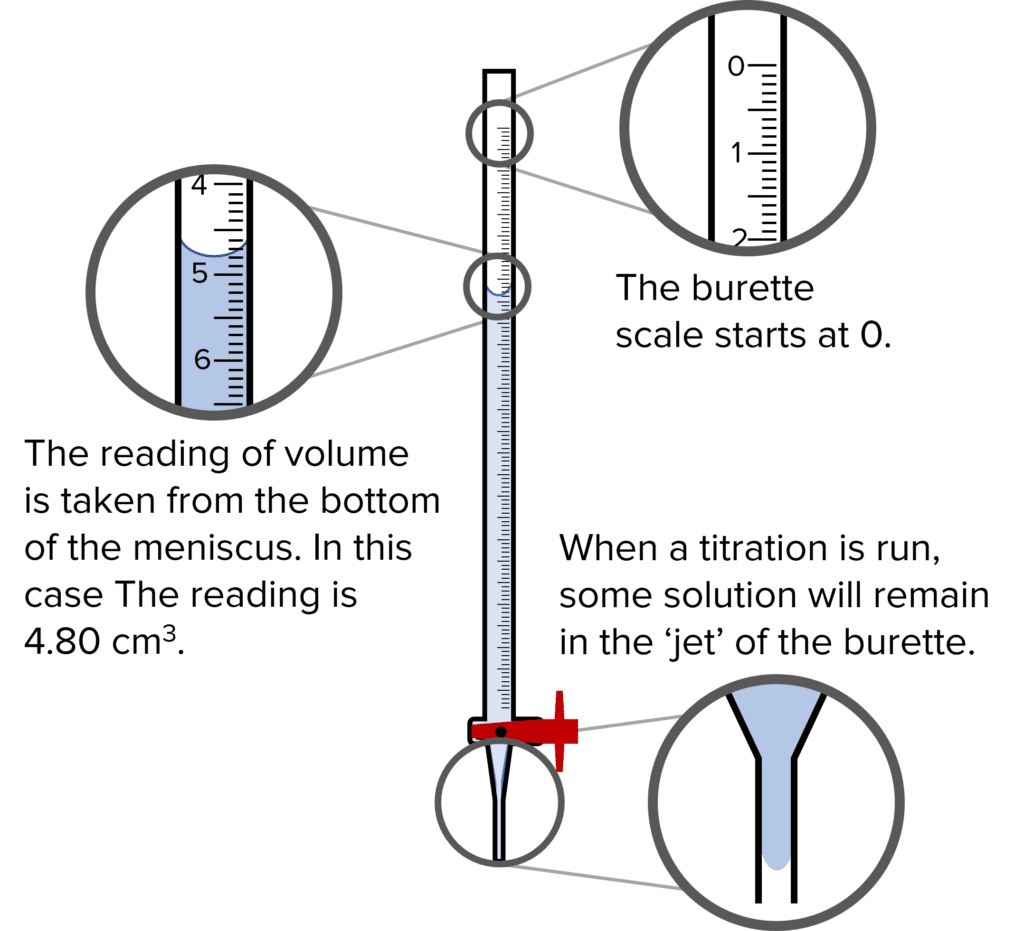
Narrow Width: The burette's narrow diameter creates a large meniscus, enabling precise readings of the liquid's volume to the nearest 0.05 cm³.
-
Volume Scale: The scale on the burette starts at 0 cm³ at the top because it measures the amount of titrant added to the analyte, not the total volume in the burette. When the burette is full, the reading is 0 cm³.
-
Reading the Meniscus: Always take readings from the bottom of the meniscus to ensure accuracy. If the meniscus lies between two lines on the scale, estimate to the nearest 0.05 cm³.
-
Jet Space: Before beginning the titration, it is crucial to allow some titrant to flow through the tap to fill the jet space. If this step is skipped, the initial titre reading will be larger than it should be, leading to errors in the calculation.
Importance of Consistency
Note
For reliable results, titrations should be conducted multiple times. The volume of titrant added (titre) should be consistent across trials. Only results that fall within 0.20 cm³ of each other are considered concordant and are used to calculate the average titre. This precision ensures the accuracy of the concentration determined for the analyte.