Data Types (OCR GCSE Computer Science): Revision Notes
📚Revision Notes
Data Types
In programming, data types define the kind of data a variable can hold. Choosing the correct data type is important for ensuring that programmes run efficiently and behave as expected. Each type has specific uses, and sometimes data types need to be converted or "cast" from one type to another. Below are common data types you will encounter in programming, along with practical uses and tips for when to choose each type.
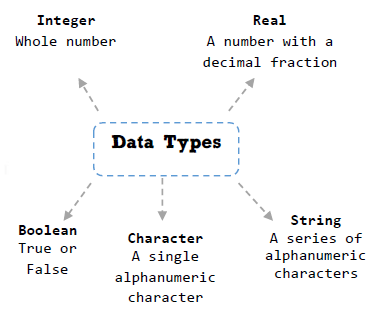
Integer
An integer is a whole number (positive or negative) without decimal places.
- Practical Use: Integers are commonly used for counting or when precision isn't required (e.g., storing the number of items in a shopping cart, a person's age). Example:
items = 5 `
Explanation: An integer value of 5 is assigned to the variable 'items'.
Real (Float)
A real number, also called a float, is a number that can contain decimal places.
- Practical Use: Real numbers are used when more precision is required, such as in financial calculations (e.g., storing a product price) Example:
price = 19.99
Explanation: A float value with decimal places is assigned to 'price'.
Boolean
A Boolean value can either be True or False.
- Practical Use: Booleans are used in conditions and decision-making processes in a programme, such as checking if a user is logged in or verifying if a condition is met. Example:
is_logged_in = True
Explanation: A Boolean value 'True' is assigned to 'is_logged_in'
Character and String
- A character is a single letter, number, or symbol.
- A string is a collection of characters (a word, sentence, or text). Practical Use: Strings are used to store and manipulate text data, like names, addresses, or any input/output involving human-readable data.
Example:
name = "Alice"  # A string is assigned to the variable `name`
first_letter = "A"  # A single character is stored in `first_letter`
Explanation:
- A string is assigned to the variable 'name'
- A single character is stored in 'first_letter'
Casting
Casting is the process of converting a variable from one data type to another (e.g., from a string to an integer).
- Practical Use: Casting is useful when data needs to be processed differently. For example, you might want to convert a user's input (which is often taken as a string) into an integer to perform mathematical operations. Example:
age = input("Enter your age: ")
age = int(age)
Explanation:
- Input is stored as a string by default
- Casting the string 'age' to an integer for further use
Practical Use of Data Types
- Integer: Students may use integers when developing programmes that count items, track scores in a game, or represent whole numbers like age or quantity.
- Real: Students may use floats in programmes that require precise calculations, such as financial apps that handle prices and discounts.
- Boolean: Booleans are used in decision-making sections of a programme, such as
ifstatements that check conditions like login status or verification. - Character and String: Strings are commonly used when handling text input/output in programmes, such as asking for the user's name and printing messages to the screen.
- Casting: Students often need to convert user inputs (which are usually strings) into integers or floats when performing calculations, such as when adding numbers entered by the user.
Understanding Data Types in Different Scenarios
Choosing Suitable Data Types
It's important to choose the correct data type based on what kind of data you're working with. For example:
- Use integers when dealing with whole numbers.
- Use floats when precision (decimals) is required.
- Use Booleans for yes/no (true/false) situations.
- Use strings for text data.
Casting and Its Importance
Sometimes data comes in one format but needs to be processed in another. Casting allows you to temporarily convert data to perform specific actions. For instance, when a user inputs a number (as a string), it must be cast to an integer to perform arithmetic calculations.
Note
Key Points to Remember
- Integers are used for whole numbers, and floats are used for numbers with decimal points.
- Booleans hold
TrueorFalsevalues, commonly used in conditions. - Strings store text and casting allows conversion between different data types, such as turning a string into an integer for calculations.