Hot Desert Ecosystem (OCR GCSE Geography A (Geographical Themes)): Revision Notes
📚Revision Notes
2.3.1 Hot Desert Ecosystem
Note
Deserts cover about one-third of the Earth's land area. A desert is a harsh environment with very little rain and extreme temperatures. Example: The Sahara, where the weather is very hot and dry, with less than 250 mm of rain per year. There is not much life in the deserts as animals find it hard to survive.
Where are Deserts Located?
- The world's hot deserts are found in subtropical areas between 20 and 30 degrees north and south of the Equator.
- The Tropic of Cancer or the Tropic of Capricorn passes through most of the world's hot desert regions.
- Deserts can be found in 5 of the world's 7 continents.
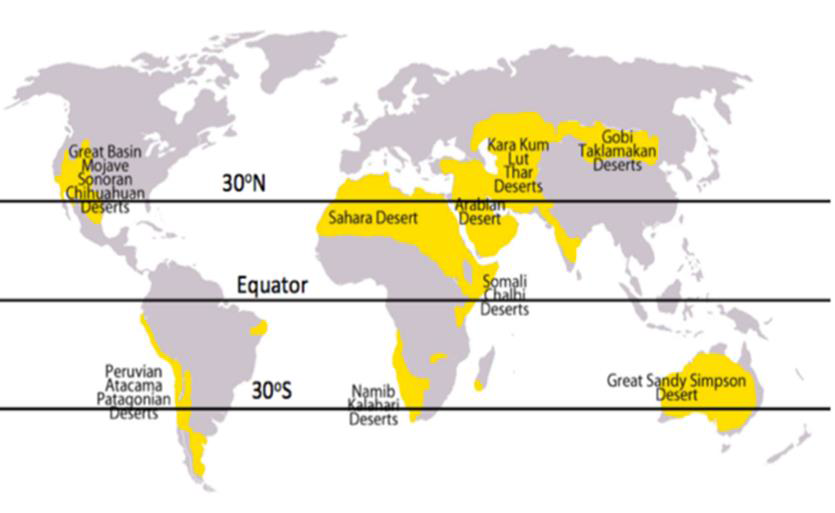
Desert Locations
Why are Deserts NOT Located at the Equator?
- The sun's rays are more concentrated at the equator, making it the hottest part of the Earth.
- Intense heat warms the land, air, and sea, causing water to evaporate into the air.
- The very warm, moist air then rises.
- Once the warm air rises, it cools, and the water turns back into rain, creating clouds.
- This means that although it is hot, there is lots of rain at the equator, leading to rainforests, not deserts.
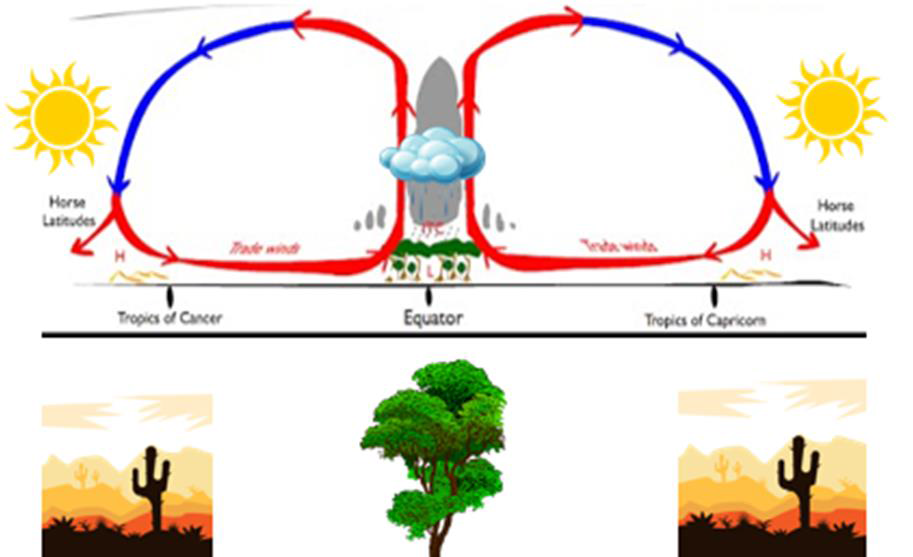
Reasons for Little Rain in Deserts
Reasons for Little Rain in Deserts
- Equator is very hot.
- Warm air rises.
- By the time it reaches 30 degrees north or south, the air has lost any moisture.
- It starts to cool down as it gets further away from the equator, and the cool, dry air sinks back down.
- As it gets closer to the equator again, it heats back up and the process repeats.
Note
What is the Soil Like in a Desert? Usually shallow with a coarse, gravelly texture. There's hardly any leaf fall, so the soil isn't very fertile. Lack of rainfall and plant material means the soil is often dry.