Environmental Problems in China (OCR GCSE Geography B (Geography for Enquiring Minds)): Revision Notes
📚Revision Notes
Environmental Problems in China
Introduction
China is a large country experiencing significant environmental challenges. For many years, economic growth was China's main priority, following the policy of "grow first, clean up later". However, environmental problems have now become serious issues that the government must address alongside economic development.
Note
This policy shift represents a major change in China's development approach. The country is now attempting to balance economic progress with environmental protection, recognising that unchecked growth has led to severe ecological damage that threatens long-term prosperity and public health.
Impacts of climate change in China
Temperature changes
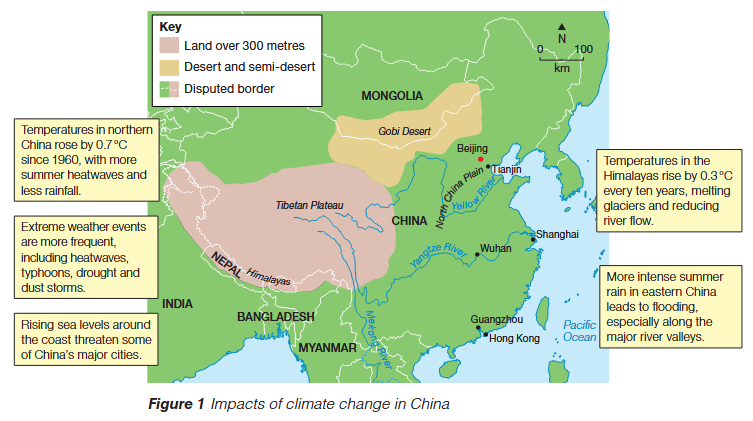
China has experienced significant warming over the past century. Average temperatures across the country have risen by 1.1°C and scientists predict they could increase by up to 3.5°C during the 21st century. This warming is not uniform across China, with different regions experiencing varying rates of temperature increase.
Important
The predicted temperature increase of 3.5°C this century would have severe consequences for China's ecosystems, agriculture, and urban populations. This rate of warming is significantly faster than the global average, making China particularly vulnerable to climate impacts.
Regional climate impacts
Climate change affects different parts of China in distinct ways:
Northern China
The northern regions, including areas around the Gobi Desert, have warmed by 0.7°C since 1960. This warming has led to more summer heatwaves and reduced rainfall, making conditions increasingly arid. The region experiences more frequent extreme weather events including dust storms from the expanding desert areas.
Himalayan region
The mountainous areas along China's western border are particularly vulnerable to climate change. Temperatures in the Himalayas are rising by 0.3°C every ten years, which is faster than the global average. This warming is causing glaciers to melt and reducing river flow from these mountains, which many communities depend on for water supply.
Note
The melting Himalayan glaciers pose a long-term threat to water security across China and neighbouring countries. These glaciers act as natural water storage systems, feeding major rivers during dry seasons. Their loss could affect hundreds of millions of people who depend on these water sources.
Coastal areas
Rising sea levels around China's coast pose a serious threat to major cities. Important economic centres like Shanghai and Hong Kong face increased flood risk as ocean levels rise. The coastal regions are home to millions of people and much of China's industrial activity, making this impact particularly significant.
Eastern China
The eastern part of the country, particularly along major river valleys like the Yangtze River, experiences more intense summer rainfall. This increased precipitation leads to severe flooding, especially along the major river systems. The combination of heavy rainfall and rising sea levels creates compound flooding risks in coastal river deltas.
Extreme weather events
Climate change has made extreme weather more frequent across China. The country now experiences:
- More intense typhoons
- Prolonged droughts
- Severe heatwaves
- Powerful dust storms
These events disrupt agriculture, damage infrastructure, and threaten lives and livelihoods.
Other environmental problems
Beyond climate change, China faces several other serious environmental challenges linked to its rapid industrial development and urbanisation.
Ecosystem loss
Natural habitats across China have been destroyed or degraded due to several development activities. Large-scale dam construction projects flood valleys and disrupt river ecosystems. Farming improvements often involve clearing natural vegetation and draining wetlands. Rapid urbanisation converts farmland and natural areas into cities, eliminating habitats for wildlife and reducing biodiversity.
Important
Common mistake to avoid: Don't assume ecosystem loss is only about losing trees or animals. Ecosystem loss affects water quality, soil stability, pollination of crops, natural flood control, and many other environmental services that humans depend on. The impacts cascade through the entire environment.
Air pollution
China's cities suffer from severe air pollution, primarily caused by two factors. The dramatic increase in car ownership means vehicle exhaust fumes pollute urban air. Additionally, burning coal for electricity generation and industrial processes releases harmful particles and gases. This air pollution causes serious health problems for the population, particularly increasing rates of lung disease and heart disease.
Note
Air pollution in Chinese cities can reach levels that are hazardous to human health, with visibility sometimes reduced to just a few hundred meters. The fine particulate matter (PM2.5) from coal burning and vehicle emissions penetrates deep into the lungs and bloodstream, causing long-term health damage even at relatively low exposure levels.
Water pollution
Rivers and water bodies across China face contamination from multiple sources. Industries discharge waste directly into rivers without adequate treatment. Sewage from growing cities often enters waterways without proper processing. This water pollution makes water unsafe for drinking and agricultural use. It also contributes to higher cancer rates in communities that depend on polluted water sources.
Desertification
Areas in northern and western China are experiencing desertification, where productive land turns into desert. Drought conditions, partly linked to climate change, cause soil to dry out and lose its fertility. Wind erosion then removes the dried topsoil. This process means land becomes unsuitable for habitation or farming, forcing communities to relocate and reducing China's agricultural capacity.
Important
Desertification is a self-reinforcing process. Once vegetation is lost, the soil becomes more vulnerable to erosion. Without plant roots to hold it in place, topsoil blows away, making it even harder for plants to regrow. This creates a cycle that is difficult and expensive to reverse.
Summary
Key Points to Remember:
- Average temperatures in China have risen by 1.1°C in the past century and could increase by up to 3.5°C this century
- Climate change impacts vary by region: northern areas experience drought and heatwaves, the Himalayas face glacier melting, coastal cities are threatened by sea level rise, and eastern regions suffer increased flooding
- China's environmental problems stem from prioritising economic growth, following a "grow first, clean up later" approach
- Major environmental challenges include ecosystem loss (from dam building, farming, and urbanisation), air pollution (from vehicles and coal burning), water pollution (from industrial waste and sewage), and desertification (from drought)
- These environmental problems are interconnected – climate change worsens desertification, industrial development causes pollution, and urbanisation destroys ecosystems
Note
Key Terms to Remember:
- Climate change: Long-term changes in temperature and weather patterns
- Desertification: The process by which fertile land becomes desert
- Urbanisation: The growth of cities and movement of people from rural to urban areas
- Ecosystem loss: Destruction or degradation of natural habitats
Note
Exam Tip: When explaining environmental problems in China, use specific examples (like the 0.7°C temperature rise in northern China or flooding along the Yangtze River) and always link problems to their causes (such as connecting air pollution to coal burning and vehicle use). For evaluation questions, consider both the economic benefits and environmental costs of China's development approach.