Drought A Hidden Disaster (OCR GCSE Geography B (Geography for Enquiring Minds)): Revision Notes
📚Revision Notes
Drought A Hidden Disaster
Overview of the 2012–2015 USA drought
Between 2012 and 2015, the United States experienced its most expensive natural disaster to date. This drought event affected vast areas of the country, but remained largely unknown internationally because it caused no direct fatalities. The disaster earned the name 'hidden' precisely because of this lack of immediate, visible casualties.
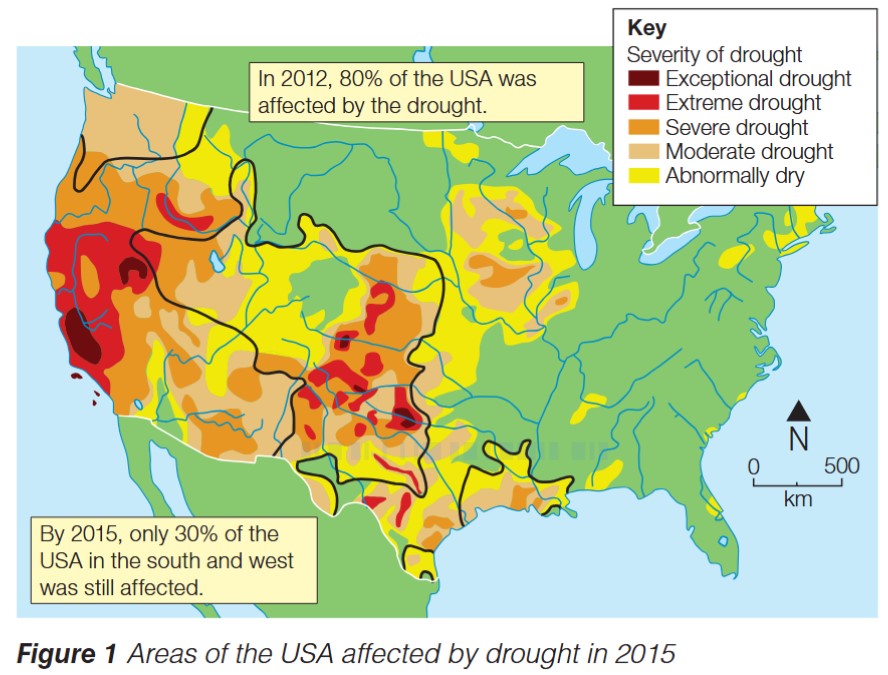
At its peak in 2012, the drought affected 80% of the entire United States. The western and central regions experienced the most severe conditions, with California suffering the worst impacts. While conditions improved by 2015, approximately 30% of the USA in the south and western states continued to experience drought. California's drought persisted until 2015, making it the longest-affected state during this event.
Note
Understanding Drought Severity Classifications
The map shows the severity of drought conditions across different regions in 2015. Drought severity is classified into five categories: exceptional drought (most severe), extreme drought, severe drought, moderate drought, and abnormally dry conditions. The western states, particularly California, show the darkest colours indicating exceptional to extreme drought, while eastern states display lighter colours showing less severe or no drought conditions.
Historical context of drought in the USA
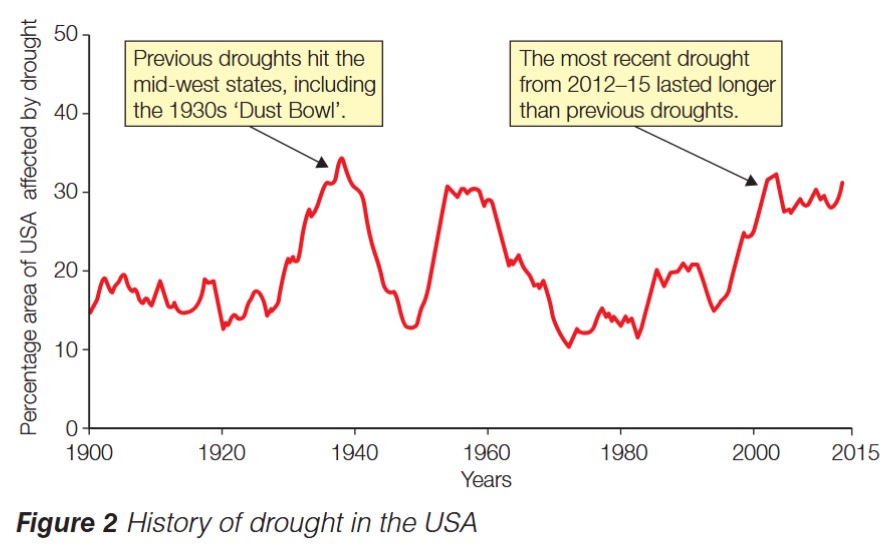
The 2012–2015 drought was not the first major drought event in American history. Throughout the 20th century, the United States experienced several significant drought periods. The most famous of these was the 1930s 'Dust Bowl', which devastated the mid-west states and caused widespread agricultural failure and migration.
Important
A Record-Breaking Duration
The historical data reveals an important pattern: while previous droughts affected smaller percentages of the country and were often shorter in duration, the 2012–2015 drought lasted considerably longer than earlier events. The graph shows drought coverage fluctuating between roughly 10% and 35% of USA land area over the past century, with notable peaks in the 1930s, 1950s, and the 2000s–2010s period.
Government and state responses to the drought
In 2015, the US government announced a comprehensive financial assistance package to help those affected by the prolonged drought. This response recognised the severe economic and social impacts the disaster was having on communities across the affected states.
Support for agriculture
Since California uses approximately 80% of its water for farming, agricultural support formed a central part of the government response. Financial assistance helped farmers implement water conservation measures on their land. These included efforts to reduce wind erosion, which helps preserve soil moisture and prevent further water loss from farmland. Without intervention, wind erosion would accelerate the drying of agricultural land, making the drought's impact even worse.
Note
Why Wind Erosion Matters
Reducing wind erosion on farmland serves a dual purpose during drought: it prevents the loss of valuable topsoil and helps retain what little moisture remains in the soil. By implementing erosion control measures, farmers can protect their land from becoming completely barren, preserving its productivity for when rainfall returns.
Livestock protection
The drought created severe risks for livestock across affected regions. Animals faced potential starvation as grazing land dried up and feed crops failed. The government provided both animal feed and access to water for livestock at risk. This support prevented mass die-offs of cattle, sheep, and other farm animals, which would have caused long-term damage to the agricultural economy.
Rural community support
Many rural communities faced the prospect of running out of drinking water entirely as wells dried up and water supplies diminished. Government assistance provided emergency water supplies and infrastructure support to ensure these communities maintained access to safe drinking water. This was critical for public health and prevented forced evacuations of remote settlements.
Food bank provisions
The drought caused significant financial hardship for families, particularly those dependent on agriculture for their livelihoods. Food banks received government funding to provide essential supplies to families struggling with the economic impacts of the disaster. This social support helped communities survive until conditions improved.
California's water restrictions
California, as the worst-affected state, implemented its own additional measures alongside federal support. The state imposed restrictions on water consumption, with particular focus on non-essential uses. Lawn watering faced strict limitations, as this represented a significant source of water waste during the crisis. These restrictions helped preserve remaining water supplies for essential uses like drinking water and critical agricultural production.
Why this disaster remained 'hidden'
Despite being the costliest natural disaster in United States history, the 2012–2015 drought received relatively little international attention. The primary reason for this was the absence of direct fatalities. Unlike hurricanes, earthquakes, or floods, drought kills slowly and indirectly.
Important
The Paradox of the 'Hidden' Disaster
People outside the USA remained largely unaware of the disaster's scale and economic impact because news coverage typically focuses on events with immediate casualties. However, the financial cost and long-term environmental consequences were enormous, affecting millions of Americans and reshaping agricultural practices across multiple states. This demonstrates how natural disasters without dramatic, immediate impacts can be just as devastating as those that dominate headlines.
Summary
Key Points to Remember:
- The 2012–2015 drought was the costliest natural disaster in US history, affecting 80% of the country at its peak in 2012
- California suffered the most severe and longest-lasting impacts, with drought conditions persisting until 2015
- The drought lasted longer than previous droughts in US history, including the famous 1930s Dust Bowl
- Government responses included financial support for farmers, livestock protection, rural water supplies, and food banks to help affected communities
- The disaster remained internationally 'hidden' because no one died directly, despite its massive economic and social impact