From Hazard to Disaster (OCR GCSE Geography B (Geography for Enquiring Minds)): Revision Notes
📚Revision Notes
From hazard to disaster
Understanding hazards and disasters
A natural hazard is a potential threat from the physical environment, such as an earthquake, hurricane, flood, or volcanic eruption. However, a hazard only becomes a disaster when it actually affects people and communities. This is a crucial distinction in geography because it means that the same natural event can have completely different outcomes depending on where it occurs and who it affects.
Note
The Crucial Distinction
The key concept here is that hazards are natural events, while disasters involve human impact. An earthquake in an uninhabited area is a hazard, but not a disaster. The same earthquake in a populated city becomes a disaster because it affects people's lives, property, and livelihoods.
The impact of a natural disaster varies significantly between different countries and regions. Advanced countries like the USA have invested heavily in disaster preparedness, warning systems, and building regulations, which help to reduce the risk to human life. However, these same countries often experience much higher economic costs when disasters strike because they have expensive infrastructure, property, and technology that can be damaged or destroyed.
The impact of Hurricane Sandy (2012)
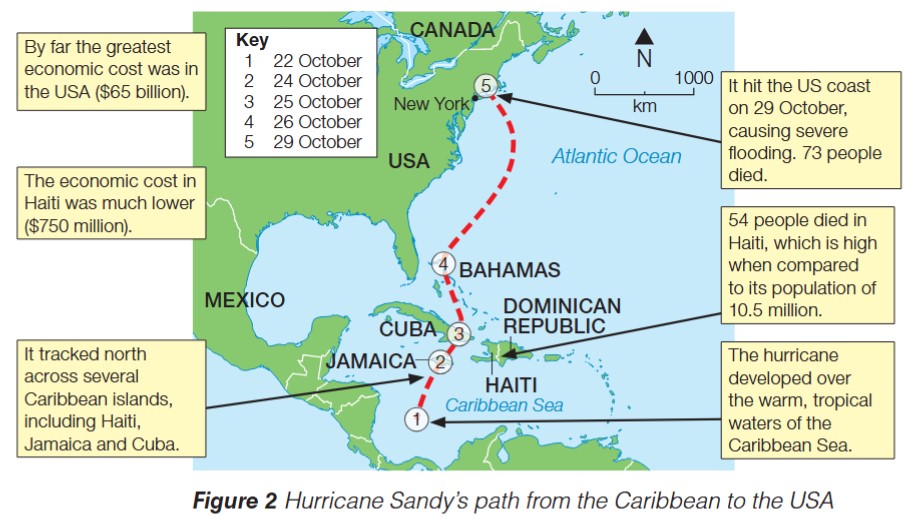
Hurricane Sandy provides an excellent case study for understanding how disasters affect different countries in different ways. When this powerful hurricane struck in October 2012, it caused devastation across several countries, but the nature of that devastation varied dramatically.
Impact in the USA
In the United States, Hurricane Sandy caused catastrophic economic damage. The hurricane killed 73 people and resulted in approximately $65 billion worth of damage, with most of the destruction concentrated in New York, the country's largest city. This made it one of the most expensive natural disasters in US history.
The enormous economic cost reflects the high value of property and infrastructure in American cities. Skyscrapers, subway systems, power networks, and thousands of homes and businesses were damaged or destroyed. However, the relatively low death toll (compared to the population affected) demonstrates the effectiveness of early warning systems, evacuation procedures, and building standards in the USA.
Impact in Haiti
The same hurricane had a very different impact when it struck Haiti, a low-income developing country in the Caribbean. In Haiti, 54 people died from the hurricane – a similar number to the USA despite Haiti having a much smaller population of just 10.5 million people (compared to the USA's 324 million). This means the death toll was proportionally much higher in Haiti.
However, the economic cost in Haiti was dramatically lower at $750 million. This isn't because the hurricane was less severe in Haiti – it's because there was simply less valuable infrastructure and property to damage. Most Haitian buildings are less expensive to construct, and the country has fewer complex infrastructure systems like the ones found in American cities.
Comparing the impacts
Example
Comparing Hurricane Sandy's Impact: USA vs Haiti
| Country | Deaths | Economic Damage | Population |
|---|---|---|---|
| USA | 73 | $65 billion | 324 million |
| Haiti | 54 | $750 million | 10.5 million |
Key Observations:
- The USA had nearly 100 times the economic cost of Haiti ($65 billion vs $750 million)
- Haiti's death toll was proportionally much higher – 54 deaths from 10.5 million people compared to 73 deaths from 324 million people
- This demonstrates the pattern: wealthy countries face higher economic costs but lower death tolls, while poorer countries face lower economic costs but higher death tolls
The comparison between the USA and Haiti illustrates a pattern that geographers observe repeatedly: advanced countries tend to experience lower death tolls but higher economic costs, while low-income developing countries often suffer higher death tolls but lower economic costs. This difference exists because:
- Wealthier countries have better warning systems and evacuation procedures
- Buildings in advanced countries are constructed to higher standards
- Emergency services can respond more quickly and effectively in developed nations
- However, everything that gets damaged in a wealthy country is more expensive to replace
Understanding disaster preparedness in advanced countries
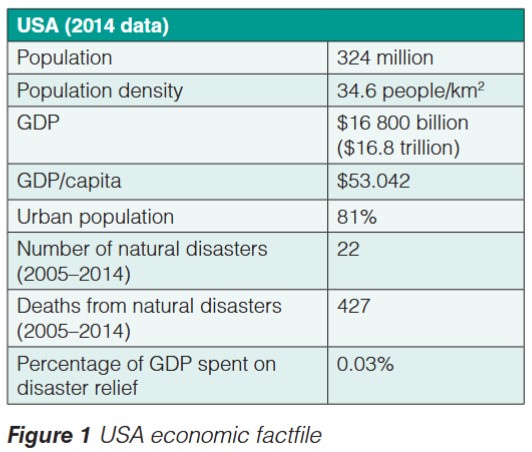
The USA demonstrates the characteristics of an advanced country (AC) when dealing with natural disasters. Let's examine the key features that affect how the country experiences and responds to natural hazards.
Note
USA Key Statistics (2014)
| Indicator | Value |
|---|---|
| Population | 324 million |
| Population density | 34.6 people/km² |
| GDP | $16,800 billion ($16.8 trillion) |
| GDP per capita | $53,042 |
| Urban population | 81% |
| Natural disasters (2005-2014) | 22 |
| Deaths from disasters (2005-2014) | 427 |
| GDP spent on disaster relief | 0.03% |
These statistics reveal both the USA's wealth and vulnerability – a large, prosperous nation that faces frequent natural hazards but has invested in systems to protect its citizens.
The USA has several advantages that help reduce deaths from natural disasters:
High GDP and wealth: With a GDP of $16.8 trillion and GDP per capita of $53,042, the USA can afford to invest in disaster preparedness. This includes sophisticated weather monitoring systems, strong building codes, and well-equipped emergency services.
Urban population: With 81% of the population living in urban areas, it's easier to implement building regulations and evacuation procedures. Cities can afford to build stronger structures and maintain better emergency response systems.
Infrastructure investment: The USA has extensive infrastructure including reinforced buildings, flood defences, and communication networks. Although this infrastructure is expensive to repair when damaged, it also helps to protect people during disasters.
Low disaster spending: Despite facing 22 natural disasters between 2005-2014, the USA spent only 0.03% of its GDP on disaster relief. This reflects both the country's enormous wealth and its ability to recover relatively quickly from disasters.
Important
Why Economic Costs Are Higher in Advanced Countries
The high value of property and infrastructure means that when disasters do strike, the economic costs are substantial. A single damaged skyscraper, flooded subway system, or destroyed power station can cost billions of dollars to repair or replace. This is why advanced countries typically experience lower death tolls but much higher economic costs compared to developing nations.
Low-income developing countries and disaster vulnerability
In contrast to advanced countries, low-income developing countries (LIDCs) face different challenges when dealing with natural hazards. These countries often have:
- Weaker building standards, with many structures unable to withstand hurricanes, earthquakes, or floods
- Limited early warning systems and evacuation procedures
- Fewer resources for disaster preparedness and emergency response
- Less advanced infrastructure overall
This means that when a natural hazard strikes an LIDC, it's more likely to result in a higher death toll. People may not receive adequate warning, buildings may collapse more easily, and emergency services may struggle to reach affected areas quickly.
However, because these countries have less valuable infrastructure and property, the total economic cost tends to be lower. A destroyed building in Haiti costs far less to replace than a destroyed building in New York, even though the human impact may be just as severe or worse.
Important
The Disaster Impact Pattern
Remember this pattern when comparing countries:
- Advanced Countries (AC): Lower death tolls + Higher economic costs
- Low-Income Developing Countries (LIDC): Higher death tolls + Lower economic costs
This isn't because disasters are less severe in one place or another – it's because of differences in wealth, infrastructure, and preparedness.
Remember!
Summary
Key Points to Remember
-
A hazard only becomes a disaster when it affects people – the same natural event can have completely different consequences depending on where it occurs and the level of preparedness.
-
Hurricane Sandy (2012) killed 73 people and caused $65 billion damage in the USA, but killed 54 people and caused only $750 million damage in Haiti, demonstrating how economic development affects disaster impacts.
-
Advanced countries like the USA typically experience lower death tolls from disasters due to better preparedness, building standards, and warning systems, but suffer higher economic costs because of expensive infrastructure.
-
Low-income developing countries often face higher death tolls from disasters but lower economic costs, reflecting less valuable infrastructure but also fewer resources for disaster preparedness.
-
The USA's investment in disaster preparedness (warning systems, building codes, emergency services) has been effective at reducing deaths, with only 427 deaths from 22 natural disasters over a 10-year period despite being a large, hazard-prone country.