Energy Futures - UK (OCR GCSE Geography B (Geography for Enquiring Minds)): Revision Notes
📚Revision Notes
Tidal Power: A Renewable Option
Introduction to tidal power
Tidal energy offers a renewable alternative for electricity generation in the UK. As an island nation, Britain is particularly well-suited to harness the power of tides. The Bristol Channel, located between Wales and southwest England, has the largest tidal range in the UK, making it an ideal location for tidal power generation.
Tidal power works by capturing the energy created by the rise and fall of sea levels during tides. This form of renewable energy has gained attention as the UK seeks to diversify its energy sources and reduce reliance on fossil fuels.
Note
The Bristol Channel's exceptional tidal characteristics stem from its unique funnel shape, which amplifies tidal movements. This natural feature creates tidal ranges of up to 10 metres, providing ideal conditions for energy generation.
Plans for a tidal lagoon
Swansea Bay Tidal Lagoon
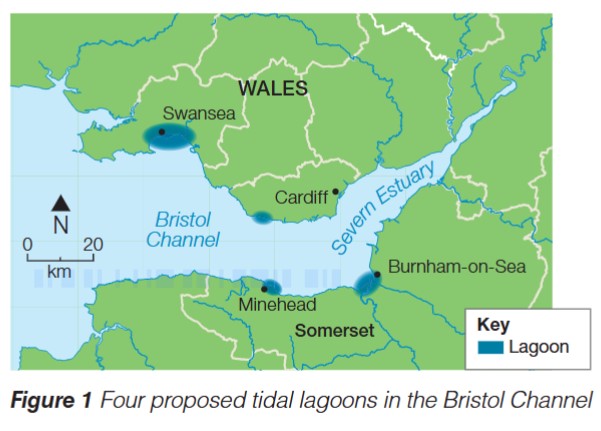
The Swansea Bay Tidal Lagoon was the first of four proposed tidal lagoons planned for the Bristol Channel. This ambitious project aimed to demonstrate the viability of tidal energy generation on a large scale. If constructed, the Swansea Bay lagoon would have had the capacity to provide electricity for approximately 150,000 homes.
The Bristol Channel's exceptional tidal range made it the preferred location for these renewable energy projects. The four proposed lagoons were strategically positioned along the Welsh and English coasts, including locations near Swansea, Cardiff, Minehead, and Burnham-on-Sea in Somerset.
Government decision
In 2018, the UK government rejected the plan for the Swansea Bay Tidal Lagoon. The primary reason for this decision was economic concern. Ministers concluded that the construction and operation costs were too high to justify the investment at that time. This setback highlighted the ongoing challenge of balancing renewable energy ambitions with financial constraints.
Important
The rejection of the Swansea Bay project represents a significant obstacle for tidal energy development in the UK. Despite the clear renewable energy potential, economic viability remains the key barrier to implementation. However, the government acknowledged that costs would decrease as construction techniques improved with subsequent projects.
How tidal power generation works
Tidal power schemes operate using a simple but effective mechanism that takes advantage of the twice-daily tidal cycle.
Low tide operation
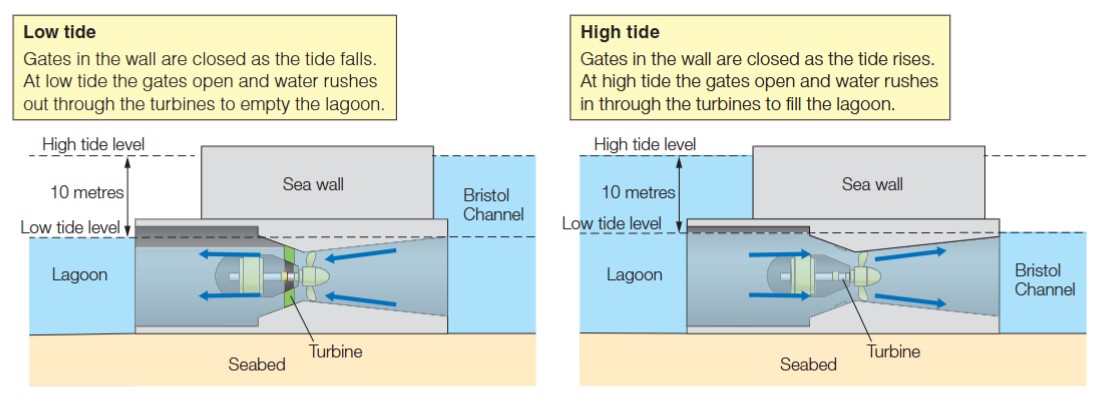
When the tide is low, gates built into the sea wall remain closed. As the tide begins to fall outside the lagoon, the gates open. Water trapped inside the lagoon at the higher level rushes out through turbines embedded in the sea wall. This outward flow of water spins the turbines, generating electricity. The turbines are positioned on the seabed, protected within the sea wall structure.
Note
The turbines are designed to operate efficiently in both directions, allowing electricity generation during both the incoming and outgoing tides. This bidirectional capability is a key feature that maximizes energy output from each tidal cycle.
High tide operation
When the tide rises, the process reverses. As sea levels increase outside the lagoon, the gates in the sea wall close once more. When the tide reaches its peak (approximately 10 metres higher than low tide in the Bristol Channel), the gates open again. Water rushes into the lagoon through the turbines, spinning them in the opposite direction. This inward flow also generates electricity.
This twice-daily cycle means tidal power can generate electricity multiple times each day, making it a reliable and predictable renewable energy source.
Advantages of tidal power
Predictability
Tidal energy is highly predictable compared to other renewable sources like wind or solar power. High and low tides occur twice every day following regular patterns determined by the moon's gravitational pull. This predictability allows energy companies to plan electricity generation with certainty, making it easier to integrate into the national grid.
Note
Unlike wind and solar power, which depend on unpredictable weather conditions, tidal patterns can be calculated accurately years in advance. This makes tidal power one of the most reliable renewable energy sources available, allowing for precise planning and grid management.
Extensive coastline
Britain's long and varied coastline provides numerous potential sites for tidal power development. The UK's island geography means there are many locations with suitable tidal ranges and coastal conditions for lagoon construction. This geographical advantage gives the UK significant potential to expand tidal energy generation in the future.
Minimal environmental impact
The construction of a tidal lagoon has minimal negative effects on natural ecosystems compared to some other forms of energy generation. Unlike fossil fuel power stations that produce air pollution, or large dams that can flood entire valleys, tidal lagoons work with natural tidal movements. The enclosed nature of lagoons means marine ecosystems can adapt within and around the structures.
Disadvantages of tidal power
High initial costs
Tidal power projects are expensive to construct initially. Building large sea walls, installing turbines, and creating lagoon structures requires substantial upfront investment. Although operational costs may be lower over time, the initial capital expenditure presents a significant barrier. The government noted that costs would decrease as more lagoons were built and construction techniques improved, but the first projects carry the highest financial risk.
Important
The cost challenge: Initial construction costs represent the single biggest obstacle to tidal power development. While operational costs are relatively low once built, securing funding for the first projects is extremely difficult. This creates a "chicken and egg" situation where costs won't decrease until multiple projects are built, but projects can't be built without accepting the high initial costs.
Requirement for government funding
Tidal power projects typically need government financial support to become viable. Unlike established energy sources that can attract private investment more easily, new renewable technologies often require public funding or subsidies. This need for government money means tidal projects must compete with other public spending priorities, including healthcare, education, and infrastructure.
Impact on local businesses
Constructing and operating tidal lagoons could negatively affect local businesses and industries. Tourism might suffer during the lengthy construction period due to noise, disruption, and changes to coastal landscapes. Fishing industries could face restrictions as lagoons alter natural fish migration patterns and limit access to traditional fishing grounds. These economic concerns must be carefully balanced against the benefits of renewable energy generation.
Note
Local economic impacts are complex and multifaceted. While construction creates temporary jobs and operational phases provide long-term employment, traditional industries like fishing and tourism may face significant challenges. Careful planning and community consultation are essential to minimize negative impacts and maximize local benefits.
Exam guidance
When answering questions about tidal power, remember to:
- Describe the process clearly, using the correct sequence (gates close/open, water flows in/out, turbines spin)
- Explain advantages and disadvantages with specific examples or reasons (e.g., don't just say "expensive" – explain it's the initial construction costs)
- Assess or evaluate by considering both sides of the argument and reaching a balanced conclusion
- Use the Swansea Bay case study to support your answers with specific facts (150,000 homes, rejected in 2018)
- Link to the broader context of UK energy futures and the need for renewable alternatives
Important
Common exam mistakes to avoid:
- Simply listing advantages and disadvantages without explanation or examples
- Forgetting to mention the twice-daily tidal cycle in process descriptions
- Not linking answers to the specific case study (Swansea Bay)
- Failing to provide balanced evaluations that consider both benefits and drawbacks
Summary
Key Points to Remember:
- Tidal power harnesses the energy from the twice-daily rise and fall of sea levels
- The Bristol Channel has the largest tidal range in the UK, making it ideal for tidal energy generation
- Swansea Bay Tidal Lagoon was the first of four proposed lagoons, capable of powering 150,000 homes, but was rejected by the government in 2018 due to high costs
- Advantages include predictability (tides occur twice daily), the UK's long coastline providing many potential sites, and minimal impact on natural ecosystems
- Disadvantages include high initial construction costs, requirement for government funding, and potential negative impacts on tourism and fishing industries
- Tidal power works by allowing water to flow through turbines during both incoming and outgoing tides, generating electricity twice per tidal cycle