Shale Gas A Non Renewable Option (OCR GCSE Geography B (Geography for Enquiring Minds)): Revision Notes
📚Revision Notes
Shale gas a non renewable option
The UK's energy situation
For approximately 50 years, the United Kingdom has depended on natural gas extracted from the North Sea, primarily for heating homes. However, these North Sea gas reserves are now becoming depleted, which means the UK must import increasing amounts of gas to meet its energy needs. This situation has prompted the government to explore alternative domestic sources of natural gas.
Note
The depletion of North Sea gas represents a significant shift in UK energy policy. After half a century of energy independence in natural gas, the UK now faces the challenge of securing reliable energy supplies for the future.
What is shale gas?
Shale gas is a type of natural gas found trapped within shale rock formations. Shale is a sedimentary rock that lies beneath large areas of the UK. This gas resource has gained attention because geological surveys estimate there is sufficient shale gas beneath the UK to supply the country's needs for approximately the next ten years. This potential domestic supply could reduce the UK's reliance on imported gas.
Note
Key Definition: Shale gas is natural gas that remains trapped in impermeable shale rock formations, requiring special extraction techniques to release it. Unlike conventional gas reserves that can flow naturally, shale gas needs the rock to be fractured to allow the gas to escape.
How is shale gas extracted?
The extraction of shale gas requires a process called fracking, which is short for hydraulic fracturing. This technique involves several distinct stages that allow gas trapped deep underground to reach the surface.
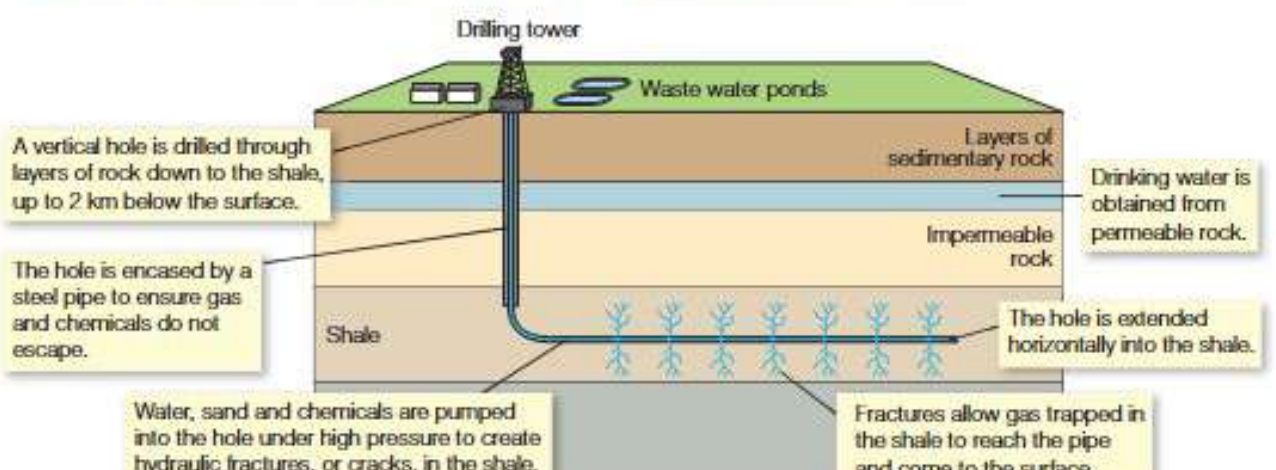
The fracking process works as follows:
Initial drilling: A vertical borehole is drilled through multiple layers of rock, extending down to depths of approximately 2 kilometres below the surface. This hole passes through different rock layers including sedimentary rock and impermeable rock before reaching the shale layer.
Horizontal extension: Once the vertical shaft reaches the shale layer, the drilling continues horizontally into the shale formation. This horizontal section can extend for significant distances through the shale rock.
Protective casing: The borehole is lined with a steel pipe to prevent gas and chemicals from escaping into surrounding rock layers and potentially contaminating groundwater sources, including drinking water obtained from permeable rock layers.
Fracturing the rock: High-pressure mixtures of water, sand, and chemicals are pumped into the horizontal section of the well. This intense pressure creates hydraulic fractures (cracks) in the shale rock, releasing the trapped gas.
Gas extraction: The fractures allow the shale gas to flow out of the rock, travel through the pipe system, and reach the surface where it can be collected. At the surface, waste water ponds store the used water and chemical mixture.
Example
Worked Example: The Fracking Process Step-by-Step
- Drill vertically downward - Bore down through rock layers to approximately 2km depth
- Turn horizontal - Once shale layer is reached, drill horizontally into the formation
- Install protective casing - Line the borehole with steel pipe to prevent leaks
- Pump high-pressure fluid - Force water, sand, and chemicals into the horizontal section
- Create fractures - The pressure cracks the shale rock, releasing trapped gas
- Extract and collect - Gas flows up through the pipe system to surface collection points
Important
Exam tip: When describing the fracking process, use a clear sequence: drilling → extending horizontally → pumping high-pressure fluid → creating fractures → extracting gas. Draw a simple diagram if asked to explain the process.
Why is fracking controversial?
Fracking has become one of the most debated energy extraction methods in the UK, generating significant public opposition and concern. The controversy stems from several environmental, social, and safety issues.
Environmental concerns
Water contamination: Evidence from the United States has shown that fracking can lead to drinking water supplies becoming contaminated with chemicals used in the fracking process. This poses serious health risks to communities living near fracking sites.
Seismic activity: Fracking operations have been linked to earth tremors (minor earthquakes) in areas where the technique is used. These tremors, although typically small, have caused alarm among residents and scientists.
Climate change implications: Some environmental groups argue that leaving shale gas in the ground, rather than extracting and burning it, would help reduce greenhouse gas emissions and combat climate change more effectively.
Important
Critical Environmental Risks:
The main environmental concerns about fracking include:
- Water contamination - Chemicals from fracking can pollute drinking water supplies
- Induced seismic activity - The process can trigger earth tremors and minor earthquakes
- Climate impact - Extracting and burning more fossil fuels contributes to greenhouse gas emissions
- Waste water management - Large volumes of contaminated water must be safely stored and disposed of
Social and political issues
Proximity to population centres: The UK is a relatively small and densely populated country, which means fracking sites would inevitably be located close to where people live. This raises concerns about noise, traffic, visual impact, and potential health risks to nearby communities.
Government moratorium: The environmental concerns and public opposition led to earth tremors, which resulted in a temporary government ban on fracking in the UK. However, the discovery of additional shale gas deposits around the country has created pressure on the government to reconsider and potentially allow fracking to resume.
Limited operations: To date, only one site in the UK has been fracked, reflecting the cautious approach taken due to the controversies surrounding the technique.
Case study: Anti-fracking protests in the UK
[IMAGE
]Public opposition to fracking has manifested in organized protests across the UK. These demonstrations reflect widespread concern about the environmental and social impacts of hydraulic fracturing. Protesters have raised several key objections to fracking, including worries about water contamination, the risk of earth tremors, and the technique's contribution to climate change through fossil fuel extraction. The strength of public feeling has been significant enough to influence government policy, contributing to the temporary ban on fracking operations.
Note
The Power of Public Opposition:
The anti-fracking movement in the UK has been notably effective in influencing policy. The protests highlight the challenge governments face when trying to balance energy security needs against environmental concerns and public opinion. This case demonstrates how grassroots activism can lead to concrete policy changes, including the moratorium on fracking operations.
Important
Exam tip: When evaluating whether the UK should use shale gas, consider both sides: energy security benefits versus environmental and social costs. Use specific examples like water contamination in the USA or earth tremors in the UK to support your arguments.
Remember!
Summary
Key Points to Remember:
-
North Sea gas is becoming depleted, forcing the UK to import more gas and consider alternative domestic sources like shale gas.
-
Shale gas is found in sedimentary rock beneath large areas of the UK, with enough reserves estimated to supply the country for approximately ten years.
-
Fracking (hydraulic fracturing) extracts shale gas by drilling vertically down to 2km, extending horizontally into shale, then pumping high-pressure water, sand, and chemicals to fracture the rock and release trapped gas.
-
Fracking is highly controversial due to environmental concerns including water contamination, earth tremors, and climate change impacts, as well as social concerns about sites being close to populated areas in the densely-populated UK.
-
Public protests and environmental concerns led to a temporary UK government ban on fracking, though pressure exists to resume operations due to newly discovered shale gas deposits.