London’s Ecological Footprint (OCR GCSE Geography B (Geography for Enquiring Minds)): Revision Notes
📚Revision Notes
London's Ecological Footprint
Cities as systems
More than half of the world's population now lives in cities. These urban areas have a massive environmental impact, consuming approximately 75% of global energy supplies and producing around 80% of all greenhouse gas emissions. To address climate change and environmental challenges, cities need to significantly reduce their environmental impact and become more sustainable.
Cities can be understood as systems – complex networks where different parts work together. London, like most major cities, operates as a linear system. This means it has clear inputs (resources that flow into the city) and outputs (waste products that flow out). For cities to become truly sustainable, they need to transition towards circular systems, where resources are recycled and reused, creating fewer inputs and outputs overall.
Note
The transition from linear to circular systems is crucial for urban sustainability. While linear systems follow a "take-make-dispose" pattern, circular systems aim to keep resources in use for as long as possible through recycling, reuse, and regeneration. This fundamental shift is essential for reducing cities' environmental impact.
London as a linear system
London functions as a linear system, constantly bringing in resources and producing waste. Understanding these flows helps us see why the city's environmental impact is so large.
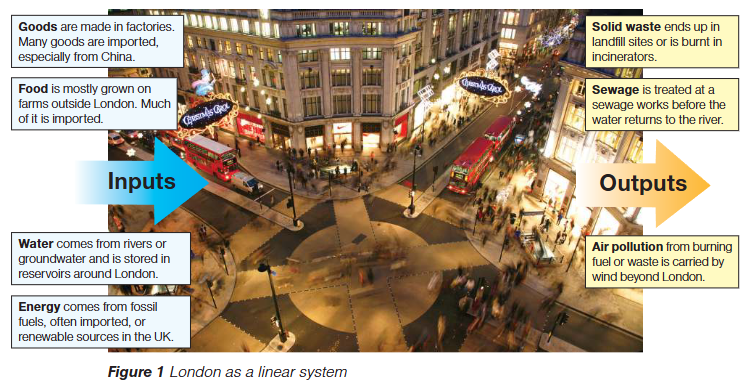
Inputs to London
London requires four main types of inputs to function:
Goods are manufactured in factories, with many items imported from overseas. For example, a significant proportion of consumer products come from countries like China.
Food is mainly produced on farms located outside London. Very little food is grown within the city itself, so most of it must be imported from rural areas across the UK and internationally.
Water is extracted from rivers and underground water sources (groundwater). This water is stored in reservoirs around London before being treated and distributed to homes and businesses.
Energy comes from various sources including fossil fuels (often imported), as well as renewable energy sources generated within the UK. This energy powers everything from transport to heating and lighting.
Outputs from London
The city produces three main categories of outputs:
Solid waste includes all the rubbish generated by households and businesses. This waste ends up in landfill sites or is burned in incinerators. Managing this waste requires significant land area and creates environmental problems.
Sewage is the wastewater from toilets, sinks, and industrial processes. Before it can be safely returned to rivers, sewage must be treated at sewage works to remove harmful substances and pollutants.
Air pollution results from burning fuel or disposing of waste. This pollution doesn't stay in London – it is carried by wind beyond the city boundaries, affecting air quality across a much wider region.
Understanding ecological footprints
To measure the true environmental impact of a city, geographers use the concept of an ecological footprint.
Important
Ecological Footprint Definition
An ecological footprint represents the total area of land or sea required to supply all of a city's resources and absorb all of its waste, anywhere in the world. The key word is "anywhere" – London's ecological footprint includes farmland in other countries, forests that absorb its carbon emissions, and oceans that process its waste.
Ecological footprints are measured in global hectares (gha) per person. A global hectare represents one hectare of biologically productive space with average productivity.
This standardized unit allows us to compare the environmental impact of different cities and countries fairly.
London's ecological footprint
London's ecological footprint is 5.8 global hectares per person. This might not sound like much until you consider what it means in practice. When you multiply this figure by London's entire population, the total area required is actually larger than the entire land area of the United Kingdom.
Important
A Critical Sustainability Problem
Globally, there is only 1.9 gha of productive land available for each person on the planet. London's residents are using more than three times their fair share of the Earth's resources. This level of consumption cannot be maintained indefinitely – it is fundamentally unsustainable.
For London (and cities like it) to become sustainable, dramatic changes are needed. The city must reduce its ecological footprint to much closer to the global average of 1.9 gha per person. This requires:
- Reducing energy consumption through improved efficiency and renewable sources
- Minimizing waste production through recycling and circular economy principles
- Sourcing more resources locally to reduce transport impacts
- Moving from a linear system towards a circular system where resources are reused
The challenge is significant, but addressing it is essential if London is to contribute to global sustainability efforts rather than continuing to exceed the planet's capacity to support its current lifestyle.
Summary
Key Points to Remember:
-
Cities operate as systems with inputs (resources) and outputs (waste). Most cities function as linear systems, but need to become circular systems to be sustainable.
-
London's main inputs are goods, food, water, and energy. Its main outputs are solid waste, sewage, and air pollution.
-
An ecological footprint measures the total land or sea area needed to supply a city's resources and absorb its waste. It is measured in global hectares (gha) per person.
-
London's ecological footprint is 5.8 gha per person – significantly higher than the global sustainable level of 1.9 gha per person.
-
London's total ecological footprint is larger than the entire UK, demonstrating that current consumption patterns are unsustainable and must be reduced.