Sustainable Urban Living (OCR GCSE Geography B (Geography for Enquiring Minds)): Revision Notes
📚Revision Notes
Sustainable urban living
Introduction to East Village
East Village represents a model sustainable community in London, developed from the Athletes Village used during the 2012 Olympic Games. The site demonstrates how Olympic legacy infrastructure can be transformed into long-term sustainable housing that balances environmental protection with community needs.
Note
The development was specifically planned to become a sustainable new community, incorporating multiple environmental strategies from its initial design phase. This approach differs from retrofitting sustainability features onto existing developments.
Development overview
The East Village development spans a 27-hectare site in east London and contains 2,800 new homes. The housing mix was deliberately designed to promote social sustainability, with an equal split between privately rented properties and more affordable rented accommodation. This 50/50 arrangement helps create a mixed-income community rather than concentrating wealth or poverty in one area.
Important
Social Sustainability Through Housing Mix
The equal split between private and affordable housing is crucial for creating a truly sustainable community. This balanced approach:
- Prevents social segregation based on income
- Creates diverse, resilient communities
- Ensures long-term social cohesion
- Demonstrates that sustainability encompasses more than just environmental factors
The site's location provides both local amenities and strong transport links to central London, making it a practical residential option while maintaining sustainable living principles.
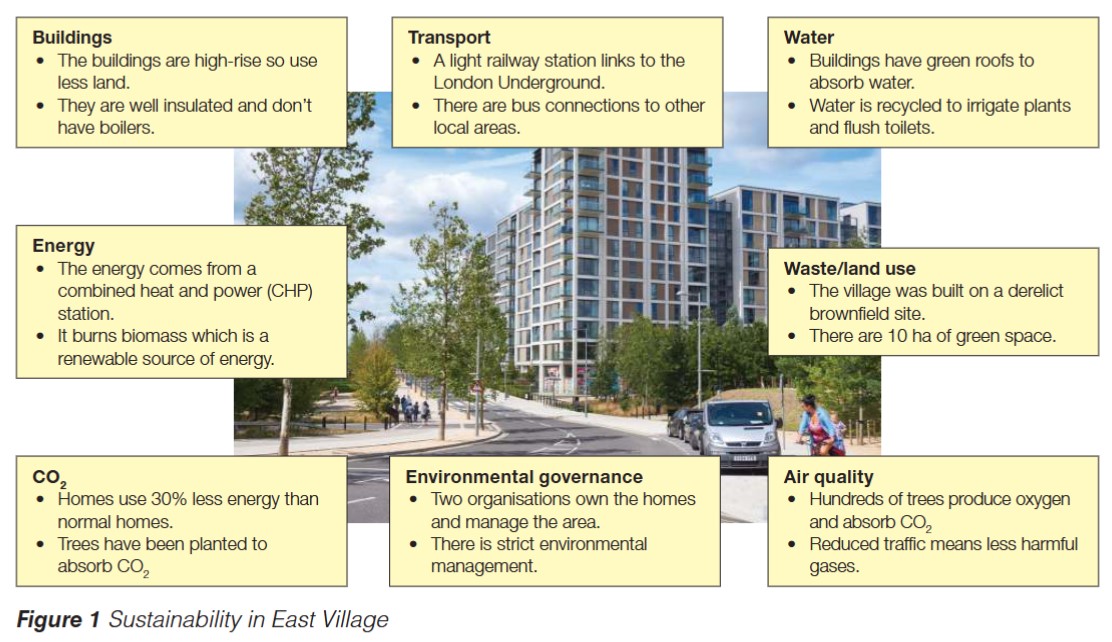
Buildings and design
The architectural approach at East Village prioritizes efficient land use through high-rise construction. Building upwards rather than outwards means the development occupies a smaller ground footprint, preserving more space for green areas and community facilities.
Each building incorporates enhanced insulation to reduce heat loss, significantly lowering energy demands for heating. Notably, individual homes do not contain traditional boilers. Instead, heating is provided centrally, which proves more energy-efficient than separate heating systems in each dwelling.
Note
Green Roofs: Multi-functional Environmental Features
Green roofs feature prominently across the development. These vegetated roof surfaces serve multiple environmental functions:
- Absorb rainfall to reduce flooding risk
- Provide insulation to improve building efficiency
- Support urban biodiversity
- Improve aesthetics and wellbeing
Their specific water management benefits are explored in more detail in the water management section below.
Energy provision
All energy for East Village comes from an on-site Combined Heat and Power (CHP) station. This facility generates both electricity and useful heat from the same energy source, making it far more efficient than conventional power generation where waste heat is typically lost.
The CHP station burns biomass as its primary fuel. Biomass represents a renewable energy source because organic materials can be regrown, unlike fossil fuels which take millions of years to form. By using renewable energy, the development reduces its dependence on finite resources and lowers carbon emissions compared to fossil fuel alternatives.
Important
Why Biomass is Considered Renewable
Biomass qualifies as renewable because:
- Organic materials can be regrown within human timescales
- The carbon released during burning was recently absorbed from the atmosphere by growing plants
- This creates a closed carbon cycle rather than adding ancient carbon to the atmosphere
- Contrasts with fossil fuels which take millions of years to form
This centralized energy approach explains why individual homes lack boilers – the CHP station provides heating through a district heating network that distributes hot water to all properties.
Transport connections
Sustainable transport access forms a crucial element of the development's environmental strategy. East Village benefits from a light railway station that connects directly to the London Underground network. This rapid transit link enables residents to commute across London without requiring private vehicles.
Additionally, multiple bus routes serve the local area, providing connections to nearby districts and facilities not directly accessible via rail. This combination of public transport options reduces the community's reliance on cars, thereby lowering traffic-related air pollution and carbon emissions.
Note
The development's design prioritizes public transport accessibility as a key sustainability strategy. By making car-free living practical and convenient, East Village encourages residents to adopt more sustainable travel patterns naturally, rather than relying solely on behavior change campaigns.
Water management systems
Water sustainability at East Village operates through several interconnected features. The green roofs mentioned earlier play a vital role by absorbing rainfall rather than allowing it to run off immediately into drains. This absorption reduces the risk of local flooding during heavy rainfall and decreases the burden on London's drainage infrastructure.
Example
Water Recycling System in Action
The development includes water recycling systems that demonstrate practical resource conservation:
Step 1: Collection Greywater (from showers, washing machines, and sinks) is collected from all properties
Step 2: Treatment The collected greywater undergoes treatment to remove contaminants and make it safe for reuse
Step 3: Redistribution Treated water is used for:
- Irrigating the development's plants and green spaces
- Supplying toilet cisterns throughout the community
Result: Significant reduction in demand for fresh drinking water from the public supply
By reusing water for these purposes, the community reduces its demand for fresh drinking water from the public supply. These measures help conserve water resources and reduce the environmental impact associated with water treatment and distribution.
Waste and land use
East Village was constructed on a derelict brownfield site. Brownfield development means building on previously developed land rather than greenfield sites (undeveloped countryside). This approach protects rural areas from urban sprawl and makes productive use of abandoned or underutilized urban land.
Important
Brownfield vs Greenfield Development
Building on brownfield land offers multiple sustainability benefits:
- Protects countryside: Preserves agricultural land and natural habitats from urban sprawl
- Regenerates urban areas: Transforms derelict or contaminated land into productive use
- Reduces infrastructure costs: Often existing transport and utility connections can be utilized
- Supports urban density: Encourages efficient land use in already developed areas
This contrasts with greenfield development, which consumes previously undeveloped land and can fragment natural ecosystems.
Despite being a densely built environment, the development incorporates 10 hectares of green space. This substantial allocation includes parks, gardens, and natural areas that provide recreational opportunities, support biodiversity, and improve residents' mental wellbeing.
The integration of significant green space within a high-density urban development demonstrates that sustainability requires balancing built and natural environments.
CO reduction strategies
Homes in East Village consume approximately 30% less energy than typical UK homes. This reduction comes from the combination of improved insulation, efficient building design, and the CHP energy system. Lower energy consumption directly translates to reduced carbon dioxide emissions.
The development also includes extensive tree planting throughout the site. Trees absorb carbon dioxide during photosynthesis and store carbon in their wood, helping offset emissions from the community's activities. Additionally, trees release oxygen, improving local air quality.
Note
Trees as Carbon Storage
Trees contribute to CO reduction through multiple mechanisms:
- Active absorption of CO during photosynthesis
- Long-term carbon storage in wood and root structures
- Oxygen production that improves air quality
- Creation of microclimates that can reduce building cooling needs
A mature tree can absorb approximately 20-30 kg of CO per year, making extensive tree planting a significant carbon mitigation strategy.
These natural and technological approaches work together to minimize the community's carbon footprint.
Environmental governance
Two organizations jointly own and manage East Village, sharing responsibility for maintaining its environmental standards. This governance structure ensures ongoing commitment to sustainability rather than allowing standards to decline after initial development.
Important
Strict environmental management policies regulate activities within the community, from waste disposal to maintenance standards. This framework helps preserve the development's sustainable features over time and prevents environmentally harmful practices from being introduced.
Without strong governance, sustainable features can deteriorate as:
- Maintenance is deferred to cut costs
- Original environmental systems are modified or removed
- New developments within the site ignore sustainability principles
Air quality improvements
Hundreds of trees planted across East Village contribute substantially to air quality. Through photosynthesis, trees absorb carbon dioxide and other pollutants while releasing oxygen. This natural air filtration benefits both residents and the wider London area.
The development's excellent public transport connections reduce traffic volumes compared to car-dependent communities. Lower traffic levels mean reduced emissions of harmful gases including nitrogen oxides and particulate matter, both of which pose serious health risks in urban environments.
Note
Health Benefits of Improved Air Quality
Reducing traffic-related air pollution provides direct health benefits:
- Decreased respiratory illnesses such as asthma
- Lower rates of cardiovascular disease
- Reduced risk of lung cancer
- Improved outcomes for vulnerable groups including children and elderly residents
These health improvements represent an often-overlooked dimension of sustainable urban design.
Measuring sustainability performance
Sustainability must be assessed across multiple dimensions rather than focusing on a single factor. Environmental performance can be evaluated using several key indicators including:
- CO emissions
- Energy consumption
- Building efficiency
- Transport accessibility
- Water management
- Waste and land use
- Air quality
- Environmental governance
Note
Understanding Radar Charts for Sustainability Assessment
A radar chart provides a useful tool for comparing sustainability across these different categories simultaneously. Each axis represents one sustainability indicator, allowing quick visual identification of strengths and weaknesses.
This multi-criteria approach prevents developments from excelling in one area while neglecting others. For example, a development might have excellent renewable energy systems but poor public transport links – the radar chart would immediately reveal this imbalance.
When assessing sustainable communities, evaluating all these dimensions provides a more complete picture than examining individual features in isolation.
Summary
Key Points to Remember:
-
East Village was purpose-built as a sustainable community using the 2012 Olympic Athletes Village, demonstrating how major event infrastructure can create lasting environmental benefits
-
The development uses multiple complementary sustainability strategies: a renewable energy CHP station, water recycling, high-rise buildings to conserve land, extensive green infrastructure, and strong public transport links
-
Building on brownfield land protects greenfield sites from development while regenerating derelict urban areas
-
True sustainability requires integrated approachesacross energy, water, transport, waste, and air quality rather than focusing on single issues
-
Effective environmental governance ensures sustainability features remain operational over time rather than deteriorating after initial development