Global Impacts of Climate Change (OCR GCSE Geography B (Geography for Enquiring Minds)): Revision Notes
📚Revision Notes
Global Impacts of Climate Change
Introduction
Climate change creates far-reaching consequences that affect every part of our planet. These impacts can be grouped into three main categories: social (affecting people and communities), economic (affecting money and livelihoods), and environmental (affecting ecosystems and natural systems). Understanding these interconnected effects helps us recognise why climate change is a critical global challenge that requires urgent action.
Note
The impacts of climate change don't occur in isolation—social, economic, and environmental effects are deeply interconnected. For example, environmental damage to ecosystems often leads to economic losses for communities that depend on those ecosystems, which then creates social challenges as people lose their livelihoods.
Rising sea levels
Sea levels worldwide are increasing due to climate change, threatening coastal communities and low-lying islands. This rise occurs through three main processes:
Thermal expansion happens when ocean water warms and expands in volume, causing sea levels to rise even without adding extra water. As global temperatures increase, vast amounts of ocean water expand, contributing significantly to sea level rise.
Melting glaciers in mountain regions worldwide release stored freshwater into the oceans. As temperatures rise, glaciers that have existed for thousands of years are melting at unprecedented rates, adding substantial volumes of water to the seas.
Melting ice caps in the Arctic and Antarctic regions represent enormous stores of frozen water. As these ice sheets melt, they release massive amounts of water into the ocean system, accelerating the rate of sea level rise.
Important
These three processes work simultaneously, combining to accelerate sea level rise. Understanding all three mechanisms is essential for comprehending the full scale of the threat to coastal regions worldwide.
Case study: The Maldives
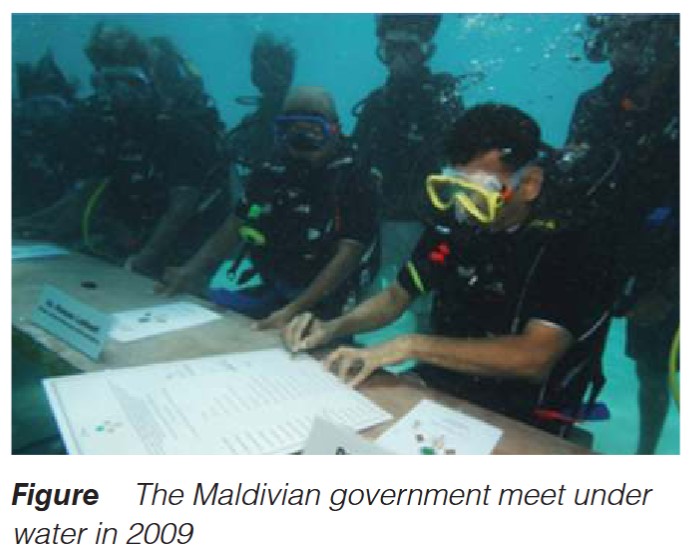
The Maldives, a nation of low-lying islands in the Indian Ocean, provides a striking example of how rising seas threaten vulnerable communities. In 2009, the Maldivian government held a cabinet meeting underwater to highlight the existential threat posed by rising sea levels.
Example
Case Study Analysis: The Maldives
Social impacts in the Maldives are severe and immediate. Communities face displacement as flooding increases, creating climate change refugees—people forced to abandon their homes due to environmental changes. The rising seas bring more acidic water that threatens fish populations, reducing available food supplies for local communities.
Economic impacts include substantial costs for relocating populations and constructing flood defences. The vital tourist industry, which many Maldivians depend upon for employment, faces disruption as beaches erode and infrastructure becomes vulnerable to flooding. This threatens the livelihoods of thousands of people.
Environmental impacts extend beyond human concerns. Flooding destroys delicate coastal ecosystems, and the ocean water becomes more acidic as it absorbs increased carbon dioxide from the atmosphere. This acidification threatens marine life and coral reefs that support biodiversity.
Extreme weather events
Climate change is intensifying weather patterns worldwide, making extreme events both more frequent and more severe. These changes directly result from disruptions to global climate systems caused by rising temperatures.
Tropical storms are becoming increasingly powerful and frequent as ocean temperatures rise. Warmer waters provide more energy to developing storm systems, creating more destructive hurricanes, typhoons and cyclones that devastate coastal regions.
Droughts and heatwaves are occurring more commonly as global temperature patterns shift. Higher average temperatures increase evaporation rates and alter rainfall patterns. Recent extreme events, such as Typhoon Haiyan in 2013 and widespread European heatwaves, demonstrate clear links to climate change.
Flooding and extreme rainfall force communities to relocate, creating climate change refugees. These displaced populations face uncertain futures, often moving to areas ill-equipped to support sudden population increases. The combination of more intense rainfall events and rising sea levels creates compound flooding risks in vulnerable regions.
Note
Climate change refugees represent one of the most significant humanitarian challenges of our time. Unlike traditional refugees fleeing conflict or persecution, climate refugees are displaced by environmental changes that make their homes uninhabitable. This creates complex legal and social challenges as there are currently no international frameworks specifically protecting climate refugees.
Food supply impacts
Climate change fundamentally threatens global food security by altering the conditions needed for successful crop production. Changing temperatures, shifting rainfall patterns, and more frequent extreme weather events are disrupting agricultural systems worldwide.
Global food production faces an overall decline, despite some regional variations. Whilst some areas like Russia may initially benefit from longer growing seasons and warmer conditions, the worldwide trend points toward decreased food availability. This creates concerns about feeding a growing global population.
Important
Sub-Saharan Africa faces particularly severe challenges, with crop yields (the amount of food produced per hectare) projected to fall by 22% by 2050. This reduction threatens food security for millions of people in already vulnerable regions.
Regional variations in impact are significant, demonstrating how climate change affects different parts of the world unequally. Areas already facing food security challenges often experience the most severe impacts, creating a pattern where vulnerable populations face disproportionate harm.
Example
Specific Impact: Vietnam Rice Production
In Vietnam, flooding linked to climate change threatens rice production, potentially affecting 1 million people and causing economic losses of $17 billion. Changing rainfall patterns make traditional farming practices unreliable, while extreme weather events destroy crops before harvest, creating sudden food shortages.
This example demonstrates how climate change creates cascading effects—environmental changes lead to agricultural disruption, which creates both social impacts (food shortages affecting millions) and economic impacts (billions in losses).
Water shortages
Climate change is creating widespread water scarcity that threatens human populations and ecosystems. By 2050, approximately 1 billion people may lack sufficient access to clean water due to climate-related changes in water availability.
Note
Causes of water shortages linked to climate change include:
- Reduced rainfall in some regions, decreasing water supplies
- Heavy rainfall in other areas that runs quickly into oceans rather than replenishing groundwater
- Melting glaciers that initially increase water flow but will eventually disappear, removing vital water sources
- Increased freshwater evaporation due to higher temperatures
Case study: Lake Chad
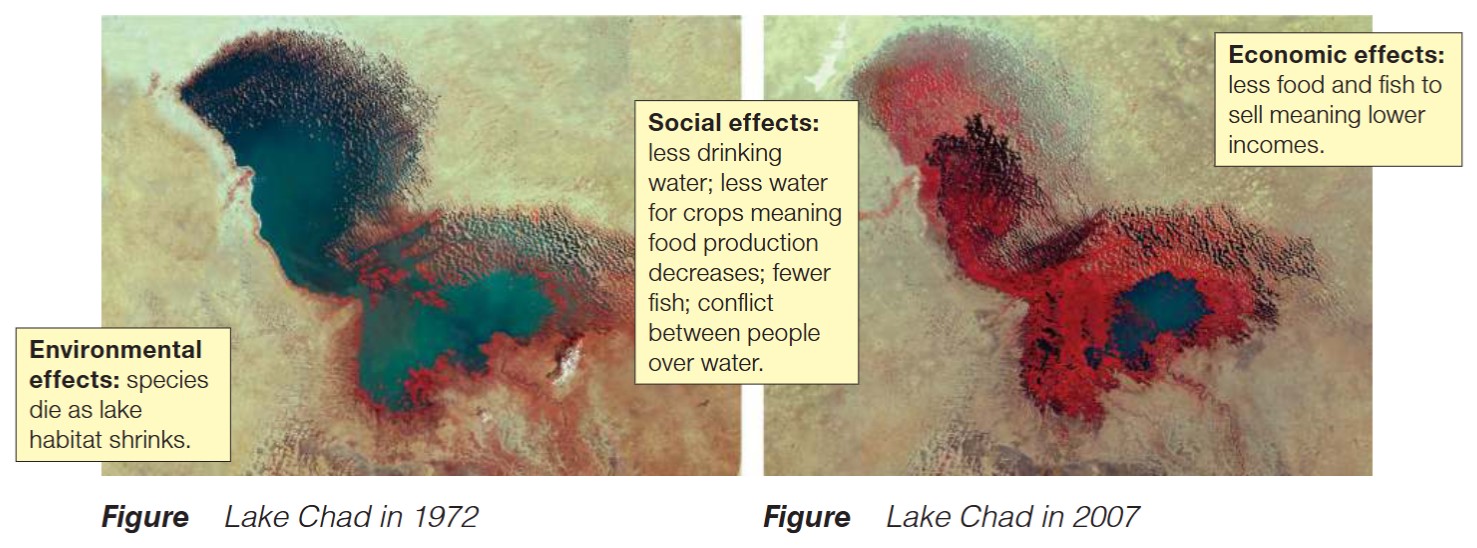
Lake Chad in Africa provides a dramatic example of climate-driven water loss and its cascading impacts. Between 1972 and 2007, this once-substantial lake shrank dramatically, affecting 30 million people who depend on it for water, food and livelihoods.
Example
Case Study Analysis: Lake Chad
Environmental effects include the loss of vital habitat as the lake shrinks. Species that depend on the lake ecosystem are dying as their habitat disappears, reducing biodiversity and disrupting food chains throughout the region.
Social effects are widespread and severe. Communities face critical shortages of drinking water, threatening basic survival. Reduced water availability means less water for irrigating crops, leading to decreased food production. Lower water levels reduce fish populations, removing a vital protein source. These pressures create conflict between communities competing for dwindling water resources.
Economic effects compound social challenges. Reduced fish catches and crop yields mean less food available for sale, directly reducing incomes for farming and fishing families. This economic stress forces people to seek alternative livelihoods or migrate to other regions, disrupting traditional communities.
Plants and animals under threat
Environmental impacts of climate change extend throughout ecosystems, fundamentally altering the conditions that plant and animal species need to survive. Changing temperatures and rainfall patterns force species to adapt, migrate, or face extinction.
Changing conditions mean that many species find themselves in increasingly unsuitable habitats. Temperature shifts, altered rainfall patterns, and changing food availability all challenge species' survival. Some species cannot adapt quickly enough to keep pace with rapid environmental changes.
Example: Polar bears
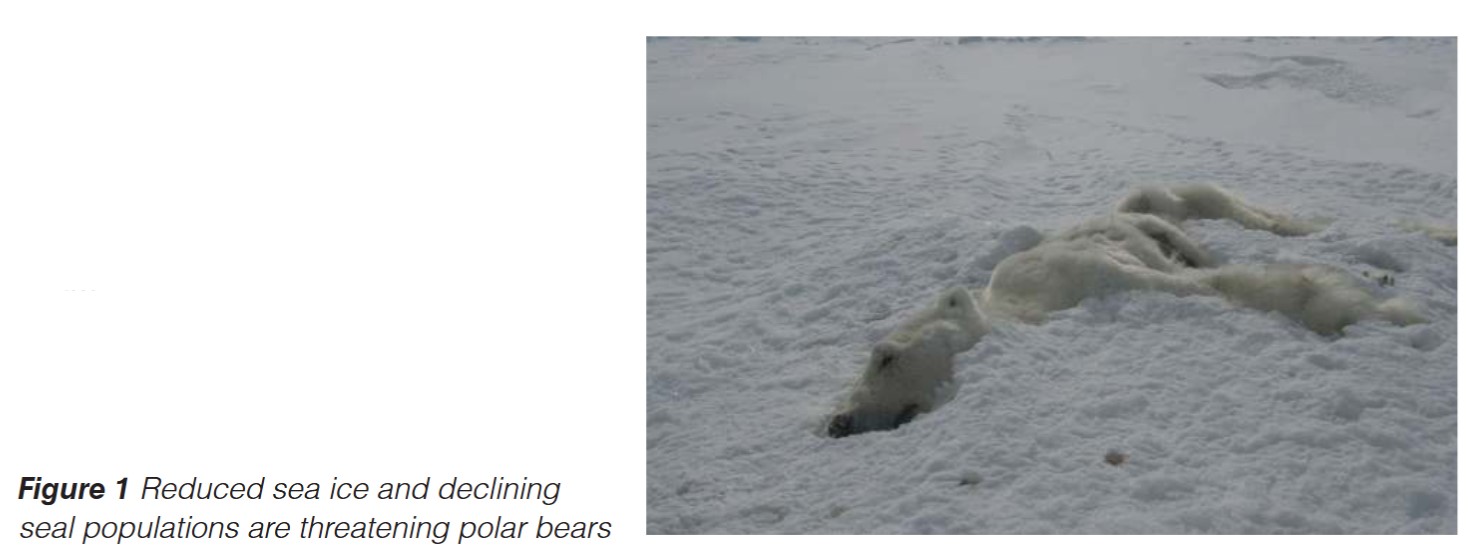
Polar bears exemplify species threatened by climate change. These Arctic predators depend on sea ice for hunting seals, their primary food source.
Example
Species Under Threat: Polar Bears
Melting Arctic ice forces polar bears to swim further to find food, expending vital energy reserves. As ice coverage decreases, hunting becomes more difficult and less successful.
Declining seal populations compound the problem. With less stable ice, seals become less available as prey, reducing the food supply for polar bears.
Reduced reproduction threatens long-term survival. Undernourished female bears produce fewer cubs, and those cubs face lower survival rates. This combination threatens the entire population's viability.
Important
The polar bear example illustrates a critical concept: climate change doesn't just affect individual animals, but disrupts entire food chains and ecosystems. When ice melts, it affects seals (the prey), which affects polar bears (the predator), demonstrating how environmental changes cascade through ecosystems.
Disease, health and food supplies
Climate change creates significant social impacts by increasing the spread of infectious diseases and threatening food production. These health challenges disproportionately affect vulnerable populations in developing regions.
Spread of disease accelerates as temperatures rise. Insects like mosquitoes, which carry diseases such as malaria, dengue fever and Zika virus, survive in regions previously too cold for them. Europe now faces mosquito-borne diseases that were historically confined to tropical regions.
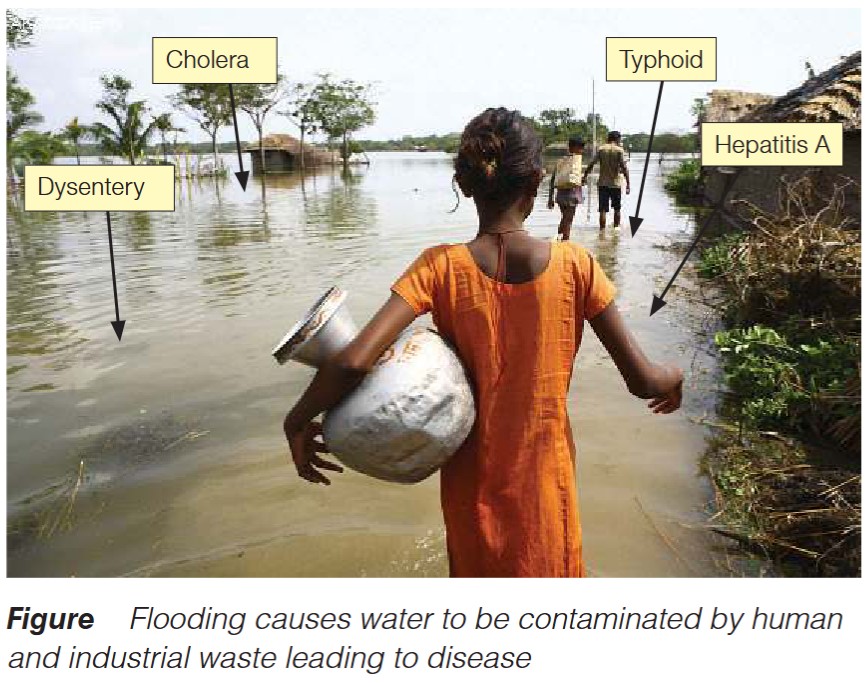
Waterborne diseases spread more readily during flooding events. When floods contaminate water supplies with human and industrial waste, diseases including cholera, typhoid, dysentery and hepatitis A spread rapidly through affected populations.
Note
Economic impacts of disease spread extend to agricultural communities worldwide. In Ethiopia, coffee crops—vital to the national economy—face threats from the coffee berry borer beetle. This pest thrives in warmer temperatures and threatens crops that 700,000 people depend upon for their income. Such examples demonstrate how climate change creates cascading economic effects through entire communities.
Exam guidance
Important
Answering Questions About Climate Change Impacts
Describe questions require you to outline what is happening without explanation. For example: "Describe how rising sea levels affect the Maldives" needs you to state the impacts (flooding, displacement, ecosystem damage) without explaining why these occur.
Explain questions need you to give reasons and show understanding of processes. For example: "Explain why climate change causes water shortages" requires you to link causes (reduced rainfall, increased evaporation, glacier melting) to effects (less available water).
Assess or evaluate questions require you to weigh up different impacts and reach a supported judgement. Consider which impacts are most significant and why, using evidence from case studies to support your points.
Always use specific case study details (like the Maldives or Lake Chad) to support your answers. Include statistics where relevant, and categorise impacts as social, economic or environmental to demonstrate comprehensive understanding.
Remember!
Summary
Key Points to Remember:
-
Climate change causes sea levels to rise through thermal expansion, melting glaciers and melting ice caps, threatening low-lying coastal areas and islands like the Maldives
-
Extreme weather events, including more severe tropical storms, droughts, heatwaves and flooding, are becoming more frequent due to climate change, creating climate change refugees
-
Global food production faces overall decline, with particularly severe impacts in Sub-Saharan Africa (22% reduction in crop yields by 2050), threatening food security for millions
-
Water shortages will affect 1 billion people by 2050 due to reduced rainfall, increased evaporation and glacier melting, with case studies like Lake Chad showing devastating social, economic and environmental effects
-
Climate change threatens species survival by altering habitats and food availability (such as polar bears losing Arctic ice hunting grounds) whilst increasing disease spread through expanding insect ranges and flooding contamination