Distinctive Landscapes (OCR GCSE Geography B (Geography for Enquiring Minds)): Revision Notes
📚Revision Notes
Flood threat to London
Why London faces flood risk
London has a long history of serious flooding events. The city's location on the River Thames, combined with tidal influences from the North Sea, creates significant flood vulnerability. Understanding past floods helps explain why major flood defenses were developed.
Note
Historical Flooding Events
In 1928, London experienced its most recent major flooding disaster. The River Thames burst its banks, and fourteen people lost their lives. This event highlighted the serious threat that river flooding posed to the capital.
An even more dangerous situation occurred in 1953. A powerful storm surge developed in the North Sea, pushing a massive volume of water up the River Thames toward London. Although the capital narrowly escaped catastrophe, over 300 people drowned along the east coast of England.
This near-miss demonstrated that London faced an urgent need for better flood protection, leading directly to the construction of permanent flood defenses.
The Thames Barrier
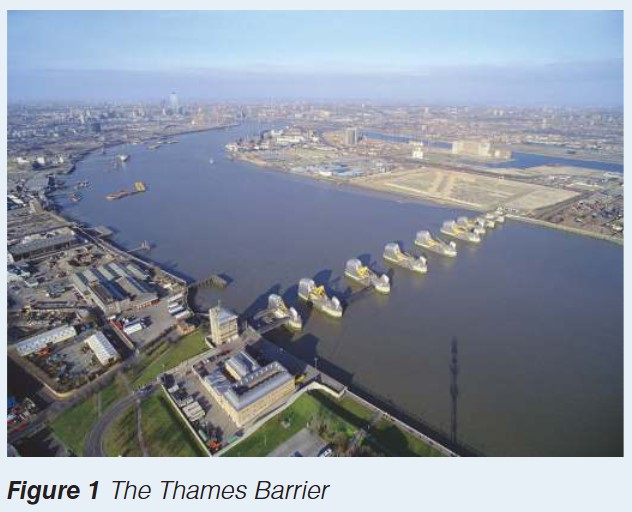
Construction of the Thames Barrier was completed in 1984 specifically to protect London from flooding caused by tidal water. The barrier works by raising large gates that can block the river channel, preventing tidal water from reaching the capital during dangerous conditions.
Important
The Barrier's Critical Role
The Thames Barrier has proven essential for London's flood protection. During the particularly stormy winter of 2013/14, operators had to close the barrier more than 50 times to prevent flooding. This frequent use demonstrates how vital the structure is for protecting the city.
However, sea levels are predicted to rise throughout the 21st century due to climate change. To address this future threat, proposals have been developed for a new, higher barrier that would be better equipped to cope with increased sea levels.
Note
Exam Tip: Describing the Thames Barrier
When describing the Thames Barrier, explain both how it works (gates raise to block tidal water) and why it's needed (protect London from storm surges and tidal flooding). Use specific examples like the 2013/14 winter to show its importance.
Flood risk management at Barking Riverside
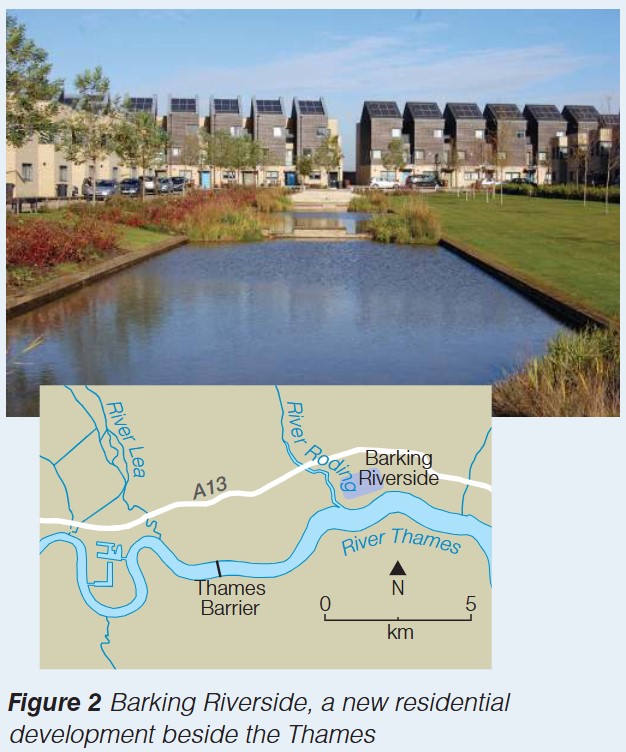
A new residential development is currently being built in east London at Barking Riverside. This site lies downstream of the Thames Barrier, which means it receives no protection from the barrier's flood defenses. Instead, the development uses alternative approaches to manage flood risk naturally.
Natural flood management strategies
The Barking Riverside development incorporates several integrated strategies to reduce flood risk:
Floodplain management: Water is permitted to disperse naturally across the floodplain area on the site. Rather than trying to channel or prevent this natural spreading, the design works with the river's natural processes.
Water features: The development incorporates water bodies as intentional design features. These include retention ponds that can temporarily store excess water during flood events, reducing the peak flow and giving water time to drain away safely.
Vegetation planting: Trees and grass have been planted extensively across the site. This vegetation reduces the speed at which rainwater infiltrates into the ground, allowing more gradual drainage and reducing surface runoff that could cause flooding.
Elevated construction: All homes are constructed on raised land platforms. This elevation protects the buildings from flood water even when the surrounding floodplain becomes inundated.
Example
Worked Example: How Barking Riverside Strategies Work Together
Consider what happens during a heavy rainfall event at Barking Riverside:
- Initial rainfall: Heavy rain falls on the development
- Vegetation effect: Trees and grass slow down water infiltration, preventing rapid runoff
- Floodplain spreading: Excess water spreads naturally across the designated floodplain areas
- Retention ponds: Water features temporarily store peak flows, reducing immediate flood risk
- Building protection: Even if flooding occurs, homes remain safe on their elevated platforms
This integrated approach means the development works with natural processes rather than fighting against them.
Note
Exam Tip: Comparing Flood Management Approaches
When answering questions about flood management, distinguish between hard engineering (like the Thames Barrier) and soft engineering/natural management (like Barking Riverside).
Explain why different approaches suit different locations:
- The barrier protects the whole city using a large-scale engineered structure
- Barking Riverside uses site-specific natural methods because it's beyond the barrier's protection
Understanding this distinction shows you can analyze the appropriateness of different flood management strategies.
Remember!
Summary
Key Points to Remember:
Historical context:
- London experienced major flooding in 1928 (14 deaths) and nearly suffered catastrophic flooding in 1953 when a North Sea storm surge killed 300 people on the east coast
- These events demonstrated the urgent need for permanent flood protection
Thames Barrier:
- Built in 1984 to protect London by raising gates that prevent tidal water from reaching the city
- Closed over 50 times during the 2013/14 winter, showing how frequently London faces flood threats
- Future sea level rise may require a new, higher barrier to be built
Barking Riverside natural flood management:
- Located downstream of the Thames Barrier with no barrier protection
- Uses integrated natural strategies: floodplain spreading, water features, vegetation, and elevated buildings
- Demonstrates sustainable approach to flood risk management
Key Terms:
- Thames Barrier: Flood defense structure that protects London from tidal flooding
- Storm surge: Rise in sea level caused by low pressure and strong winds during storms
- Floodplain: Low-lying land beside a river that naturally floods during high flow
- Natural flood management: Using natural processes and features to reduce flood risk
- SUDS (Sustainable Urban Drainage Systems): Techniques that manage rainwater to reduce flooding and pollution
Critical Processes:
- Tidal flooding occurs when high tides (often made worse by storm surges) push water up rivers toward inland areas
- Natural flood management works by slowing water flow, increasing infiltration, and providing temporary water storage
- Hard engineering (Thames Barrier) protects large areas but requires maintenance; soft engineering (Barking Riverside) works with natural processes and is more sustainable