Geology and Landscape (OCR GCSE Geography B (Geography for Enquiring Minds)): Revision Notes
📚Revision Notes
Geology and Landscape
What is geology?
Geology involves studying the Earth and examining the different types of rocks that form its surface. Understanding geology helps us explain why landscapes look different across the UK and how rock types shape the physical environment.
The UK contains three main categories of rock, each formed through different geological processes.
The three rock types found in the UK
Igneous rock
Igneous rock forms when molten material from deep within the Earth cools and solidifies. As the molten rock cools, it crystallises to create solid rock composed of interlocking mineral crystals. This process gives igneous rocks their characteristic hard, crystalline structure.
Sedimentary rock
Sedimentary rock consists of small fragments of rock, shells, or other organic materials that accumulate in layers over time. These particles are deposited, often on sea beds or lake floors, where they gradually compress and cement together to form solid rock.
Metamorphic rock
Metamorphic rock develops when existing rocks are transformed by intense heat or extreme pressure deep underground. These conditions alter the rock's structure and mineral composition without melting it completely, creating new rock types with different properties.
Note
Distinguishing the Three Rock Types:
Remember that each rock type has a distinct formation process:
- Igneous - formed from cooling molten rock (think "ignite" = fire/heat)
- Sedimentary - formed from deposited layers of particles (think "sediment" = settled material)
- Metamorphic - formed by transformation of existing rock (think "metamorphosis" = change)
Geographic distribution of rocks across the UK
The distribution of rock types varies significantly across the UK, creating distinct regional patterns.
Most igneous and metamorphic rocks are located in Scotland and Wales. These harder, older rocks dominate the northern and western upland areas of Britain. In contrast, sedimentary rocks are predominantly found across England, particularly in the lowland areas.
Note
Age Pattern of UK Rocks:
An important pattern to note is that UK rocks generally become younger as you travel south and east. This means the oldest rocks are typically found in the north and west, while younger formations appear in southern and eastern regions.
Contrasting landscapes: Case studies of granite and chalk
The UK's varied geology creates dramatically different landscapes. Two excellent examples that demonstrate this contrast are the granite mountains of Scotland and the chalk hills of southern England.
The Cuillin Hills - a granite landscape
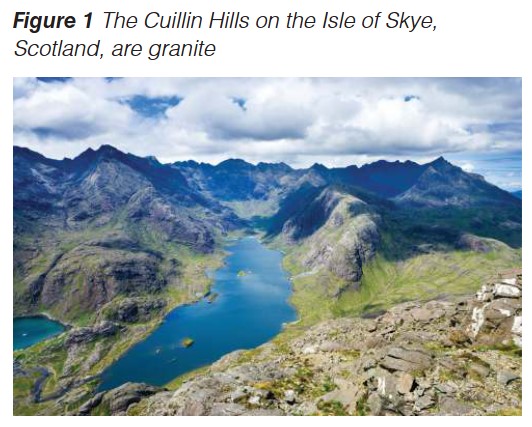
The Cuillin Hills, located on the Isle of Skye in Scotland, showcase a classic granite landscape. This igneous rock formed deep underground when molten material cooled very slowly, allowing large crystals to develop.
The granite creates a dramatic, rugged landscape with:
- Steep, rocky mountains with jagged peaks
- Impermeable rock that prevents water from soaking through
- Thin, waterlogged soils that are often boggy
- Poor agricultural potential due to infertile soil conditions
Note
The hard granite weathers and erodes very slowly, which is why these ancient mountains still stand high despite millions of years of exposure to weather. This resistance to weathering is a key characteristic of igneous rocks.
The South Downs - a chalk landscape
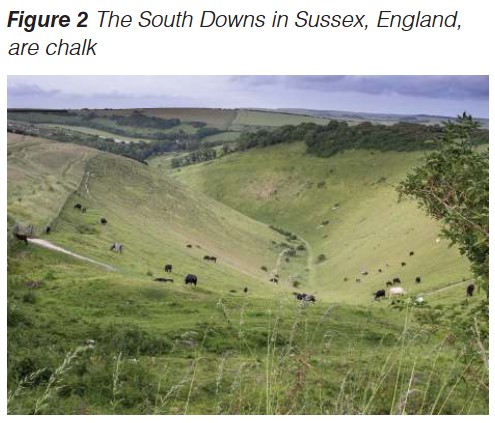
The South Downs in Sussex, England, present a completely different landscape formed from chalk. This sedimentary rock developed from layers of tiny sea creature shells, rich in calcium carbonate, that accumulated on ancient seabeds millions of years ago.
The chalk creates a gentle, rolling landscape with:
- Smooth, rounded hills with gentler slopes
- Permeable rock that allows water to drain through easily
- Well-drained, fertile soils ideal for agriculture
- Extensive grassland and crop cultivation
Unlike granite, chalk is a soft rock that weathers and erodes relatively quickly, shaping the landscape into its characteristic rounded forms.
Detailed comparison of granite and chalk characteristics
The stark differences between granite and chalk landscapes stem from their contrasting geological properties. Understanding these differences is essential for explaining how geology influences landscape formation.
| Feature | Granite (Cuillin Hills) | Chalk (South Downs) |
|---|---|---|
| Formation | Igneous rock formed when molten rock cools slowly below the Earth's surface | Sedimentary rock formed from layers of sea creature shells that sink to the seabed |
| Composition | Large crystals of different coloured minerals interlocked together | Small particles of shells made from calcium carbonate |
| Properties | Hard, impermeable rock that weathers and erodes slowly | Soft, permeable rock that weathers and erodes easily |
| Soils and farming | Forms infertile soil that is often boggy and unsuitable for growing crops | Forms fertile soil that is well-drained and suitable for growing grass and crops |
Understanding the impact of rock properties
Important
Permeability - A Critical Factor:
Permeability is a crucial factor in determining landscape characteristics. Granite's impermeability means water cannot pass through the rock, causing it to collect on the surface and create waterlogged, boggy conditions. This results in poor drainage and limits agricultural use. Conversely, chalk's permeability allows water to drain through the rock efficiently, creating dry surface conditions with well-drained soils that support productive farming.
Weathering and erosion rates also differ significantly between the two rock types. Granite's hardness means it resists breakdown by weather and erosion processes, maintaining steep slopes and dramatic relief over geological time. Chalk's softer composition means it breaks down more easily, resulting in gentler slopes and smoother landscape profiles.
Note
Agricultural Implications:
The agricultural implications directly reflect these geological differences. The Cuillin Hills' infertile, boggy soils support little farming activity, whereas the South Downs' fertile, well-drained soils have supported agriculture for thousands of years, including both livestock grazing and arable farming.
Example
How Rock Properties Create Landscape Outcomes:
Let's trace how permeability affects the complete landscape system:
Granite (Impermeable):
- Water cannot drain through rock
- Water collects on surface → boggy conditions
- Poor drainage → waterlogged soils
- Result: Infertile soils unsuitable for crops
Chalk (Permeable):
- Water drains through rock easily
- Surface stays dry → good drainage
- Efficient drainage → well-drained soils
- Result: Fertile soils ideal for agriculture
This demonstrates how a single rock property creates a cascade of landscape effects.
Important
Exam Guidance:
When describing or explaining landscape features in exam questions:
- Always link the rock type to specific landscape characteristics
- Use correct geological terminology (igneous, sedimentary, permeable, impermeable)
- Make clear connections between rock properties and visible landscape features
- Include specific place examples to support your answers
- Explain processes, not just features (e.g., explain how permeability affects soil quality)
Summary
Key Points to Remember:
-
Geology examines Earth's rocks: The UK contains three main rock types - igneous, sedimentary, and metamorphic - each formed through different processes.
-
Rock distribution patterns: Igneous and metamorphic rocks dominate Scotland and Wales, while sedimentary rocks are more common in England. Rocks generally get younger towards the south and east.
-
Granite creates rugged landscapes: As a hard, impermeable igneous rock, granite forms dramatic mountains with poor soils and limited farming potential, as seen in the Cuillin Hills.
-
Chalk creates gentle landscapes: As a soft, permeable sedimentary rock, chalk forms rolling hills with fertile, well-drained soils ideal for agriculture, as seen in the South Downs.
-
Rock properties shape landscapes: Permeability, hardness, and weathering rates directly determine landscape features, soil quality, and land use possibilities.