Landscapes of the UK (OCR GCSE Geography B (Geography for Enquiring Minds)): Revision Notes
📚Revision Notes
Landscapes of the UK
What is a landscape?
A landscape refers to what we see when we look at a particular area of land. When we observe any landscape, we typically encounter either natural or built features, though most landscapes contain a combination of both types of features.
These different features don't exist in isolation – they interact with each other in various ways. For instance, people might plant trees to create forests, or rivers might flood and affect buildings. This interaction between natural and human elements creates the distinctive character of each landscape.
Important
Very few landscapes are entirely natural or entirely human-made. A mountain might appear completely natural, but people may have planted forests on its slopes. Similarly, a city is clearly built by humans, but it might still have a river flowing through it, which is a natural feature.
Main elements of landscapes
Every landscape, whether in the UK or elsewhere, is made up of five main types of elements:
Note
Understanding these five elements is essential for describing any landscape you encounter in your exam. Make sure you can identify and explain each type.
Physical elements are the solid features of the land itself, such as mountains, valleys, hills and plains. These form the basic shape and structure of the landscape.
Water elements include features like rivers, streams, lakes and ponds. Water can be both still (like a lake) and moving (like a river), and plays a crucial role in shaping landscapes over time.
Living elements encompass all the plants and animals in an area, such as trees, grass, wildflowers and wildlife. These elements can change with the seasons and give landscapes their colour and texture.
Transitory elements are temporary features that change regularly, including weather conditions and seasons. These affect how a landscape looks at different times – for example, snow in winter or sunshine in summer.
Human elements are all the features created by people, including buildings, roads, bridges and various land uses. These show how humans have modified the natural landscape to meet their needs.
Understanding landscape interaction
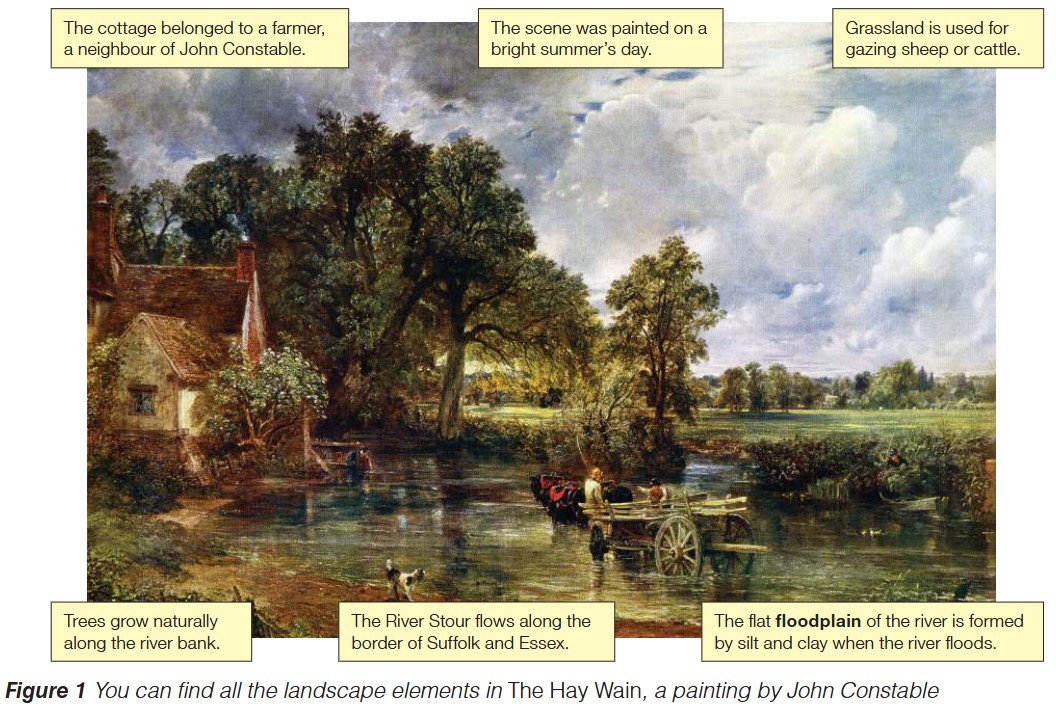
The Hay Wain, a famous painting by John Constable, provides an excellent example of how different landscape elements work together in a typical English rural scene. The painting depicts the River Stour, which flows along the border between Suffolk and Essex.
Example
Analysing Landscape Elements: The Hay Wain
In this landscape, we can identify multiple interacting elements:
- Living element: Trees grow naturally along the riverbank
- Water element: The River Stour flows through the scene
- Physical element: The flat floodplain has formed over time from silt and clay deposits left when the river floods
- Interaction: The grassland visible in the painting was used for grazing livestock, showing interaction between human land use and natural features
- Human element: A brick cottage stands near the river
- Transitory element: The scene was captured on a bright summer's day
Natural and built landscapes
When geographers classify landscapes, they often distinguish between natural and built landscapes, though this distinction isn't always clear-cut.
Natural landscapes are dominated by features formed by natural processes, with minimal human interference. These might include mountain ranges, river valleys or areas of natural forest. However, even landscapes that appear natural often have some human influence.
Built landscapes are areas where human activity has significantly shaped the environment. Cities, towns and farmland are examples of built landscapes. Yet even these contain natural elements, such as rivers or the underlying geology.
Important
Critical Exam Point:
Most UK landscapes contain both natural and human features. Understanding how these features interact is essential for describing and explaining landscape characteristics. Don't make the mistake of describing a landscape as purely natural or purely human-made.
Exam guidance
When answering questions about landscapes, remember to:
Note
Exam Success Tips:
- Describe means identify and give details about the different elements you can see
- Explain means give reasons why features exist or how they interact with each other
- Always refer to specific landscape elements (physical, water, living, transitory, human)
- Consider both natural and human influences on the landscape
- Think about how features interact rather than just listing them
Remember!
Summary
Key Points to Remember:
- A landscape is the view of an area of land, containing both natural and built features
- Five main elements make up all landscapes: physical, water, living, transitory and human
- Very few landscapes are completely natural or completely human-made – most contain both types of features
- Landscape features interact with each other, such as rivers flooding buildings or people planting forests
- Understanding these interactions helps explain what makes each landscape distinctive
Key Terms:
- Landscape – the view of an area of land
- Natural landscape – dominated by features formed by natural processes
- Built landscape – significantly shaped by human activity
- Floodplain – flat land formed by silt and clay deposits when a river floods
- Landscape elements – the five components that make up any landscape (physical, water, living, transitory, human)