Earthquake Disaster in Nepal (OCR GCSE Geography B (Geography for Enquiring Minds)): Revision Notes
📚Revision Notes
Earthquake disaster in Nepal
Introduction
On 25 April 2015, Nepal experienced a devastating earthquake measuring 7.8 on the Richter scale. This natural disaster had catastrophic consequences for the country and its people, particularly affecting the capital city, Kathmandu, and surrounding rural areas. As a low-income developing country (LIDC), Nepal faced significant challenges in responding to and recovering from this tectonic hazard.
Note
Understanding LIDC Status
A Low-Income Developing Country (LIDC) is classified by having limited economic resources, typically measured by Gross National Income (GNI) per capita. These countries often face challenges including poor infrastructure, limited access to healthcare and education, and greater vulnerability to natural disasters due to inadequate building standards and emergency preparedness.
Context: Nepal as an LIDC
Understanding Nepal's development status is crucial to appreciating the scale of impact and response challenges:
| Indicator | Data |
|---|---|
| Total population | 30 million |
| Population of Kathmandu | 1.183 million |
| Rural population | 81.4% |
| GNI per capita | $730 |
| Population below poverty line | 25.2% |
| Average life expectancy | 68 years |
| Literacy rate | 64% |
Nepal's status as an LIDC meant the country had limited resources, poor infrastructure, and weak building regulations—all factors that increased vulnerability to earthquake hazards.
Causes of the 2015 earthquake
Tectonic setting
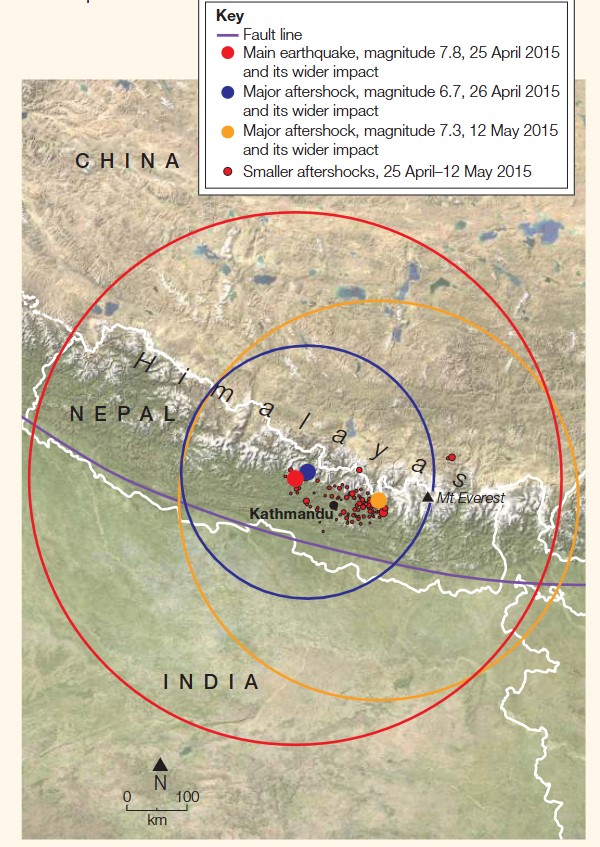
Nepal sits in the Himalayan mountain range, positioned along a collision plate boundary. At this boundary, the Indo-Australian Plate is moving northward and colliding with the Eurasian Plate. This ongoing collision causes immense tectonic pressure to build up along fault lines in the region.
Important
The Unpredictability of Earthquakes
Scientists were aware that stress was accumulating along the plate boundary beneath Nepal, but they could not accurately predict when this pressure would be released through an earthquake. This highlights a critical challenge in earthquake hazard management—while we understand the tectonic processes, predicting the exact timing of earthquakes remains impossible.
The earthquake event
The main earthquake struck without warning on 25 April 2015 with the following characteristics:
- Magnitude: 7.8 on the Richter scale
- Focus depth: 15km below the Earth's surface (shallow focus)
- Epicentre location: Directly beneath Kathmandu, the capital city
- Cause: Sudden release of built-up tectonic pressure along the collision plate boundary
The shallow focus meant that seismic energy reached the surface quickly with little dissipation, maximising the destructive power of the earthquake waves.
Aftershocks and landslides
Aftershocks
The main earthquake triggered numerous aftershocks over the following weeks and months:
- Multiple aftershocks of varying magnitudes occurred between 25 April and 12 May 2015
- A major aftershock measuring 6.7 struck on 26 April 2015, extending the area of impact
- Another significant aftershock of magnitude 7.3 occurred on 12 May 2015, causing additional damage
Important
The Danger of Aftershocks
These continuing tremors threatened weakened buildings and hampered rescue efforts, as people feared further collapses. Buildings already damaged by the main earthquake were at high risk of complete collapse during aftershocks, making it dangerous for rescue workers to enter damaged structures and for residents to return to their homes.
Landslides
The mountainous terrain of Nepal proved particularly vulnerable to earthquake-induced landslides:
- Steep slopes became unstable due to ground shaking
- A total of 547 landslides were directly linked to the earthquake and its aftershocks
- On 15 May, one major landslide completely flattened an entire village
- Landslides buried houses in mountain communities and severed road connections
- Main transport routes were blocked, making it extremely difficult for emergency services to reach affected areas
Consequences of the earthquake
Note
Understanding Primary vs Secondary Consequences
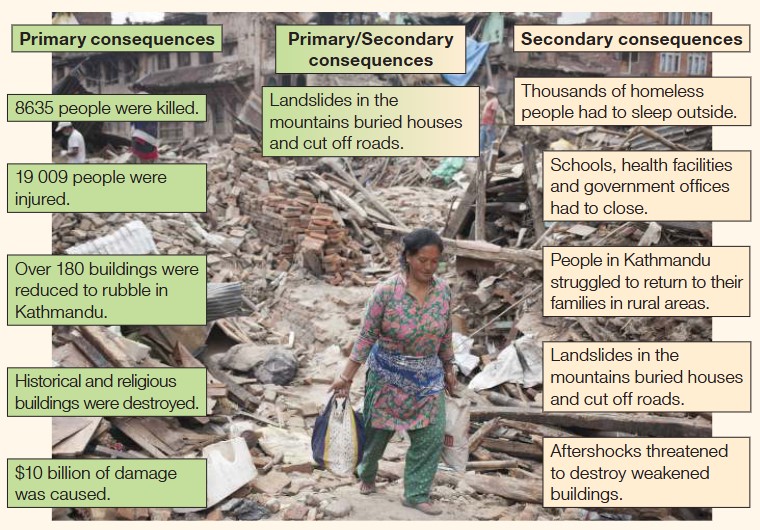
Primary consequences are the immediate impacts that occur while the ground is still shaking—these are the direct results of the earthquake itself.
Secondary consequences are the after-effects that follow the initial disaster—these result from the damage caused by the primary impacts and can continue for weeks, months, or even years.
Primary consequences
Primary consequences are the immediate impacts that occur while the ground is still shaking. These included:
Human impacts:
- 8,635 people were killed
- 19,009 people were injured
Building damage:
- More than 180 buildings were reduced to rubble in Kathmandu alone
- Many poorly constructed buildings collapsed, trapping occupants
- Historical and religious buildings of cultural significance were destroyed
Economic impact:
- An estimated $10 billion of damage was caused
- This represented a massive economic loss for an LIDC
Secondary consequences
Secondary consequences are the after-effects that follow the initial disaster. These included:
Displacement and homelessness:
- Thousands of people became homeless and had to sleep outside
- Families in Kathmandu struggled to return to their homes in rural areas due to damaged infrastructure
Infrastructure disruption:
- Schools, health facilities, and government offices had to close
- This disrupted education, healthcare services, and administrative functions
Continued hazards:
- Landslides in the mountains buried additional houses and cut off roads
- Aftershocks threatened to destroy buildings already weakened by the main earthquake
- Communities remained at risk for weeks after the initial event
Service disruption:
- Lack of basic services such as clean water, electricity, and sanitation
- Breakdown of communication networks
Responses to the earthquake
Emergency (short-term) responses
Immediate aid was crucial to save lives and provide basic necessities:
Non-governmental organisations (NGOs):
- International and local NGOs played a vital role in supporting injured people and homeless families
- They provided essential services where government capacity was limited
International aid from neighbouring countries:
- India rapidly mobilised emergency supplies
- Provided 10 tonnes of blankets for shelter
- Delivered 50 tonnes of water for drinking and sanitation
- Supplied 22 tonnes of food for survivors
British government support:
- Pledged £33 million in aid to Nepal
- £10 million specifically allocated to primary health care and rebuilding hospitals
World Food Programme:
- Provided food assistance to 1.8 million people
- Described as one of their most complex operations due to Nepal's difficult mountainous terrain
Long-term responses
Sustainable recovery required longer-term development approaches:
Example
Worked Example: Cash for Work Programmes
Cash for work programmes demonstrated an innovative approach to disaster recovery:
How it worked:
- Survivors were paid to work on reconstruction projects in their own communities
- Workers received income while rebuilding infrastructure such as roads, schools, and community buildings
- This approach provided multiple benefits simultaneously
Benefits:
- Provided income to families who had lost livelihoods
- Rebuilt infrastructure needed for recovery
- Restored local economies by circulating money within communities
- Gave people agency in their own recovery rather than being passive recipients of aid
International aid coordination:
- Debate arose over how international donations should be managed
- Some called for government management, while aid workers expressed concerns about corruption
- This highlighted challenges in aid delivery to LIDCs
Perspectives on the response
One month after the disaster, different stakeholders reflected on the response efforts:
Local government concerns:
- Nepal's Finance Minister noted that less than 10% of relief money came from overseas sources
- Called for future international donations to be managed by the Nepali government to ensure coordination
International aid workers:
- Emphasised providing materials, services, and goods rather than direct cash to governments
- Expressed concerns about potential corruption in fund management
Child protection organisations:
- Save the Children warned about the danger of children being taken by human traffickers during the chaos
- Highlighted the need for vigilant safeguarding measures
Logistical challenges:
- Organisations like the World Food Programme emphasised the extreme difficulty of operating in Nepal's mountainous terrain
- This geographical challenge complicated the delivery of aid to remote communities
Exam guidance
When answering questions about the Nepal earthquake, remember to:
For 'describe' questions:
- State specific facts, figures, and locations
- Use data such as magnitude (7.8), deaths (8,635), and damage cost ($10 billion)
- Mention both primary and secondary consequences
For 'explain' questions:
- Link causes to Nepal's location on a collision plate boundary
- Connect consequences to Nepal's LIDC status (poor building quality, limited resources)
- Explain why the shallow focus (15km depth) increased damage
For 'evaluate' or 'assess' questions:
- Consider the effectiveness of different responses (NGOs vs government, emergency vs long-term aid)
- Discuss challenges faced due to Nepal's geography and development level
- Compare different stakeholder perspectives on the response
Summary
Key Points to Remember:
-
The 2015 Nepal earthquake (magnitude 7.8) was caused by pressure release at a collision plate boundary between the Indo-Australian and Eurasian plates, with a shallow focus of 15km beneath Kathmandu.
-
Nepal's status as an LIDC meant poor building quality, limited emergency resources, and high vulnerability, contributing to 8,635 deaths, 19,009 injuries, and $10 billion in damage.
-
The earthquake triggered 547 landslides and numerous aftershocks (including a 7.3 magnitude event on 12 May), which caused additional damage and blocked access routes to affected areas.
-
Primary consequences included immediate deaths, injuries, and building collapse, while secondary consequences involved homelessness, service disruption, and ongoing hazards from aftershocks.
-
Response efforts combined emergency aid (NGOs, international supplies from India, World Food Programme support) with long-term measures (cash for work programmes), though challenges included difficult terrain, coordination issues, and concerns about corruption.