Hazards Fieldwork (OCR GCSE Geography B (Geography for Enquiring Minds)): Revision Notes
📚Revision Notes
Hazards fieldwork
Introduction
Fieldwork is an essential component of GCSE Geography that allows you to test geographical theories and concepts in real-world settings. When studying hazards, fieldwork enables you to investigate how people perceive, prepare for, and respond to hazards such as droughts, floods, or other natural events. This process involves developing a clear hypothesis and using systematic methods to gather and analyse evidence.
Note
Fieldwork provides a crucial opportunity to apply theoretical knowledge in practical settings, helping you understand how geographical concepts work in the real world and develop important research skills.
Understanding hypothesis testing
A hypothesis is a statement that can be tested through fieldwork investigation. It represents a prediction or theory about a geographical phenomenon that you believe to be true based on your initial understanding. The purpose of fieldwork is to determine whether your hypothesis is correct, incorrect, or needs modification based on the evidence you collect.
For hazards fieldwork, your hypothesis should relate directly to how hazards affect people, places, or the environment.
Example
Worked Example: A Testable Hypothesis
Consider this hypothesis about drought impacts:
"Experiencing drought in the UK has raised awareness of the need to conserve water and has led to people changing their habits."
This hypothesis is effective because it:
- Makes a clear, testable claim
- Can be investigated through primary data collection
- Relates directly to human responses to hazards
- Contains measurable elements (awareness and behavioural change)
You can use various fieldwork methods to gather evidence that either supports or contradicts your hypothesis.
Designing an effective questionnaire
Questionnaires are one of the most common methods for collecting primary data in hazards fieldwork. They allow you to gather information about people's awareness, attitudes, experiences, and behaviours related to hazards. However, questionnaires must be carefully designed to ensure they collect reliable, unbiased data that genuinely tests your hypothesis.
Planning your questionnaire
Before creating your final questionnaire, you should develop a pilot version (a trial questionnaire) and test it with a small group. This allows you to identify any confusing questions, technical problems, or areas for improvement. Once refined, you should conduct your questionnaire survey with as large a sample size as possible to ensure your results are representative and reliable.
Important
When designing questions, you must consider potential bias – factors that might influence respondents to answer in particular ways or that might make your sample unrepresentative. Carefully worded, neutral questions help reduce bias and produce more trustworthy data.
Types of questions
There are two main types of questions you can include in your questionnaire, each serving different purposes:
Closed questions require short, specific answers, typically one word, a phrase, or a selection from multiple choice options. These questions are quick to answer and straightforward to analyse because responses can be easily counted and converted into graphs or statistics. For example, "Did you know there was a drought in the UK in 2012?" requires only a yes/no response.
Open questions allow respondents to provide longer, more detailed answers where they can explain their thoughts, experiences, or opinions. These questions generate qualitative data that provides deeper insight into people's perspectives but takes more time to analyse. For example, "What changes have you made to your habits to use less water?" invites a detailed, personal response.
Note
Comparing Question Types
Both question types have advantages:
- Closed questions make data collection and analysis quicker and more objective
- Open questions reveal the reasoning, motivations, and complexities behind people's responses
A well-designed questionnaire typically includes both types to gather comprehensive data.
The enquiry process: analysis, conclusion and evaluation
Once you have gathered your data through questionnaires or other fieldwork methods, you must work through several stages to complete your investigation and determine whether your hypothesis is supported.
Analysis
Analysis involves examining your collected data systematically using appropriate techniques. You should create visual representations of your data such as graphs, charts, or tables that make patterns and trends clear. Statistical techniques may also help you identify relationships or significant findings in your data.
Important
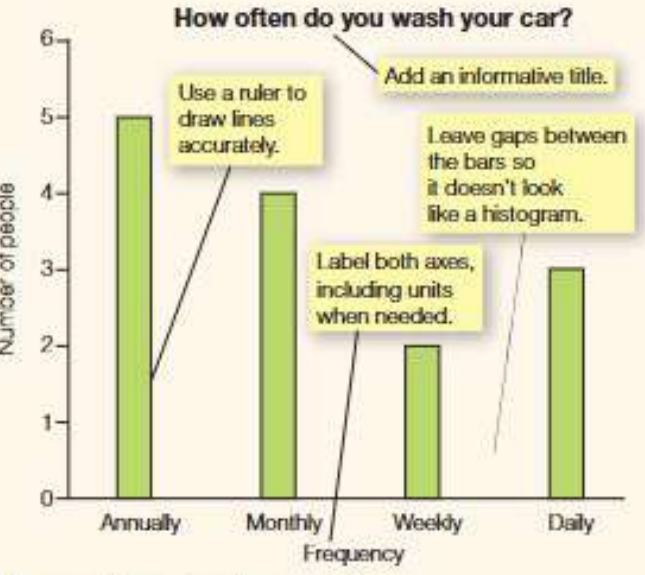
Best Practices for Presenting Data Graphically
When presenting data graphically, follow these essential guidelines:
- Include informative titles that clearly describe what the graph shows
- Accurately label axes with units (e.g., "Number of respondents", "Percentage (%)")
- Draw graphs precisely using a ruler where appropriate
- Ensure scales are consistent and appropriate for your data
[IMAGE
]Draw together your key findings and explain what they reveal about your research question. Look for patterns, anomalies, or unexpected results in your data.
Conclusion
The conclusion stage requires you to make a clear judgement about your hypothesis based on your research findings. You should state whether your hypothesis is correct, incorrect, or requires modification. This judgement must be supported by specific evidence from your fieldwork data.
Note
Explain how your findings support your conclusion, referring to particular statistics, examples, or patterns you identified during analysis. Use specific data from your fieldwork to justify your judgement.
Evaluation
Evaluation involves critical reflection on your research process and methods. Consider both strengths and limitations of your fieldwork approach. Ask yourself: What aspects of the investigation were successful? What problems did you encounter? How reliable and representative is your data? What factors might have introduced bias or error?
Most importantly, identify how your investigation could be improved if repeated. You might suggest:
- Using a larger sample size
- Rephrasing confusing questions
- Collecting data at different times or locations
- Using additional research methods to support your findings
Summary
Key Points to Remember:
-
A hypothesis is a testable statement that guides your fieldwork investigation – it should make a clear prediction about a geographical phenomenon related to hazards.
-
Questionnaires must be carefully designed to avoid bias, and should be piloted before use to identify and fix problems.
-
Closed questions produce quick, quantifiable data (numbers/statistics), while open questions provide detailed qualitative insights (explanations/opinions) – use both types for comprehensive data collection.
-
The enquiry process follows three key stages: Analysis (examining data using graphs and statistics), Conclusion (judging whether your hypothesis is correct based on evidence), and Evaluation (critically assessing your methods and suggesting improvements).
-
Always present your data clearly using properly labelled graphs and tables with informative titles and accurate scales.