Plate Tectonics Shaping Our World (OCR GCSE Geography B (Geography for Enquiring Minds)): Revision Notes
📚Revision Notes
Plate Tectonics Shaping Our World
Introduction
Understanding how plate tectonics shape our world is essential for explaining the distribution of earthquakes, volcanoes, and mountain ranges across the globe. This topic explores the structure of Earth and the powerful processes that occur at plate boundaries.
The structure of Earth
Earth is composed of several distinct layers, each with different properties and characteristics. Understanding this layered structure is fundamental to explaining how tectonic processes work.
Layers of Earth
Earth consists of four main layers:
Crust: This is the outermost layer of Earth and exists in two forms:
- Continental crust forms the land masses we live on
- Oceanic crust lies beneath the ocean floors and is thinner and denser than continental crust
Note
The oceanic crust is not only thinner than continental crust, but it's also younger. Most oceanic crust is less than 200 million years old because it's constantly being created at mid-ocean ridges and destroyed at subduction zones.
Mantle: Located beneath the crust, the mantle is composed of rock that exists close to its melting point. This means the rock can flow very slowly over long periods of time, behaving almost like a thick, viscous liquid. The mantle is the thickest layer of Earth.
Note
The mantle's ability to flow is called plasticity. Although it's solid rock, over geological timescales (millions of years), it can slowly deform and flow like a very thick liquid. This behavior is crucial for plate movement.
Core: Earth's core is divided into two parts:
- Outer core consists of liquid metal (mainly iron and nickel)
- Inner core is solid metal despite extremely high temperatures, due to immense pressure
The lithosphere
The lithosphere refers to the rigid outer layer of Earth, which includes the crust and the uppermost section of the mantle. This rigid layer is what breaks into tectonic plates. The lithosphere sits on top of the more fluid mantle below, allowing the plates to move.
Important
The lithosphere is rigid and brittle, which is why it can break into separate plates. In contrast, the layer below (called the asthenosphere) is partially molten and plastic, allowing it to flow slowly and enabling plate movement.
Tectonic plates and how they move
What are tectonic plates?
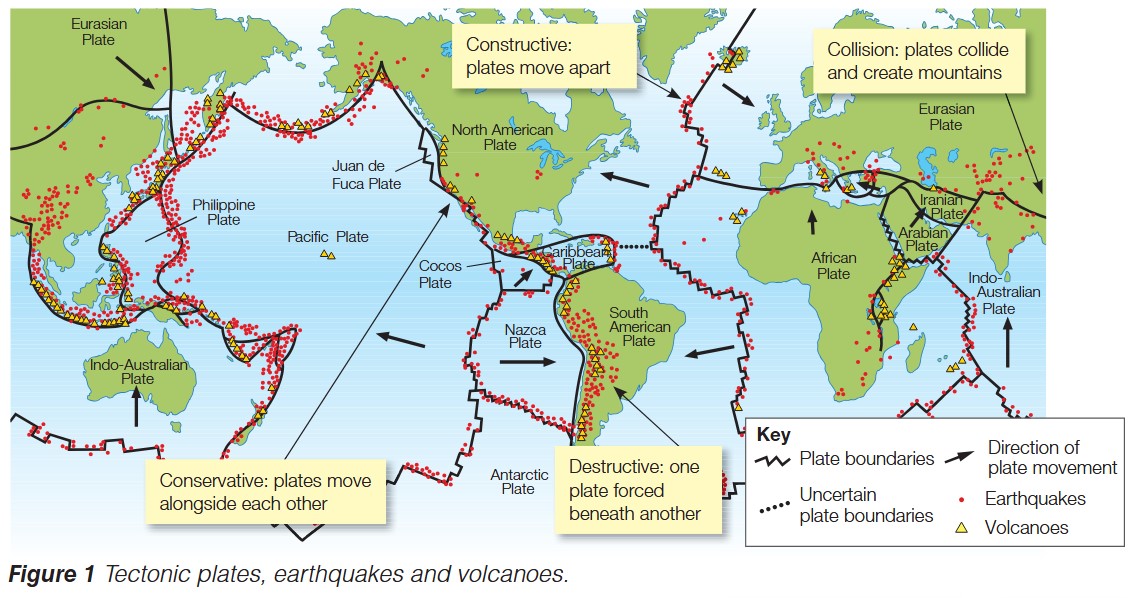
Earth's lithosphere is divided into large sections known as tectonic plates. These plates are constantly shifting gradually in various directions across Earth's surface. Major plates include the Pacific Plate, Eurasian Plate, North American Plate, South American Plate, African Plate, Indo-Australian Plate, and Antarctic Plate, among others.
Note
Tectonic plates move at different speeds, typically ranging from 1 to 10 centimeters per year - about the same rate at which your fingernails grow. Despite these slow speeds, over millions of years, plates can travel thousands of kilometers.
Why do plates move?
Tectonic plates move due to three interconnected processes occurring within Earth:
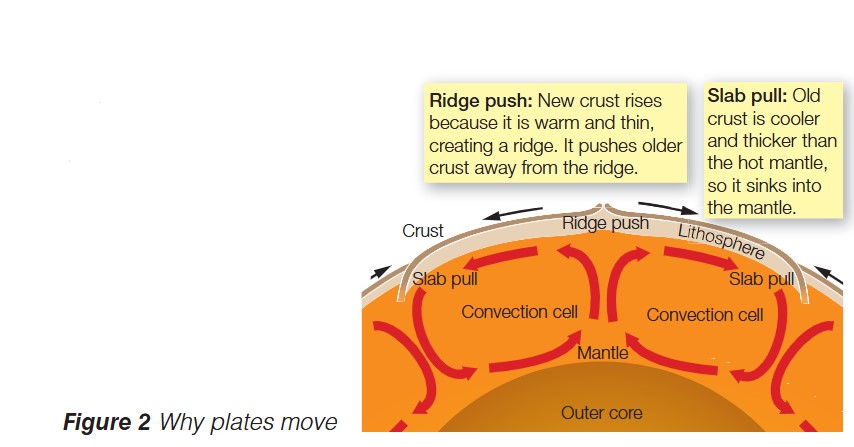
Convection currents: Heat from Earth's core creates circular movements within the mantle. Hot material rises towards the surface, cools, then sinks back down, creating convection cells. These currents drag the overlying plates along with them, causing plate movement.
Ridge push: At mid-ocean ridges, new oceanic crust forms through volcanic activity. Because this newly formed crust is warm, it is less dense and sits higher than older crust, creating an elevated ridge. Gravity causes this new crust to push older crust away from the ridge as it cools and becomes denser.
Slab pull: As oceanic crust moves away from mid-ocean ridges, it gradually cools and becomes denser and thicker. Eventually, this older, cooler crust becomes so dense that it sinks into the mantle at destructive plate boundaries. The weight of this descending plate pulls the rest of the plate behind it, creating a powerful force for plate movement.
Important
Slab pull is considered the most powerful force driving plate movement. The weight of a dense, sinking oceanic plate generates more force than ridge push or convection currents alone. These three processes work together, but slab pull is the dominant mechanism.
Plate boundaries
Plate boundaries are the zones where two tectonic plates meet. The type of boundary depends on how the plates are moving relative to each other. Most earthquakes and volcanoes occur at these boundaries due to the stress and friction created by plate movement.
Types of plate boundaries
Constructive boundaries: Also called divergent boundaries, these occur where plates move apart from each other. As the plates separate, magma rises from the mantle to fill the gap, creating new crust. This process forms mid-ocean ridges and is associated with volcanic activity and shallow earthquakes. An example is the Mid-Atlantic Ridge.
Note
At constructive boundaries, volcanic eruptions are generally less explosive than at destructive boundaries. This is because the magma that rises from the mantle is less viscous (more runny) and contains less trapped gas, allowing it to flow more easily.
Destructive boundaries: Also known as convergent boundaries, these form where plates move towards each other. When an oceanic plate meets a continental plate, the denser oceanic plate is forced beneath the continental plate in a process called subduction. This creates deep ocean trenches, volcanic mountain ranges, and powerful earthquakes. The friction and melting of the descending plate generates magma that rises to form volcanoes.
Important
At destructive boundaries, volcanic eruptions are typically more explosive and dangerous than at constructive boundaries. As the oceanic plate subducts, water is released from ocean sediments, lowering the melting point of the mantle and creating thick, gas-rich magma that can erupt violently.
Conservative boundaries: These occur where plates slide past each other horizontally, moving in opposite directions or at different speeds in the same direction. No crust is created or destroyed at these boundaries, but the friction between the plates can cause powerful earthquakes. The San Andreas Fault in California is a well-known example.
Note
Conservative boundaries are called "conservative" because they conserve the amount of crust - no new crust is created and no old crust is destroyed. However, don't be fooled by the name - these boundaries can still produce devastating earthquakes!
Collision boundaries: These form where two continental plates move towards each other. Because both plates have similar densities, neither can sink into the mantle. Instead, the crust crumples and folds upwards, creating massive fold mountain ranges. The Himalayas were formed by the collision of the Indo-Australian Plate with the Eurasian Plate. These boundaries experience earthquakes but not volcanic activity.
Important
Collision boundaries produce earthquakes but NO volcanoes. This is because neither continental plate subducts into the mantle, so there's no mechanism to generate the magma needed for volcanic activity. Remember this key distinction for exams!
Distribution of tectonic features
The global distribution of earthquakes and volcanoes is closely linked to plate boundaries:
- Most earthquakes occur along plate boundaries where stress builds up due to plate movement
- Volcanic activity is concentrated at constructive and destructive boundaries where magma can reach the surface
- The "Ring of Fire" around the Pacific Ocean contains approximately 75% of the world's active volcanoes and experiences 90% of the world's earthquakes
- Earthquakes and volcanoes are rare in the middle of plates, far from boundaries
Note
The Ring of Fire is a horseshoe-shaped zone around the Pacific Ocean where multiple tectonic plates meet. It contains most of the world's active volcanoes and earthquake zones, making it one of the most geologically active regions on Earth. Countries like Japan, Indonesia, Chile, and the western United States lie within this zone.
Understanding this distribution helps geographers predict where tectonic hazards are most likely to occur.
Exam guidance
Important
Essential Exam Tips:
When answering questions about plate tectonics:
- Describe questions require you to state what you observe, such as the distribution of earthquakes along plate boundaries
- Explain questions need you to give reasons why, such as explaining how convection currents cause plate movement
- Always use accurate geographical terminology like "constructive boundary" rather than vague terms
- Link processes to specific examples where possible
- Use Figure 1 to identify specific plates and boundary types when asked about distribution
Summary
Key Points to Remember:
- Earth has four main layers: crust (continental and oceanic), mantle, outer core (liquid), and inner core (solid)
- The lithosphere consists of the crust and upper mantle, which is broken into tectonic plates
- Plates move due to three processes: convection currents in the mantle, ridge push at mid-ocean ridges, and slab pull at subduction zones
- There are four main types of plate boundary: constructive (plates moving apart), destructive (plates moving together with subduction), conservative (plates sliding past), and collision (continental plates colliding)
- Plate movement at boundaries causes earthquakes and volcanic activity, with most tectonic hazards occurring along plate boundaries rather than in plate interiors
- Collision boundaries produce earthquakes but NO volcanoes
- The Ring of Fire contains 75% of active volcanoes and 90% of earthquakes