Tropical Storms and Extreme Weather (OCR GCSE Geography B (Geography for Enquiring Minds)): Revision Notes
📚Revision Notes
Tropical Storms and Extreme Weather
What are tropical storms?
Tropical storms are powerful rotating weather systems that bring extremely dangerous conditions including strong winds, torrential rainfall, and flooding. These weather systems are also known as hurricanes, cyclones, or typhoons depending on where in the world they occur. Understanding how they form and what hazards they create is essential for protecting vulnerable communities in affected regions.
Note
Regional naming conventions: While the scientific term is "tropical storm," these weather systems have different names in different parts of the world:
- Hurricanes (Atlantic Ocean and Eastern Pacific)
- Cyclones (Indian Ocean and South Pacific)
- Typhoons (Western Pacific)
All three terms refer to the same type of weather phenomenon.
Formation of tropical storms
Conditions required for tropical storm development
Tropical storms can only develop when very specific atmospheric and oceanic conditions are present. These powerful weather systems require:
Important
Critical formation conditions:
Four essential conditions must be met simultaneously for a tropical storm to form. If any one of these conditions is absent, a tropical storm cannot develop.
Sea temperature: The ocean surface must exceed 26.5°C. This warm water provides the energy needed to fuel the storm through evaporation of water vapour.
Ocean depth: The warm water needs to extend to at least 60 metres below the surface. This ensures there is enough heat energy available to sustain the storm as it develops.
Location: These storms form in specific latitude zones between 5° and 15° north and south of the Equator. They cannot form directly at the Equator itself because of the way the Earth's rotation affects air movement.
The Coriolis effect: At these latitudes, the Earth's rotation creates a force that causes the storm to start spinning. This spinning motion is essential for tropical storm development. The Coriolis effect is too weak at the Equator, which is why tropical storms don't form there.
Landfall: Once a tropical storm moves over land, it is cut off from its energy source (the warm ocean water). Without this supply of warm, moist air, the storm rapidly loses strength and begins to dissipate.
How tropical storms form and intensify
Tropical storms develop through a series of connected processes that create a powerful, self-sustaining weather system:
Example
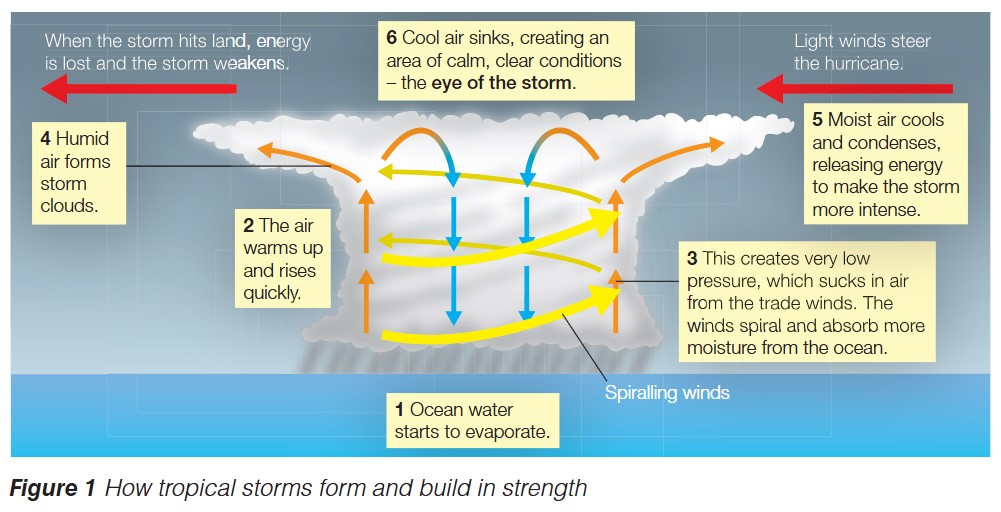
The Six-Step Formation Process:
Step 1 - Ocean evaporation: Warm ocean water evaporates, creating water vapour that rises into the atmosphere. This process transfers huge amounts of heat energy from the ocean into the air above.
Step 2 - Rising air: The warm, humid air rises rapidly because it is less dense than the surrounding cooler air. As air rises, it creates an area of low pressure at the surface.
Step 3 - Low pressure system develops: The very low pressure at the surface acts like a vacuum, sucking in air from surrounding areas. This air is drawn in by the trade winds, which are diverted toward the center of the low pressure area. The Coriolis effect causes this inflowing air to spiral rather than move in straight lines.
Step 4 - Storm cloud formation: As the humid air continues to rise, it cools and forms towering storm clouds (cumulonimbus clouds). These clouds can reach heights of over 15 kilometres.
Step 5 - Energy release through condensation: When the rising water vapour condenses into cloud droplets, it releases enormous amounts of latent heat energy. This released energy warms the surrounding air, causing it to rise even faster. This creates a positive feedback loop that makes the storm more and more intense.
Step 6 - The eye of the storm: Cool air sinks in the very center of the storm, creating an area of calm, clear conditions called the "eye". The eye typically has light winds and no rain. However, surrounding the eye is the "eyewall" where the strongest winds and heaviest rainfall occur.
The storm is steered across the ocean by prevailing winds. Light winds at high altitude guide the hurricane's path, typically moving it westward away from the tropics.
Energy sources for tropical storms
Tropical storms are powered by two main energy sources:
Note
The self-reinforcing energy cycle:
Tropical storms maintain their intensity through a continuous cycle:
- Evaporating ocean water provides warm, moist air as the storm's fuel source
- Condensation releases latent heat energy when water vapour forms clouds and rain
- This energy warms the air, causing it to rise faster and draw in even more moist air
- The cycle repeats, potentially for days or weeks while over warm water
This self-reinforcing mechanism explains why tropical storms can maintain their strength for extended periods and why they weaken rapidly when they move over land or cooler water.
Hazards and extreme weather from tropical storms
Types of extreme weather
Tropical storms create multiple hazardous weather conditions that pose serious threats to people and property:
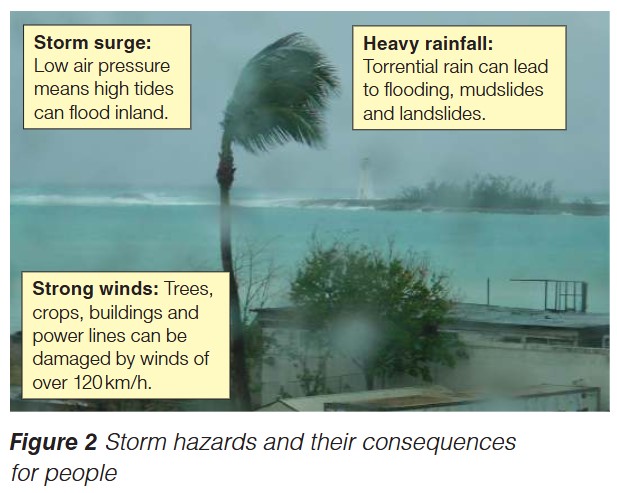
Strong winds: Tropical storms generate sustained winds that commonly exceed 120 kilometres per hour. The strongest winds are found in the eyewall surrounding the calm center. These powerful winds can:
- Uproot large trees and snap branches
- Damage or destroy buildings, especially those with weak structures
- Flatten crops, devastating agriculture
- Bring down power lines, causing widespread electricity outages
- Turn loose objects into dangerous flying debris
Heavy rainfall: Tropical storms bring torrential rain that can persist for hours or days. This intense rainfall leads to:
- Flash floods when drainage systems are overwhelmed
- Flooding of rivers and low-lying areas
- Mudslides on steep slopes when soil becomes saturated
- Landslides that can bury buildings and block roads
Important
Storm surge - the deadliest hazard:
Storm surge is one of the most dangerous hazards associated with tropical storms. The extremely low atmospheric pressure at the center of the storm causes the ocean surface to rise, creating a dome of water beneath the storm. When this elevated water reaches the coast, it can flood areas far inland.
Storm surge is responsible for many deaths during tropical storms, particularly in low-lying coastal communities. The combination of storm surge with high waves and heavy rainfall creates catastrophic flooding conditions.
Impacts on people and environments
The extreme weather conditions created by tropical storms have devastating consequences for affected regions:
Threats to human life: People are endangered by multiple hazards including drowning in floods, being struck by flying debris, buildings collapsing, and lack of access to clean water and medical care after the storm.
Damage to homes and infrastructure: Buildings are damaged or destroyed by high winds, flooding, and landslides. Roads, bridges, and power lines are often badly damaged, making rescue and recovery efforts difficult.
Note
Economic and livelihood impacts:
Several economic sectors are particularly vulnerable to tropical storms:
- Fishing communities lose boats and equipment
- Shipping is disrupted by dangerous sea conditions
- Transport networks are damaged or blocked
- Tourism facilities are destroyed, affecting the income of many people
- Agriculture is devastated by flooding and wind damage to crops
The combination of these impacts can leave communities struggling to recover for months or even years after a major tropical storm. The economic losses can run into billions of dollars, setting back development in affected regions.
Exam guidance
Important
Understanding command words:
When answering questions about tropical storms, pay attention to command words:
- "Describe" questions require you to state the features or characteristics (e.g., "Describe the conditions needed for tropical storm formation")
- "Explain" questions need you to give reasons or causes (e.g., "Explain how condensation provides energy for tropical storms")
- "Assess" or "Evaluate" questions require you to weigh up evidence and reach a judgment
Key processes to remember: Make sure you understand the sequence of tropical storm formation and can explain the role of evaporation, condensation, and the release of latent heat energy. These processes are fundamental to how tropical storms work.
Links to other topics: Tropical storms connect to several other geography concepts including atmospheric circulation, climate zones, coastal processes, and natural hazards management.
Remember!
Summary
Key Points to Remember:
Formation conditions:
- Tropical storms form over oceans warmer than 26.5°C and at least 60 metres deep, between 5° and 15° latitude north and south of the Equator
- The Coriolis effect from Earth's rotation causes the storms to spin, and they are powered by energy from warm, moist air and condensation
- When tropical storms reach land, they weaken rapidly as they lose their energy source of warm ocean water
Main hazards:
- Strong winds over 120km/h
- Torrential rainfall leading to flooding and landslides
- Storm surge causing coastal flooding
Impacts:
- Severe damage to people's lives, homes, infrastructure, and industries such as fishing, shipping, transport, tourism, and agriculture
Key terms to remember:
- Tropical storm: A powerful rotating storm system with winds exceeding 120km/h
- Coriolis effect: The force caused by Earth's rotation that makes tropical storms spin
- Storm surge: Coastal flooding caused by low air pressure raising sea levels
- Eye: The calm center of a tropical storm with light winds and clear skies
- Flash flood: Rapid flooding caused by intense rainfall overwhelming drainage systems
- Landslide/mudslide: Downslope movement of saturated soil and rock