Typhoon Haiyan - a Tropical Storm (OCR GCSE Geography B (Geography for Enquiring Minds)): Revision Notes
📚Revision Notes
Typhoon Haiyan - a Tropical Storm
Overview of Typhoon Haiyan
Typhoon Haiyan struck the Philippines in November 2013 and became one of the most powerful tropical storms ever recorded. This case study is essential for understanding how extreme weather events can become major hazards, particularly in emerging and developing countries with limited resources and infrastructure.
The storm developed into a Category 5 typhoon on the Saffir-Simpson scale, representing the highest level of storm intensity. Its impact was catastrophic, resulting in widespread devastation and significant loss of life across the Philippine islands.
Note
The Saffir-Simpson scale is used to classify hurricane and typhoon intensity from Category 1 (weakest) to Category 5 (strongest). Category 5 storms have sustained winds exceeding 252 km/h and are capable of causing catastrophic damage.
The Philippines: country context
Understanding why the Philippines suffered such severe damage requires knowledge of the country's development status and geographical characteristics. The Philippines is classified as an emerging and developing country (EDC), which means it has lower levels of economic development, weaker infrastructure, and fewer resources to prepare for and respond to natural disasters compared to more developed nations.
In terms of global development rankings, the Philippines was positioned at 117 out of 187 countries, highlighting the challenges the nation faces in providing adequate protection and services for its population.
Key statistics for the Philippines
| Indicator | Value |
|---|---|
| Total population | 99.14 million |
| Population in rural areas | 50.64% |
| GNI per capita | $3,470 |
| Percentage below the poverty line | 25.2% |
| Average life expectancy | 69 years |
| Number of islands | 7,107 |
These statistics reveal important vulnerability factors. With over half the population living in rural areas and more than a quarter below the poverty line, many Filipino families lacked the resources to prepare adequately for the typhoon or to evacuate safely. The archipelago nature of the country, with over 7,000 islands, also made evacuation and emergency response particularly challenging.
Note
EDC status indicates that a country is in the process of industrializing and improving economic conditions, but still faces significant challenges in infrastructure, healthcare, education, and disaster preparedness. This makes populations particularly vulnerable to natural hazards.
Formation and causes of Typhoon Haiyan
Typhoon Haiyan developed over the Pacific Ocean in November 2013 at a latitude of 7 degrees north. Several atmospheric and oceanic conditions combined to create this exceptionally powerful storm.
Conditions favouring typhoon formation
The formation of Typhoon Haiyan required specific environmental conditions:
- Location: The storm formed at 7°N over the Pacific Ocean, within the tropical zone where the Coriolis effect is strong enough to cause rotation but not so strong as to prevent formation
- Sea temperature: Surface water temperatures exceeded 26.5°C, providing the enormous amounts of heat energy needed to fuel the storm's development
- Ocean depth: The ocean depth was greater than 60 metres, ensuring that cooler water from below could not easily mix with the warm surface waters and weaken the storm
- Coriolis effect: This phenomenon, caused by Earth's rotation, created the spinning motion necessary for typhoon formation
As Typhoon Haiyan tracked westward across the warm ocean waters, it passed over minimal landmass, which allowed it to continue gaining energy. Without significant land to slow it down, the storm intensified rapidly, eventually reaching Category 5 status on the Saffir-Simpson scale - the most severe classification for tropical storms.
Note
Exam Tip: Explaining Typhoon Formation
When explaining typhoon formation, remember to include specific data (such as the 26.5°C temperature threshold) and explain why each condition matters, not just list them. Examiners want to see understanding of the processes, not just memorization of facts.
Primary impacts of Typhoon Haiyan
The impacts of Typhoon Haiyan were devastating and occurred across multiple dimensions. Understanding these impacts helps explain why this event was such a significant hazard.
Human casualties and immediate destruction
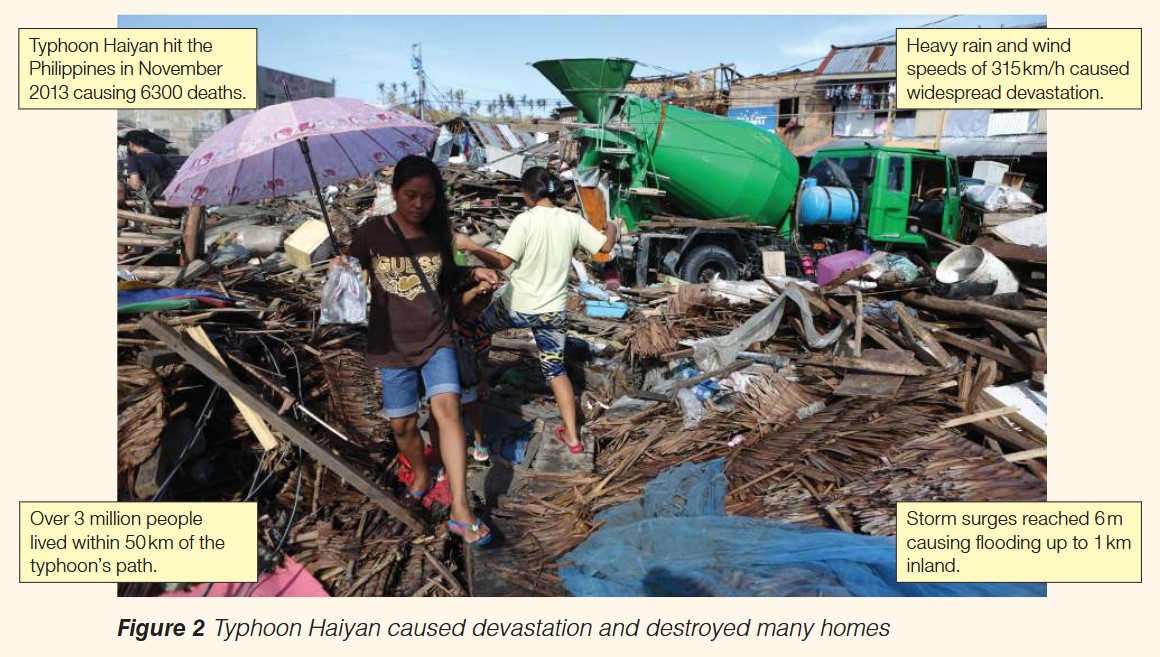
The typhoon claimed approximately 6,300 lives, making it one of the deadliest natural disasters in Philippine history. Wind speeds reached an extreme 315 kilometres per hour, powerful enough to destroy buildings, uproot trees, and turn debris into dangerous projectiles. The heavy rainfall that accompanied these winds caused additional flooding and landslides in vulnerable areas.
Over 3 million people lived within 50 kilometres of the typhoon's path, placing them directly in the zone of greatest danger. This massive population exposure meant that even relatively small percentages of casualties translated into thousands of deaths and injuries.
Storm surge and coastal flooding
One of the most destructive aspects of Typhoon Haiyan was the storm surge - a rapid rise in sea level caused by the typhoon's low atmospheric pressure and powerful winds pushing water toward the coast. Storm surges reached heights of 6 metres, sending massive walls of water crashing into coastal communities. This seawater penetrated up to 1 kilometre inland, flooding areas that would normally be safe from the ocean.
Important
The combination of storm surge, heavy rainfall, and the archipelago geography meant that many communities faced flooding from multiple directions, with no safe evacuation route available. Storm surges are often the deadliest component of tropical storms, as they can arrive suddenly and with little warning.
The combination of storm surge, heavy rainfall, and the archipelago geography meant that many communities faced flooding from multiple directions, with no safe evacuation route available.
Note
Understanding Primary vs Secondary Impacts
When describing impacts in exams, distinguish between:
- Primary impacts: Direct results of the hazard, like wind damage, storm surge, and immediate casualties
- Secondary impacts: Consequences that follow, like disease outbreaks, economic disruption, and long-term displacement
This distinction shows deeper understanding of how hazards create cascading effects.
Why the Philippines suffered such severe damage
While Typhoon Haiyan was an exceptionally powerful storm, several factors related to the Philippines' development status and recent history made the damage particularly severe.
Vulnerability as an emerging and developing country
The Philippines' status as an EDC meant that many communities lacked the infrastructure and resources necessary to withstand such an extreme event. Buildings in affected areas often did not meet strict construction standards that might have helped them survive the powerful winds. Emergency services, while present, were overwhelmed by the scale of the disaster and struggled to reach affected areas quickly.
Recent earthquake and compound vulnerability
The area impacted by Typhoon Haiyan was still recovering from a recent earthquake when the typhoon struck. Buildings that had been weakened or damaged by seismic activity were even more vulnerable to the typhoon's winds. Many people had not yet been able to repair their homes or had moved into temporary shelters that offered little protection against a Category 5 storm.
Important
Compound Vulnerability
The concept of compound vulnerability is crucial for understanding disaster impacts. When a community is already stressed by one hazard (the earthquake), it has fewer resources and resilience to cope with another hazard (the typhoon). This creates a multiplier effect where the combined impact is greater than the sum of individual hazards.
Warning systems and evacuation challenges
Although meteorologists warned that a powerful typhoon was approaching, many residents did not evacuate or did not have anywhere safe to go. Some people had experienced previous typhoon warnings that resulted in less severe storms, leading to complacency. Others lacked the transportation or financial resources to evacuate to safer areas. In rural communities spread across thousands of islands, organising effective mass evacuation presents enormous logistical challenges.
The combination of natural hazard severity and human vulnerability factors created a disaster of exceptional magnitude, demonstrating how extreme weather becomes a true hazard when it intersects with vulnerable populations.
Remember!
Summary
Key Points to Remember:
-
Typhoon Haiyan struck the Philippines in November 2013 as a Category 5 storm, making it one of the most powerful tropical cyclones ever recorded, with wind speeds of 315 km/h
-
The storm formed at 7°N over the Pacific Ocean where conditions were ideal: sea temperatures exceeded 26.5°C, ocean depth was over 60m, and the Coriolis effect enabled rotation
-
Approximately 6,300 people died due to the extreme winds, heavy rainfall, and devastating storm surges that reached 6 metres high and flooded coastal areas up to 1 kilometre inland
-
Over 3 million people within 50km of the typhoon's path were affected, with the Philippines' status as an emerging and developing country (EDC) making communities particularly vulnerable
-
The Philippines' vulnerability was compounded by its EDC status, recent earthquake damage, and challenges with evacuation, including poverty (25.2% below poverty line), rural isolation (50.64% rural population), and limited infrastructure across 7,107 islands