Typhoon Haiyan’s Path of Destruction (OCR GCSE Geography B (Geography for Enquiring Minds)): Revision Notes
📚Revision Notes
Typhoon Haiyan's Path of Destruction
Introduction
Typhoon Haiyan struck the Philippines in November 2013, becoming one of the strongest tropical storms ever recorded. This case study examines the devastating consequences of the typhoon and the emergency and long-term responses that followed. Understanding how extreme weather events like Haiyan can become hazards helps us appreciate the challenges faced by communities in vulnerable regions.
Note
Typhoon Haiyan, also known locally as Typhoon Yolanda, was a category 5 super typhoon that made landfall on November 8, 2013. Its sustained wind speeds reached over 300 km/h, making it one of the most powerful storms to ever strike land.
Consequences of Typhoon Haiyan
The impacts of Typhoon Haiyan were widespread and severe, affecting millions of people across the Philippines. These consequences can be categorized into primary effects (direct impacts) and secondary effects (indirect impacts that followed).
Primary consequences
Primary consequences are the immediate, direct results of the typhoon itself. These effects occurred during and immediately after the storm passed through.
A devastating storm surge wiped out approximately 90% of Tacloban city, the capital of Leyte province. The massive wall of seawater overwhelmed coastal defenses and swept away entire neighborhoods.
Note
The storm surge reached heights of up to 6 meters in some coastal areas, making it the most destructive aspect of the typhoon. This wall of water traveled inland at high speed, giving residents little time to reach safety.
Heavy rainfall triggered flash flooding and landslides across affected regions. The combination of intense precipitation and already saturated ground caused widespread land instability.
Extremely strong winds caused extensive damage to buildings, trees and agricultural crops. Wind speeds exceeded 300 km/h in some areas, tearing roofs from structures and uprooting mature trees.
Falling debris from damaged structures caused numerous deaths and injuries. People were struck by flying objects, collapsing buildings and falling trees during the height of the storm.
Secondary consequences
Secondary consequences developed in the hours, days and weeks following the typhoon. These indirect impacts often caused additional suffering for survivors.
Many people found themselves without shelter, clean drinking water or electricity. Essential services were disrupted for extended periods, making survival extremely difficult.
Important
The disruption of basic services created cascading problems: without clean water, disease spread rapidly; without electricity, hospitals couldn't function properly; without shelter, people were exposed to infections and further weather hazards.
Roads became blocked by fallen trees, damaged vehicles and debris from destroyed buildings. This created major obstacles for emergency responders trying to reach affected communities.
Transport disruption led to the cancellation of 453 flights. This hampered relief efforts and prevented people from evacuating or receiving help from outside the affected region.
Social consequences
The human impact of Typhoon Haiyan was devastating, affecting families and communities across multiple provinces.
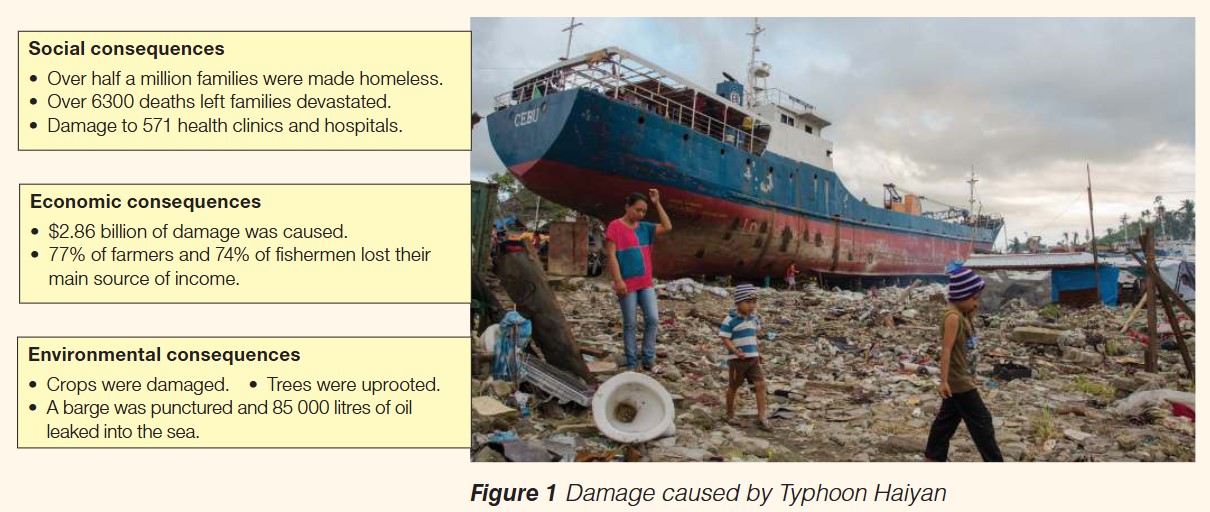
More than half a million families lost their homes in the disaster. The destruction of housing left people exposed to the elements with nowhere safe to shelter.
Important
Devastating Human Toll
Over 6,300 deaths left families devastated and communities broken. Many people lost multiple family members, and some bodies were never recovered. This loss of life represented one of the deadliest natural disasters in Philippine history.
The health system suffered severe damage, with 571 health clinics and hospitals either destroyed or badly damaged. This left survivors without access to medical care when they needed it most.
Economic consequences
The typhoon inflicted enormous economic damage that would take years to recover from.
The total economic cost reached $2.86 billion. This figure included damaged infrastructure, destroyed homes, lost crops and disrupted businesses.
Note
This economic damage represented approximately 0.8% of the Philippines' GDP, making it one of the costliest natural disasters in the country's history. The burden fell disproportionately on poor communities with limited resources to rebuild.
Approximately 77% of farmers and 74% of fishermen lost their main source of income. This meant families suddenly had no way to earn money or feed themselves, creating long-term poverty.
Environmental consequences
Natural ecosystems suffered significant damage from the storm's fury.
Agricultural crops were destroyed across vast areas of farmland. Rice paddies, coconut plantations and vegetable crops were flattened or washed away.
Trees were uprooted throughout the affected regions. This loss of vegetation increased the risk of soil erosion and landslides in subsequent rainy seasons.
Note
Oil Spill Crisis
A barge was punctured during the storm, releasing 85,000 liters of oil into the sea. This oil spill contaminated coastal waters and damaged marine ecosystems, affecting fishing grounds that communities depended on for their livelihoods.
Responses to Typhoon Haiyan
The Philippine government and international community mounted both immediate emergency responses and longer-term recovery efforts to help affected communities.
Emergency (short-term) aid
The government declared seven provinces to be under a 'state of national calamity'. This special designation allowed authorities to control prices of essential goods and coordinate emergency operations more effectively.
Emergency short-term aid focused on providing immediate life-saving assistance. This included food, clean water, temporary shelter and medical supplies to keep survivors alive in the critical first days after the disaster.
Example
International Emergency Response
The United Nations launched an appeal for $301 million in emergency aid. This international fundraising effort helped coordinate the global response to the crisis, bringing together governments, NGOs, and international organizations to deliver rapid assistance.
The World Health Organization (WHO) managed healthcare workers who provided medical treatment to injured survivors and helped prevent disease outbreaks in crowded evacuation centers.
Long-term aid
After addressing immediate needs, attention shifted to long-term aid focused on recovery and development. This aimed to help communities rebuild their lives and become more resilient to future disasters.
Cash for work schemes employed local people to clear debris from streets and public spaces. This approach provided income to families while speeding up the cleanup process.
Note
These cash-for-work programs were particularly effective because they addressed multiple problems simultaneously: they provided immediate income to desperate families, accelerated the cleanup of communities, and helped restore dignity by allowing people to earn rather than simply receive handouts.
Infrastructure repair programs focused on rebuilding essential services. This included repairing water supply systems, reconstructing damaged roads and rebuilding coastal defenses.
Replanting programs helped farmers re-establish mangrove forests around the coast. Mangroves act as natural barriers against storm surges and provide important ecosystem services.
Example
Scale of Aid Delivered (First 100 Days)
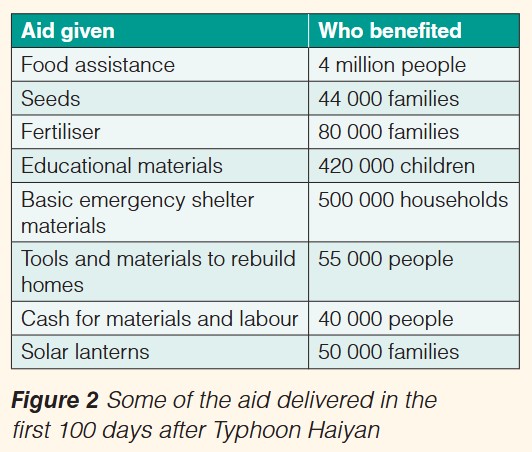
The table above shows the scale of aid delivered in the first 100 days after the typhoon:
- Food assistance reached 4 million people
- Seeds distributed to 44,000 families to help them restart farming
- Fertilizer provided to 80,000 families
- Educational materials delivered to 420,000 children to help schools reopen
- Basic emergency shelter materials benefited 500,000 households
- Reconstruction tools and materials provided to 55,000 people to rebuild their homes
- Cash assistance helped 40,000 people meet their immediate needs
- Solar lanterns distributed to 50,000 families to provide lighting without electricity
This massive relief effort demonstrated the importance of coordinated international response to major disasters.
Remember!
Summary
Key Points to Remember:
- Typhoon Haiyan caused both primary consequences (direct impacts like storm surge and wind damage) and secondary consequences (indirect impacts like homelessness and transport disruption)
- The social impact was catastrophic, with over 6,300 deaths and more than 500,000 families made homeless
- Economic damage totaled $2.86 billion, with farmers and fishermen losing their livelihoods
- Emergency short-term aid provided immediate life-saving assistance (food, water, shelter, medical care)
- Long-term aid focused on recovery and development (infrastructure repair, cash for work schemes, replanting programs)
Key Terms:
- Primary consequences: Direct, immediate impacts of a hazard
- Secondary consequences: Indirect impacts that follow after a hazard event
- Storm surge: A rise in sea level caused by a tropical storm, which can flood coastal areas
- Emergency (short-term) aid: Immediate relief provided in the days and weeks after a disaster
- Long-term aid: Recovery and development assistance provided months and years after a disaster
- Infrastructure: Basic physical systems like roads, water supply, electricity and buildings
Exam Guidance:
When answering questions about tropical storm consequences, remember to distinguish between primary and secondary effects. For 'explain' questions, always link consequences to the storm's characteristics (wind speed, rainfall, storm surge). When evaluating responses, consider both short-term emergency aid and long-term development, using specific examples and data from this case study.