More About Biomes (OCR GCSE Geography B (Geography for Enquiring Minds)): Revision Notes
📚Revision Notes
More About Biomes
Global climate patterns
The distribution of biomes across Earth is directly linked to global climate zones. Climate patterns are primarily controlled by the position of the Sun and how it heats different parts of the planet.
Note
The Sun's angle in the sky is the key factor determining climate patterns across the globe. This angle varies with latitude, creating distinct climate zones from the Equator to the poles.
At the Equator:
- The Sun sits directly overhead, providing intense heating to the ground surface
- Strong surface heating causes warm, moist air to rise rapidly
- This rising air leads to heavy rainfall throughout the year
At the poles:
- The Sun's angle is very low in the sky, delivering minimal heat
- Cold air sinks towards the surface
- This sinking air produces very little rainfall
Understanding these climate patterns helps explain why certain biomes develop in specific locations around the world.
Major world biomes
Biomes are large-scale ecosystems characterised by distinctive climate conditions, vegetation types, and animal communities. Six major biomes can be identified across the planet:
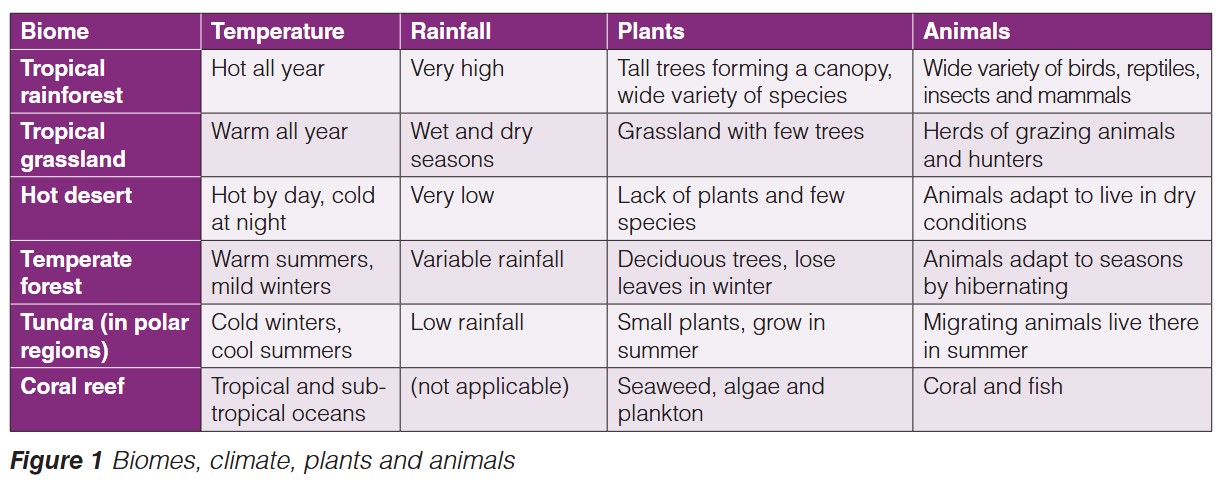
Tropical rainforest
Climate conditions:
- Hot temperatures all year round with minimal seasonal variation
- Very high rainfall throughout the year
Vegetation:
- Tall trees grow in layers, forming a dense canopy
- Extremely wide variety of plant species
Wildlife:
- Wide variety of birds, reptiles, insects and mammals
- High biodiversity due to stable, warm, wet conditions
Note
Tropical rainforests contain more than half of the world's plant and animal species despite covering less than 6% of Earth's land surface. The consistent warmth and moisture create ideal conditions for life to thrive.
Tropical grassland
Climate conditions:
- Warm temperatures maintained all year
- Distinct wet and dry seasons rather than continuous rainfall
Vegetation:
- Dominated by grassland with scattered trees
- Trees are few due to seasonal drought
Wildlife:
- Large herds of grazing animals (herbivores)
- Hunters (carnivores) that prey on the grazing animals
Hot desert
Climate conditions:
- Hot by day but cold at night due to lack of cloud cover
- Very low rainfall (often less than 250mm per year)
Vegetation:
- Very limited plant life
- Low number of species due to water scarcity
Wildlife:
- Animals show special adaptations to survive in dry conditions
- Adaptations include nocturnal behaviour and water conservation mechanisms
Temperate forest
Climate conditions:
- Warm summers and mild winters
- Variable rainfall distributed throughout the year
Vegetation:
- Dominated by deciduous trees
- Trees lose their leaves in winter to conserve energy
Wildlife:
- Animals adapt to seasonal changes
- Many animals hibernate during winter months when food is scarce
Tundra (in polar regions)
Climate conditions:
- Cold winters with temperatures well below freezing
- Cool summers with brief growing season
- Low rainfall (often described as a "cold desert")
Vegetation:
- Small plants that only grow during summer months
- Limited plant diversity due to harsh conditions
Wildlife:
- Migrating animals that only live there during summer
- Animals leave during winter when conditions become too extreme
Coral reef
Climate conditions:
- Found in tropical and sub-tropical oceans
- Warm water temperatures year-round
- Rainfall measurement not applicable (marine environment)
Vegetation:
- Seaweed, algae and plankton form the plant life
- Plants adapted to underwater conditions
Wildlife:
- Coral organisms and fish
- High biodiversity in warm, shallow waters
Note
Coral reefs are sometimes called the "rainforests of the sea" because they support an incredible diversity of marine life despite covering less than 1% of the ocean floor.
Adaptations to climate extremes
Plants and animals in each biome show specific adaptations that enable them to survive in their climate. The most extreme examples of adaptation can be seen in the tundra and tropical rainforest, which represent opposite ends of the climate spectrum.
Important
Climate-Adaptation Relationship
Adaptations are not random features - they are direct responses to specific environmental challenges. When studying any biome, always ask: "What climate challenge does this adaptation help overcome?"
Tundra plant adaptations
Tundra plants face extremely challenging conditions with cold temperatures and low rainfall. They have developed several key adaptations to survive in the polar climate:
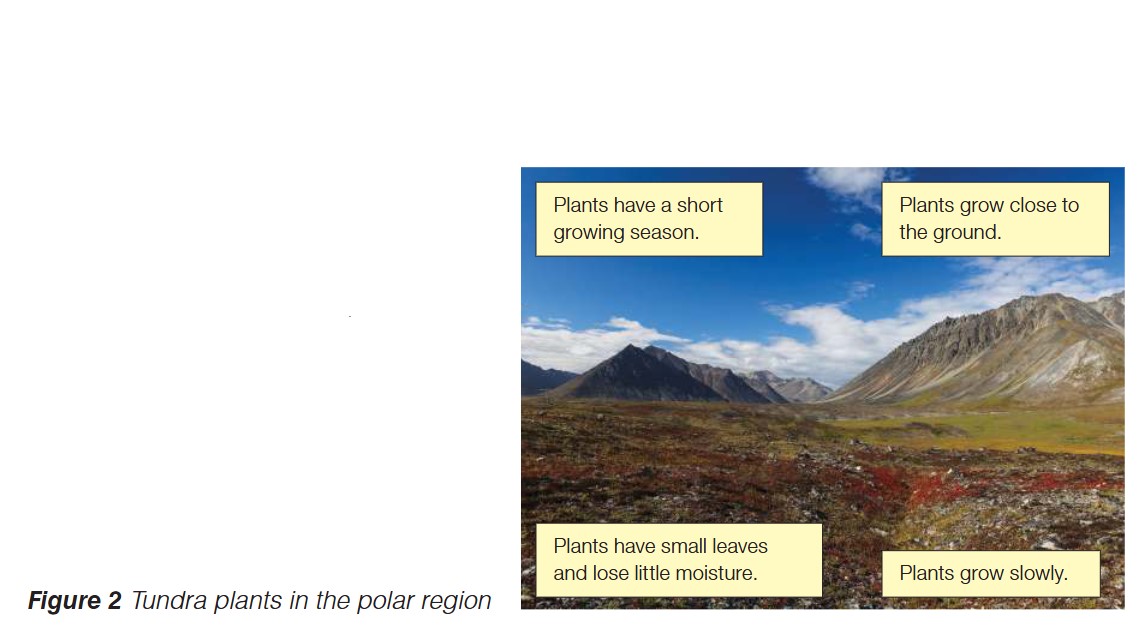
Short growing season:
- Plants only grow during the brief summer months
- They must complete their life cycle quickly before winter returns
Ground-hugging growth:
- Plants grow close to the ground surface
- This protects them from harsh winds and helps them access slightly warmer temperatures near the soil
Small leaves:
- Tiny leaf size reduces moisture loss
- This is critical in an environment where water is frozen for much of the year
Slow growth:
- Plants grow very slowly to conserve energy
- The harsh conditions mean resources are limited
Example
Worked Example: Linking Climate to Adaptation
Question: Explain how small leaves help tundra plants survive.
Answer:
- Tundra climate has low rainfall and water frozen for most of the year
- Small leaves have less surface area
- This reduces water loss through transpiration
- Therefore, small leaves help plants conserve precious water in a dry environment
Tropical rainforest adaptations
At the opposite extreme, tropical rainforest plants are adapted to consistently hot and wet conditions. Trees grow tall to compete for sunlight, forming multiple layers of canopy. The warm, wet climate supports the highest biodiversity of any terrestrial biome.
Note
In tropical rainforests, the competition for light is so intense that some plants have evolved to grow on other plants (called epiphytes) to reach the canopy without building tall trunks themselves.
Exam guidance
Important
Exam Success Strategies
For 'describe' questions:
- State the key characteristics of the biome (temperature, rainfall, vegetation, animals)
- Use data from the table where relevant
For 'explain' questions:
- Link the climate conditions to the adaptations you describe
- Show how specific features help organisms survive (e.g., "Small leaves reduce moisture loss in the dry tundra climate")
For case study questions:
- Be prepared to give specific examples of plants or animals
- Link adaptations back to climate conditions
Remember!
Summary
Key Points to Remember:
-
Climate patterns are controlled by the Sun's angle: overhead at the Equator (hot and wet), low at the poles (cold and dry)
-
Six major biomes can be identified: tropical rainforest, tropical grassland, hot desert, temperate forest, tundra, and coral reef
-
Each biome has distinctive temperature, rainfall, vegetation and animal characteristics
-
Adaptations help plants and animals survive in their specific climate conditions
-
Tundra and tropical rainforest represent opposite climate extremes, with very different adaptations