Polar Regions (OCR GCSE Geography B (Geography for Enquiring Minds)): Revision Notes
📚Revision Notes
Polar Regions
Introduction
Polar regions are areas of extreme cold located at the Earth's most northern and southern latitudes. There are two main polar regions: the Arctic, which surrounds the North Pole, and Antarctica, which surrounds the South Pole. These remote environments share many characteristics but also have important differences.
Note
Polar regions represent the coldest environments on Earth, with temperatures regularly dropping below -50°C in winter. Despite their harsh conditions, these regions play a crucial role in regulating Earth's climate and ocean currents.
Location and characteristics
The Arctic
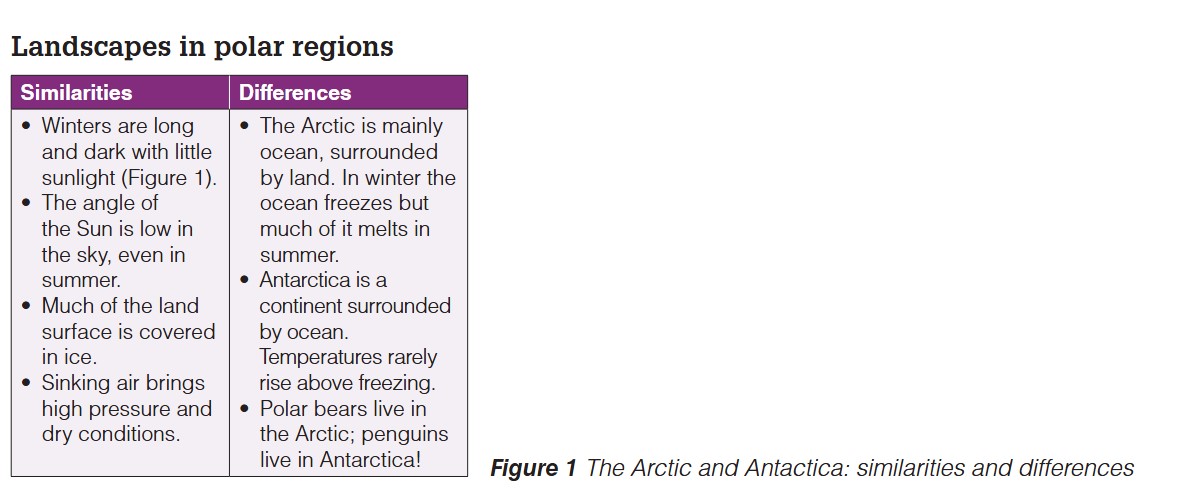
The Arctic is located at the Earth's northernmost point, centred on the North Pole. It extends to the Arctic Circle and includes parts of several countries. Unlike Antarctica, the Arctic is primarily a frozen ocean surrounded by land masses including parts of Canada, Russia, Greenland, and Scandinavia. During winter, the ocean freezes over, but much of this ice melts during the summer months.
Antarctica
Antarctica is positioned at the Earth's southernmost point, centred on the South Pole. It extends to the Antarctic Circle and is fundamentally different from the Arctic in structure. Antarctica is a continent—a large land mass—that is surrounded by ocean. This continent is almost entirely covered by thick ice sheets.
Important
Critical Difference to Remember:
- Arctic = Ocean surrounded by land
- Antarctica = Continent (land) surrounded by ocean
This fundamental structural difference affects everything from ice formation patterns to the types of wildlife that can survive in each region.
Similarities between the polar regions
Despite being at opposite ends of the Earth, the Arctic and Antarctica share several key environmental features:
Climate conditions: Both regions experience descending air masses that create high atmospheric pressure systems. This sinking air results in extremely dry conditions with very little precipitation. The cold temperatures mean that when precipitation does occur, it falls as snow rather than rain.
Note
The high pressure systems in polar regions work differently from those in other parts of the world. The cold, dense air sinks, creating stable atmospheric conditions that prevent cloud formation and precipitation—this is why polar regions are technically classified as deserts despite being covered in ice.
Winter darkness: Winters in both polar regions are characterised by long periods of darkness with minimal sunlight. The angle at which sunlight reaches these high-latitude areas means that solar radiation is spread thinly across the surface, contributing to the extreme cold. During winter months, the Sun barely rises above the horizon, and at the poles themselves, there can be 24 hours of complete darkness.
Ice coverage: The land and ocean surfaces in both regions are extensively covered by ice. This ice cover is a defining feature of polar landscapes and plays a crucial role in the global climate system.
Differences between the polar regions
Physical structure
The most fundamental difference between the two polar regions is their physical structure. The Arctic consists mainly of ocean that freezes in winter, whilst Antarctica is a solid continent covered by ice. This difference has significant implications for ice formation, wildlife, and climate patterns.
Seasonal ice patterns
In the Arctic, the ocean freezes during winter but substantial areas of sea ice melt each summer when temperatures rise above freezing. In contrast, Antarctica remains frozen year-round because it is a continent with permanent ice sheets. Temperatures rarely rise above freezing, even during the Antarctic summer.
Sunlight patterns throughout the year
The polar regions experience extreme variations in daylight hours throughout the year:
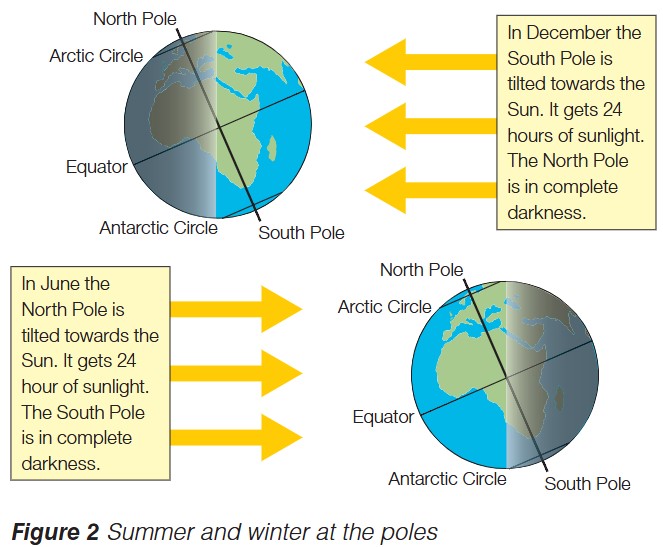
- In December, the Sun is directly over the Southern Hemisphere. This means Antarctica receives 24 hours of continuous sunlight whilst the Arctic experiences 24 hours of complete darkness.
- In June, the opposite occurs. The Sun is directly over the Northern Hemisphere, giving the Arctic 24 hours of daylight whilst Antarctica is plunged into 24 hours of darkness.
This phenomenon occurs because of the Earth's tilt on its axis as it orbits the Sun.
Note
These extreme daylight patterns are known as the "midnight sun" in summer and "polar night" in winter. The exact duration of continuous daylight or darkness depends on how close you are to the poles—the closer you are, the longer these periods last.
Wildlife
The different physical structures of the two regions support different wildlife:
- Polar bears are found only in the Arctic, where they hunt on sea ice and the surrounding land masses.
- Penguins live exclusively in Antarctica and the surrounding Southern Ocean, where they have adapted to life on the ice-covered continent.
Important
A Helpful Way to Remember:
- Arctic has polar bears (both words contain the letter 'r')
- Antarctica has penguins (both words start with a vowel sound)
No polar bears live in Antarctica, and no penguins live in the Arctic!
Landscape features of polar regions
Both polar regions display distinctive landscape features created by ice and extreme cold conditions. Understanding these features is essential for comprehending how polar environments function.
Ice sheets
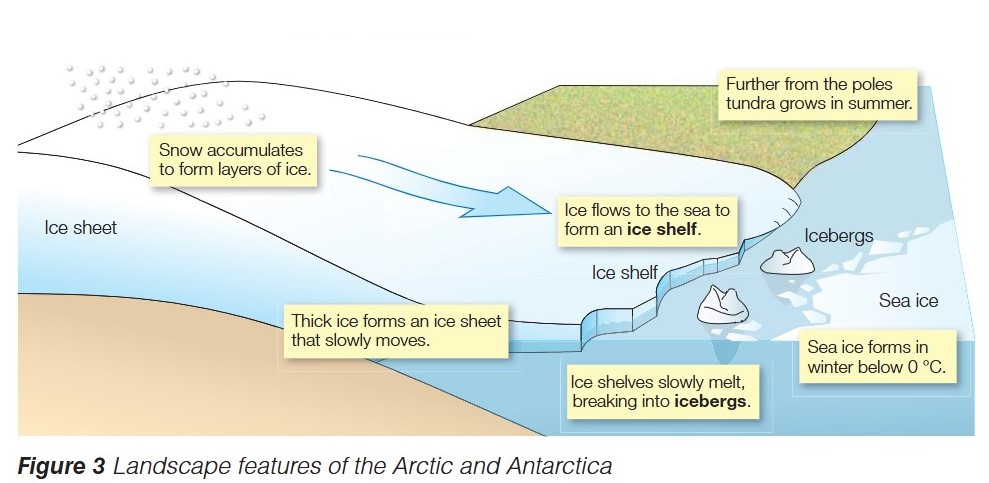
Ice sheets are vast, thick layers of ice that cover large areas of land. They form over thousands of years as snow accumulates and compresses into dense ice. Antarctica and Greenland (in the Arctic) are covered by massive ice sheets that can be several kilometres thick. These ice sheets contain the majority of the world's freshwater.
Glaciers
Glaciers are large masses of ice that flow slowly downhill under their own weight. They form from accumulated snow in areas where more snow falls in winter than melts in summer. In polar regions, glaciers flow from the high interior ice sheets towards the coast. As they move, they shape the landscape, carving valleys and transporting rock and sediment.
Ice shelves
Ice shelves form where glaciers and ice sheets extend beyond the land and float on the ocean surface. These massive platforms of floating ice remain attached to the land-based ice but extend out over the sea. Ice shelves are particularly common around the coast of Antarctica.
Icebergs
Icebergs are large chunks of freshwater ice that break off (or "calve") from ice shelves or glaciers and float freely in the ocean. When sections of ice shelves crack and separate, they create icebergs that can be enormous—sometimes the size of small countries. These icebergs gradually melt as they drift into warmer waters.
Example
Ice Formation Sequence: From Snow to Iceberg
Step 1: Snow accumulates on land over thousands of years ↓ Step 2: The weight compresses the snow into a thick ice sheet ↓ Step 3: The ice sheet flows downhill, forming a glacier ↓ Step 4: The glacier extends over the ocean, creating an ice shelf ↓ Step 5: Sections break off the ice shelf, forming icebergs that float away
This process demonstrates how ice moves from land to sea in polar regions.
Sea ice
Sea ice forms when ocean water freezes during winter when temperatures drop below 0°C. Unlike icebergs, which are made of freshwater, sea ice forms directly from salty ocean water. In the Arctic, sea ice covers much of the ocean during winter but retreats significantly during summer. Sea ice provides important habitat for wildlife and affects ocean circulation patterns.
Note
Key Difference: Sea Ice vs Icebergs
- Sea ice = Frozen ocean water (salty origin)
- Icebergs = Frozen freshwater from glaciers and ice shelves
Sea ice forms from the ocean itself, whilst icebergs originate from land-based ice that has moved into the ocean.
Tundra
Further from the poles, where summer temperatures rise above freezing, a type of vegetation called tundra can grow. Tundra consists of low-growing plants including mosses, lichens, grasses, and small shrubs. These hardy plants can survive the harsh conditions, though the growing season is very short. Tundra is found in areas surrounding the Arctic Ocean and on the Antarctic Peninsula where conditions are slightly less extreme.
Exam guidance
Important
Answering Different Question Types:
Describe questions require you to state key features. For example: "Describe the climate of polar regions" would need you to mention high pressure, dry conditions, cold temperatures, and long dark winters.
Explain questions need you to give reasons. For example: "Explain why polar regions experience 24 hours of darkness in winter" requires you to discuss the Earth's tilt and the position of the Sun.
Compare questions ask you to identify similarities and differences. Always structure your answer clearly, perhaps discussing similarities first, then differences, or by using comparative language such as "whereas," "in contrast," and "similarly."
Remember!
Summary
Key Points to Remember:
-
Polar regions are located at Earth's extreme northern (Arctic) and southern (Antarctica) latitudes around the North and South Poles.
-
The Arctic is mainly frozen ocean surrounded by land, whilst Antarctica is a continent surrounded by ocean.
-
Both regions have high atmospheric pressure, dry conditions, extremely cold temperatures, and long winters with minimal sunlight.
-
Polar regions experience 24-hour sunlight in summer and 24-hour darkness in winter due to Earth's axial tilt.
-
Key landscape features include ice sheets, glaciers, ice shelves, icebergs, sea ice, and tundra vegetation in slightly warmer areas.
-
Polar bears inhabit the Arctic; penguins live in Antarctica.