Sustainable Management of Whaling (OCR GCSE Geography B (Geography for Enquiring Minds)): Revision Notes
📚Revision Notes
Sustainable Management of Whaling
Introduction
Whaling has a long history in polar regions, but the way it has been practiced has changed dramatically over time. Understanding how whaling became unsustainable and how it can be managed more effectively is crucial for both marine conservation and respecting indigenous communities' traditional rights.
A history of whaling
Traditional sustainable whaling practices
Indigenous Arctic communities, particularly the Inuit people, have hunted whales for hundreds of years. This traditional whaling was sustainable because hunters caught individual whales one at a time, using every part of the animal for essential resources including oil, meat and bones. The small scale of this hunting meant whale populations could naturally replenish themselves.
Note
Traditional whaling practices demonstrated sustainability through careful resource management - hunting only what was needed and ensuring whale populations could recover between hunts. This balance between human needs and environmental preservation is a key principle of sustainable management.
Industrial-scale whaling in the 20th century
The twentieth century brought dramatic changes to whaling practices. Large factory ships began harvesting whales in huge quantities, transforming whaling into an industrial operation. These factory vessels processed whales for various commercial products including margarine, chemicals, cosmetics and animal feed.
Important
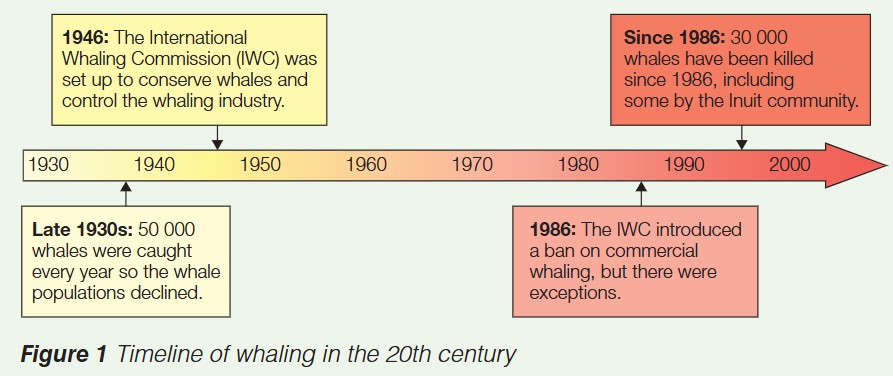
By the late 1930s, approximately 50,000 whales were being caught annually. This intense hunting pressure caused whale populations to decline sharply, threatening many species with extinction. The scale and speed of this decline made it clear that industrial whaling was environmentally unsustainable.
The contrast between traditional and industrial whaling demonstrates how technology and commercial interests can transform a sustainable practice into an environmental crisis.
International efforts to regulate whaling
In response to declining whale populations, the International Whaling Commission (IWC) was established in 1946. This international organization aimed to conserve whale populations while regulating the whaling industry.
Despite these conservation efforts, whale populations continued to decline. In 1986, the IWC introduced a ban on commercial whaling, though some exceptions were permitted. However, even after this ban, approximately 30,000 whales have been killed, including some by indigenous Inuit communities exercising their traditional rights.
Note
Exam tip: When explaining the history of whaling, use a clear timeline structure. Examiners look for understanding of cause and effect - show how industrial whaling led to population decline, which prompted international regulation.
Case study: Clyde River, Canada
Background and location
Clyde River is a settlement on Baffin Island in northern Canada's Arctic region. In 2008, it became Canada's first marine wildlife sanctuary, representing an important step in sustainable whaling management. The area is significant because approximately 2,000 bowhead whales stop there during their annual migration along the coast.
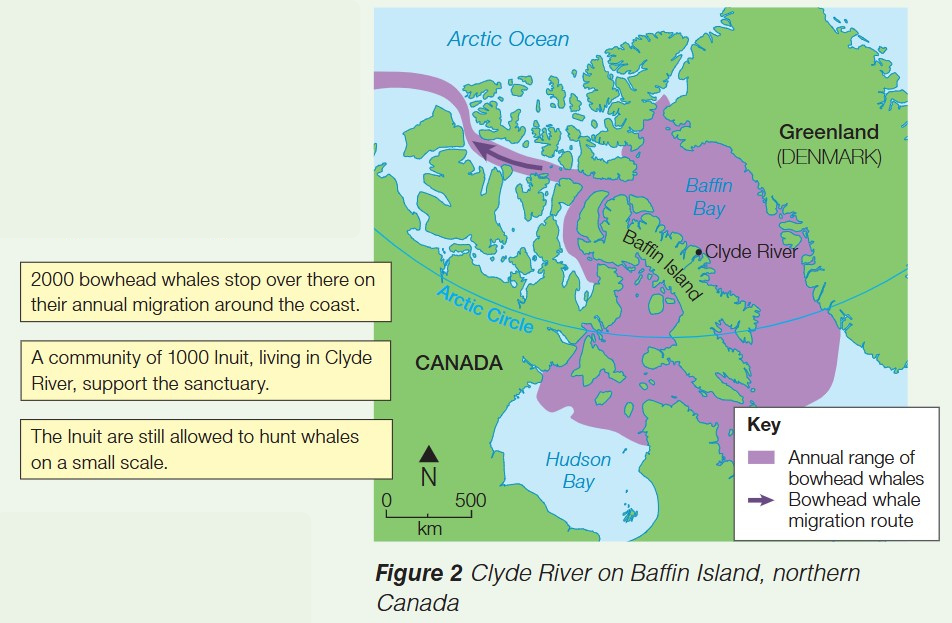
A community of around 1,000 Inuit people live in Clyde River and actively support the marine sanctuary, demonstrating how conservation and indigenous communities can work together effectively.
The 2014 whale hunt and its significance
Example
Case Study in Action: The 2014 Clyde River Hunt
In 2014, indigenous Inuit hunters from Clyde River killed a bowhead whale. This event was particularly significant for several reasons:
Historical context: It was the first Inuit whale hunt in the area in over 100 years, marking a return to traditional practices after a century-long gap.
Environmental support: The environmental organization Greenpeace supported this hunt, arguing that small-scale hunting by indigenous communities can be part of a sustainable management strategy.
Balancing interests: The hunt represented a careful balance between conservation goals and cultural rights, showing how modern sustainability can accommodate both environmental protection and traditional practices.
This support from a major conservation group highlights how modern approaches to sustainability recognize the importance of indigenous rights and traditional practices.
Features of sustainable management at Clyde River
The Clyde River sanctuary demonstrates several key features of sustainable whaling management:
Protection through designation: The marine wildlife sanctuary status provides legal protection for the whale population and their habitat, allowing numbers to recover.
Small-scale hunting permissions: The Inuit community is still permitted to hunt whales, but only on a small scale. This maintains their traditional cultural practices and food sources without threatening the whale population.
Community involvement: The local Inuit community actively supports the sanctuary, ensuring local buy-in for conservation measures. This is crucial because communities that benefit from and care about an area are more likely to protect it effectively.
Migration corridor protection: The sanctuary protects an important part of the bowhead whales' migration route, ensuring they have safe passage through critical habitat during their annual movements.
Note
Exam tip: When writing about this case study, use specific facts and figures (1,000 people in community, 2,000 whales on migration, first hunt in 100+ years). Examiners reward specific place knowledge. Also explain how the example shows sustainable management working in practice - the balance between conservation and traditional rights.
Key terms
Sustainable management: Managing a natural resource in a way that meets current needs while ensuring it remains available for future generations.
Industrial-scale whaling: Large-scale commercial hunting of whales using factory ships and modern technology, primarily for commercial products rather than subsistence.
International Whaling Commission (IWC): An international organization established in 1946 to conserve whale populations and regulate whaling activities globally.
Marine wildlife sanctuary: A protected area of ocean where wildlife and their habitats receive legal protection from harmful activities.
Bowhead whales: A species of large whale found in Arctic and sub-Arctic waters, traditionally hunted by indigenous communities.
Commercial whaling: Hunting whales for profit to produce commercial products such as oil, cosmetics and food products.
Summary
Key Points to Remember:
-
Traditional Inuit whaling was sustainable for centuries because it operated on a small scale, with communities hunting individual whales for essential resources.
-
Industrial whaling in the 20th century became unsustainable, with 50,000 whales caught annually by the late 1930s, causing severe population decline.
-
The International Whaling Commission (IWC) was established in 1946 and banned commercial whaling in 1986, though exceptions exist for indigenous communities.
-
Clyde River on Baffin Island demonstrates successful sustainable management by combining whale protection (Canada's first marine wildlife sanctuary, 2008) with small-scale indigenous hunting rights.
-
Effective sustainable management requires balancing conservation needs with indigenous communities' traditional rights and involving local people in protection efforts.
Critical processes and frameworks:
- Sustainable management involves setting limits on hunting, protecting migration routes and breeding areas, and monitoring population numbers.
- The IWC regulatory framework shows how international cooperation can address environmental challenges.
- Community-based conservation at Clyde River shows that local involvement is essential for long-term sustainability.