Tropical Rainforests (OCR GCSE Geography B (Geography for Enquiring Minds)): Revision Notes
📚Revision Notes
Tropical Rainforests
Location and distribution
Tropical rainforests are found in a belt around the Equator, situated between the Tropic of Cancer (23.5°N) and the Tropic of Capricorn (23.5°S). They occur on several continents including Asia, Africa, Australia and South America.
Despite occupying only 5% of the Earth's surface, tropical rainforests are extraordinarily important ecosystems. They contain 50% of the world's biodiversity – the variety of all living organisms on our planet.
Note
Key term: Biodiversity refers to the range and variety of different species of plants, animals and microorganisms in an ecosystem.
Climate characteristics
Tropical rainforests have a distinctive hot and wet climate throughout the year. This climate creates ideal conditions for plant growth and supports the high levels of biodiversity.
Temperature patterns
Temperatures remain consistently high throughout the year, typically averaging between 25-27°C. There is very little seasonal variation in temperature, creating stable growing conditions year-round.
Rainfall patterns
Annual rainfall is extremely high, often exceeding 2,000mm per year. While rainfall occurs throughout the year, there may be wetter and drier seasons, though all months receive substantial precipitation.
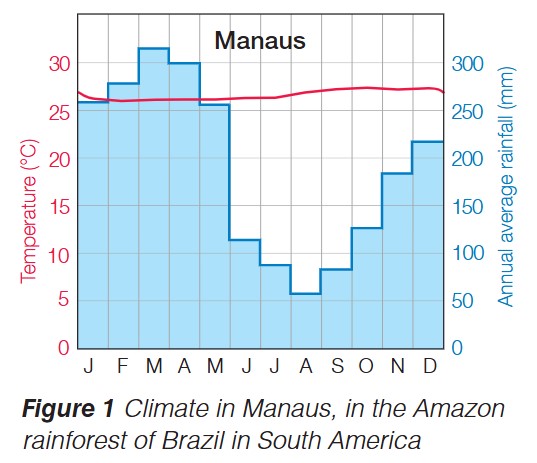
The climate graph for Manaus in the Amazon rainforest of Brazil demonstrates these typical tropical rainforest climate characteristics.
Important
Exam tip: When describing climate graphs, always refer to both temperature and rainfall patterns, and mention specific data values where possible.
Structure and layers of the rainforest
Tropical rainforests have a distinctive vertical structure with different layers, each supporting different types of plants and animals. This layered structure develops because plants compete intensely for sunlight in the hot, wet conditions.
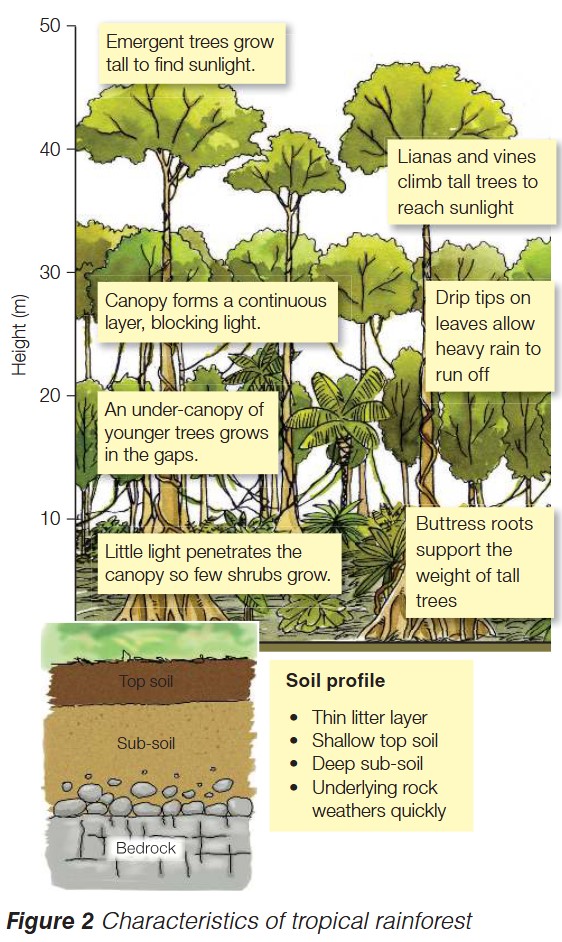
Emergent layer (approximately 40-50m height)
The tallest trees break through the main canopy to reach maximum sunlight. These emergent trees can grow extremely tall because the hot, wet climate and competition for light drive upward growth. They must be strong enough to withstand exposure to wind and intense sunlight.
Canopy layer (approximately 30-40m height)
This layer forms a continuous cover of tree crowns that blocks most sunlight from reaching below. The canopy acts like a green roof over the forest, and most rainforest wildlife lives at this level where food is abundant.
Note
Key Adaptations in the Canopy:
Lianas and vines are woody climbing plants that use tree trunks for support, allowing them to reach sunlight in the canopy without investing energy in thick trunks.
Drip tips on leaves are pointed extensions that allow heavy rain to run off quickly, preventing leaf damage and reducing the weight of water on branches.
Under canopy (approximately 10-30m height)
Younger trees and shade-tolerant species grow in this darker layer. Plants here can only grow where gaps in the canopy allow light to penetrate, such as where an old tree has fallen.
Forest floor (0-10m height)
Very little light penetrates to the forest floor – often less than 2% of sunlight. As a result, only shade-adapted shrubs and young trees can survive here. The forest floor is relatively clear of vegetation compared to the dense growth above.
Root systems
Buttress roots are wide, flared roots that extend from the base of tall trees. They provide stability and support for the enormous weight of emergent and canopy trees. The shallow root systems spread horizontally because most nutrients are concentrated in the upper soil layers.
Soil characteristics
Tropical rainforest soils have a distinctive profile with several layers:
- Thin litter layer: Fallen leaves and organic matter decompose rapidly in the hot, humid conditions
- Shallow top soil: Only a thin layer of nutrient-rich soil exists
- Deep sub-soil: Underlying layers are nutrient-poor
- Bedrock: The underlying rock weathers quickly in the hot, wet conditions
Important
Rainforest soils are surprisingly nutrient-poor despite supporting such lush vegetation. This is because nutrients are rapidly taken up by plant roots, meaning they don't accumulate in the soil.
Nutrient cycling
The nutrient cycle in tropical rainforests operates rapidly due to the hot, wet climate. Understanding this cycle is crucial for explaining why rainforest ecosystems are so productive yet have poor soils.
How the nutrient cycle works
The majority of nutrients are stored in biomass – the living matter of plants and animals, particularly in trees. When leaves, branches or whole trees die and fall to the forest floor, decomposition occurs extremely rapidly in the warm, moist conditions.
Tree roots quickly absorb the released nutrients before they can be washed away by heavy rain or leached deeper into the soil. This means the soil itself remains low in nutrients because trees take them up almost immediately.
Important
Critical Balance:
This creates a delicate balance – if trees are removed, the soil quickly loses its fertility because nutrients are no longer being cycled through the system.
Note
Exam tip: When explaining nutrient cycling, make clear links between climate (hot and wet), rapid decomposition, and quick uptake by roots.
Water cycling
Water cycles rapidly through tropical rainforest ecosystems, contributing to local and regional rainfall patterns.
The water cycle process
The dense forest canopy intercepts heavy rainfall, acting as a protective umbrella that prevents soil erosion. Not all rain reaches the ground immediately – some is absorbed by leaves and branches.
Water quickly evaporates from leaf surfaces and the forest floor due to high temperatures. This water vapour rises into the atmosphere where it forms clouds, which then produce more rainfall. In this way, rainforests create much of their own rainfall and help regulate local climate.
Note
This rapid cycling means that rainforests play a crucial role in maintaining rainfall patterns. If large areas of forest are cleared, local rainfall can decrease significantly.
Why tropical rainforests matter
The unique characteristics of tropical rainforests make them globally significant ecosystems:
- They contain half of all species on Earth despite covering only 5% of land surface
- They play a vital role in regulating global climate and rainfall patterns
- They store vast amounts of carbon in their biomass
- Indigenous peoples depend on them for their livelihoods and cultures
- They provide resources including medicines, foods and raw materials
Summary
Key Points to Remember:
- Tropical rainforests are located between the Tropic of Cancer and Tropic of Capricorn, covering parts of Asia, Africa, Australia and South America
- They cover just 5% of Earth's surface but contain 50% of global biodiversity
- The climate is hot (25-27°C year-round) and wet (over 2,000mm rainfall annually) with little seasonal variation
- The forest has four distinct layers: emergent trees, canopy, under canopy and forest floor, each adapted to different light levels
- Nutrients cycle rapidly through the ecosystem, being stored mainly in biomass rather than in the nutrient-poor soil
- Water cycles quickly through interception, evaporation and cloud formation, with rainforests helping to create their own rainfall
- Key adaptations include emergent trees growing tall for sunlight, lianas climbing for support, drip tips for water run-off, and buttress roots for stability