Transformation of landscape and people: grazing animals, ecological devastation and mestizos (OCR GCSE History B (Schools History Project)): Revision Notes
📚Revision Notes
Transformation of landscape and people: grazing animals, ecological devastation and mestizos
Examine the Map
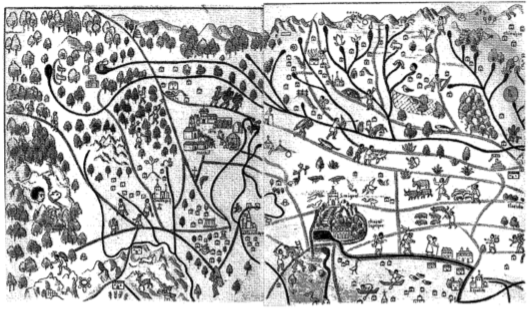
Image showing Mapa de Mexico (Aztec Empire after the fall of Tenochtitlan and emergence of Spanish rule)
Note
Under Spanish rule, people in the former Aztec Empire became mestizos. Moreover, the social status of Aztec nobles were devalued as Spanish authorities focused on individual achievement rather than pre-conquest wealth. Though some, including the descendants of Moctezuma, retained their status.
The Landscape
With beliefs that Lake Texcoco was disease-ridden, the Spanish began to drain and fill in the lake. Moreover, trees were cut down to supply the demand for lumber, fuel, and lime production.
The Spanish turned the vast amount of agricultural land of the Aztecs into livestock pastures. In addition, they replaced traditional subsistence crops with new cash crops like sugarcane and coffee.
The People
Aztec warriors were enlisted as auxiliary troops of the Spanish and participated in campaigns in northern and southern Mesoamerica.
The outbreak of smallpox between 1520 and 1521 caused a significant decline of the Aztec population.
The conquistadors merged traditional Aztec institutions with their own. The indigenous clan-based neighbourhood called a calpolli was mixed with the barrio, and a tianguis, the head of the town who managed tribute flows.
A mestizo is a person of mixed race, commonly used to describe a Spanish and indigenous descent.
As the population diminished, settlement patterns also change. New communities were formed as population centres changed.
Note
For three centuries, Mexico City built on the ruins of Tenochtitlan was settled by no fewer than 700,000 Spanish. As a result, a mixed-race population emerged. Most were Europeans intermixed with the indigenous population. During the colonial period, administration was based on racial separation or classes. The four main classes included the following:
Spanish born in Spain. The most powerful and privileged group were the Spanish born in Spain who were sent across the Atlantic to settle and rule the colony. They were the people who could hold high office in the colonial government.
Creoles. They were people of Spanish descent but born in Mexico. Most of them were landowners and merchants, indeed among the wealthiest, but had little influence in the colonial government.
Mestizos. The mixed race usually of Spanish and indigenous descent held lower positions compared to "pure" Spanish and creoles.
Indigenous. The pre-Columbian population became the most marginalised group in New Spain after the Spanish conquest.
They were subject to forced labour and harsh living conditions.
Glossary of Terms
MESTIZO
A person of mixed race, usually of Spanish and indigenous descents.
ENCOMIENDA
A Spanish system of granting land to loyal subjects by the Crown.
CHRISTIANITY
A religion based on the teachings of Jesus Christ. It was brought by the Spanish to Central America.
TRIBUTE
A form of payment made periodically by a person to the ruler.
CREOLES
People of Spanish descent but born in Mexico.
CONVERSION
A process of changing one's religion or set of beliefs. The Aztecs were requred to convert to Christianity.
Exam Practise
Task 1: Essay
Note
Among the impacts of Spanish rule over the Aztecs was the decline of indigenous population and introduction of the system of encomienda. Write a substantial essay showing the connection of these two effects.
Task 2: Source Interpretation
Note
Based on your understanding of the historical context, make your own interpretation of the source. How did the Aztecs react to the coming of missionaries?
'You say that our gods are not original. That's news to us... for our ancestors came to earth and they spoke quite differently... They gave us our supper and our breakfast... and we beg them for Thunder-Rain and Water.'
- Alleged statement of an Aztec priest to the Franciscans