The relationship between Government responses and changes to the campaigns, 1910–1914 (OCR GCSE History B (Schools History Project)): Revision Notes
📚Revision Notes
The relationship between Government responses and changes to the campaigns, 1910–1914
Government and changes in campaigns, 1910-14
In the 1900s, a member of parliament was able to propose a bill that was important to them. These were called Private Members' Bills. Parliament would vote on them but they could only become law if the majority of Parliament voted for it.
In 1908 Private Members' bills for suffrage gained the following votes.
| Conservatives | Liberals | Irish | Labour | TOTAL | |
|---|---|---|---|---|---|
| For | 30 | 185 | 21 | 33 | 269 |
| Against | 30 | 48 | 14 | 2 | 94 |
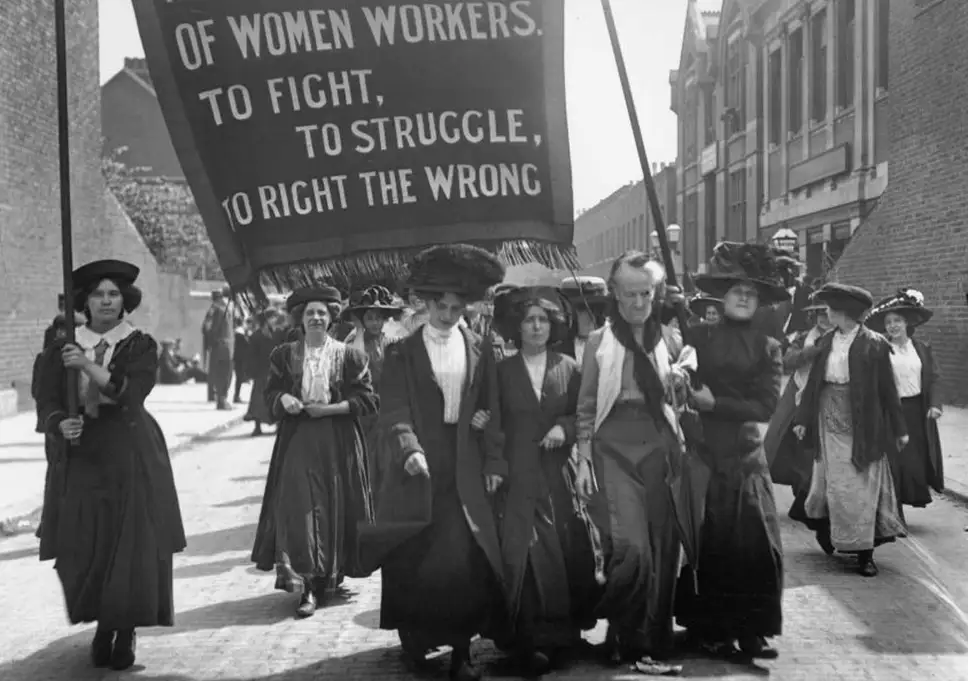
Even with these numbers, the campaign did not receive the necessary support from the Liberal government and it could not become law. The Liberals were focused on bringing about social reforms and it was feared that giving women the vote would disadvantage the Liberals in elections. When in 1910 the government refused to hear any more Private Members' Bills on suffrage, suffragettes were furious and embarked on anti-Liberal demonstrations.
Votes for a bill of Suffrage in 1912 gained the following votes:
| Conservatives | Liberals | Irish | Labour | TOTAL | |
|---|---|---|---|---|---|
| For | 63 | 117 | 3 | 35 | 218 |
| Against | 114 | 73 | 35 | - | 222 |
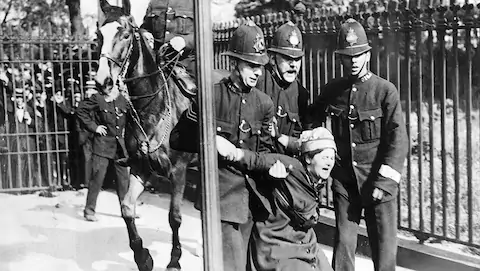
Alongside is a table showing a bill for suffrage in 1912. As you can see, the numbers have fallen dramatically. Why? From 1908 to 1912, suffragettes became increasingly militant and embarked on violent campaigns that saw property damaged, telephone wires cut, vehicles vandalised, and police officers and MPs assaulted. In Parliament, the Irish were also more concerned with their own big issue, which was Home Rule.
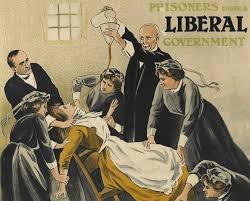
The government did not want any deaths, as this would create martyrs, thus it gave approval for force feeding. It was a painful and brutal procedure in which a pipe was forced up a hunger striker's nose and into her stomach so that liquid food could be force fed to them. They were often too weak to resist.
Some women resorted to extreme measures such as hunger strikes. Upon being arrested and sent to prison for their militant action, they would then begin starving themselves in order to be given the same rights as political prisoners - who were granted frequent visits and the freedom to write books and articles.
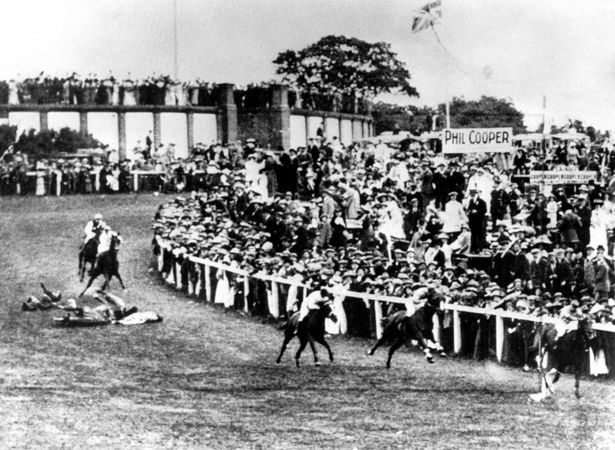
From 1913-14, on the brink of WWI, support began to change for suffragettes. In June 1913, a tragic event also took place when Emily Wilding Davison, a committed militant suffragette threw herself in front of the King's horse at a horse race. She died of her injuries four days later. Some historians believe she was attempting to tie the suffragettes' colours to the horse, others believe she committed suicide.
Note
Emmeline Pankhurst declared Emily a martyr. Her funeral was a major WSPU event attended by other militant suffragettes, 50 hunger strikers, and around 6,000 women. Another 50,000 members of the public turned out to watch the funeral procession.
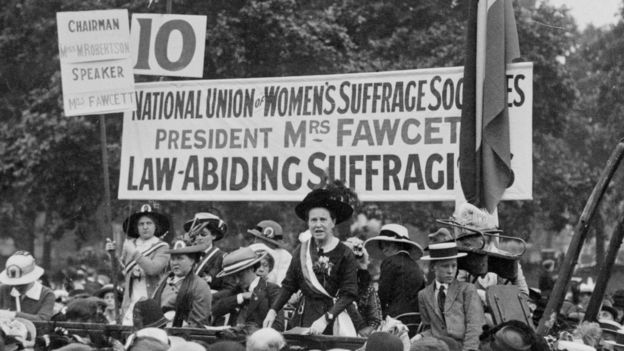
Come 1913, the public was growing tired of violent tactics of suffragettes. Indeed, even Emmeline's daughter disagreed with the direction of the WSPU and emigrated. By contrast, the NUWSS was growing in support again with its law-abiding tactics.
Note
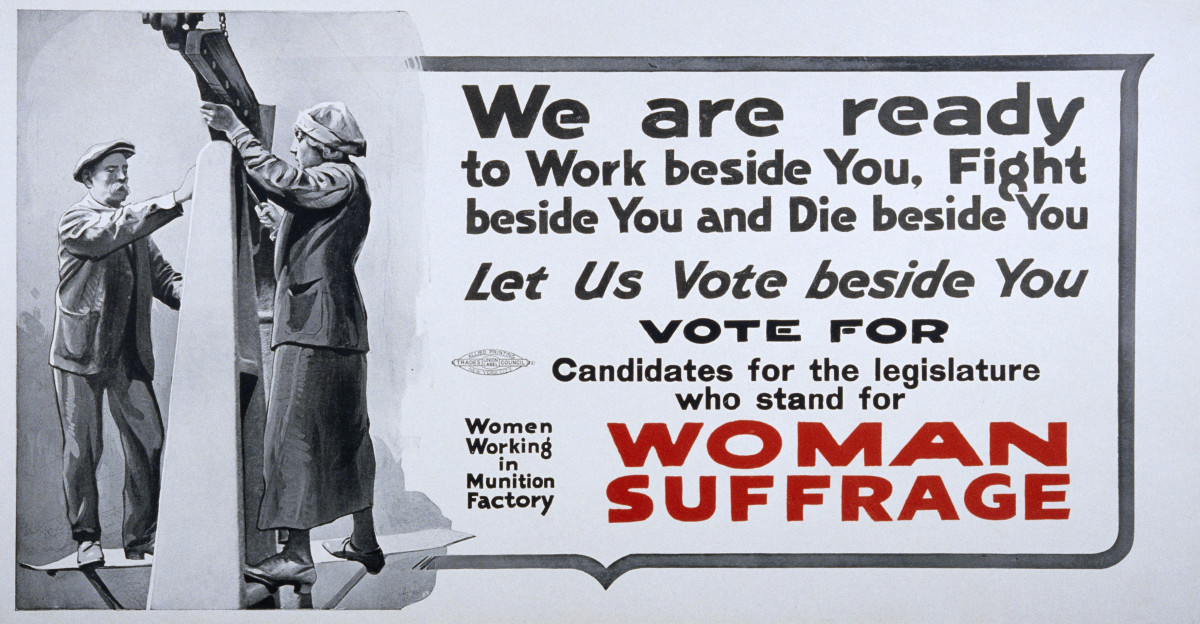
When WWI broke out in 1914, Emmeline Pankhurst realised it would be bad for the cause to continue with militant campaigning for suffrage while thousands of men were being killed on the front line defending Britain. Thus, she persuaded the WSPU to stop its militant activities. During the war, women helped the war effort by keeping things on the homefront running by entering the workforce and taking on traditionally male jobs.
By the end of the war in 1918, women were granted the vote - but only those who were over the age of 30. It would be another 10 years of campaigning before the age was lowered to 21. Emmeline Pankhurst died a little over two weeks before the 1928 Act was passed.
Glossary of Terms
Edwardian Era
Spanning 1900-10 and into WWI, it is regarded as a 'Golden Age' of British history and involved social and political reform.
Suffragette
A working arrangement between the Liberals and Labour Party in British parliament in order to oppose Conservative agendas.
NUWSS
The National Union of Women's Suffrage Societies (NUWSS) was an organisation of women's suffrage societies around the United Kingdom. It was moderate and law-abiding.
Franchise
An authorisation granted by a government giving (certain) citizens the right to vote in general elections.
Force feeding
A system of compulsory payments by employees and employers to provide state assistance for people who are sick, unemployed, or retired.
WSPU
The Women's Social and Political Union was a women-only political movement and leading militant organisation campaigning for women's suffrage.
Exam Practise
Task 1
Using your knowledge of history and additional research where necessary, answer the following questions.
- In what way did the NUWSS give rise to more militant women's suffrage organisations?
- How effective were the militant campaigns of the WSPU? What was the public's and government's response to this?
- How did militant activity end up helping grow support for the NUWSS?
- How do you think WWI helped further the cause for women's suffrage? How did women's roles change during WWI?