Nazi racial policy: the growing persecution of Jews (OCR GCSE History B (Schools History Project)): Revision Notes
📚Revision Notes
Nazi racial policy: the growing persecution of Jews
Note
The Nazi ideology was formulated by Adolf Hitler. He believed that a person's attitude, behaviour and capability were determined by race. Aside from possessing physical and mental traits, Hitler and the Nazis adopted the Darwinian concept of "survival of the fittest".
<img src="https://simplestudy-assets-prod.s3.eu-west-1.amazonaws.com/assets/backend/uploads/manually-styled-note-images/15933a6f-786c-4892-a1e9-fb23c13ab05b.png" width="270" height="368" alt="Nazi propaganda poster warning Germans about the dangers of east European "subhumans." Germany, date uncertain." />
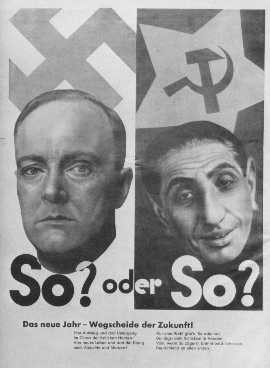
Nazi propaganda poster warning Germans about the dangers of east European "subhumans." Germany, date uncertain.
Aside from the Jewish race, Nazis treated other groups as subhuman, including the gipsies, Poles, people with disabilities, Soviet prisoners of war, homosexuals, Jehovah's Witnesses and Afro-Germans. They were targeted for imprisonment and total annihilation.
The Nazis believed that it was their obligation as a superior race to subdue and exterminate inferior races. For them, maintaining the purity of their race was vital, so they avoided interracial relationships to prevent degeneration of the Aryan race. Hitler believed that the Aryan was superior above all races.
By outlining their racial enemies, Jews within and outside Germany became their priority target. The Nazis viewed Jews as instruments and supporters of capitalism and communism.
Note
Among the minorities in Germany, the Jewish population was heavily targeted from 1933. When WWII began, mass killings of Jews through the Final Solution was well recorded in history.
1933
Jewish businesses and products were boycotted by the Nazis. Books with Jewish authors were publicly burned. Furthermore, Jewish professionals including teachers, lawyers and civil servants were fired. Race science taught German students that Jews were subhuman.
1935
The Nuremberg Laws took effect, which stripped Jews of German citizenship. Marriage between Jews and Germans was outlawed and sexual relationships were also prohibited. Jews were stripped of civil and political rights.
1938
Jewish children were forbidden from attending school. Jews were required to add Israel (men) and Sara (women) to their names. On 9 November, Hitler's SS embarked on Kristallnacht, which attacked around 191 synagogues, Jewish homes and businesses.
Policy of persecution of minorities
Sterilisation
Nazi scientists believed in eugenics in which people with disabilities were believed to be carriers of degenerative genes that should be eliminated in order to keep the next generation of Aryans pure.
On 1 January, 1934, the Law for the Prevention of Genetically Diseased Offspring came into effect, which decreed that any person who had hereditary diseases should undergo medical experiments and sterilisation.
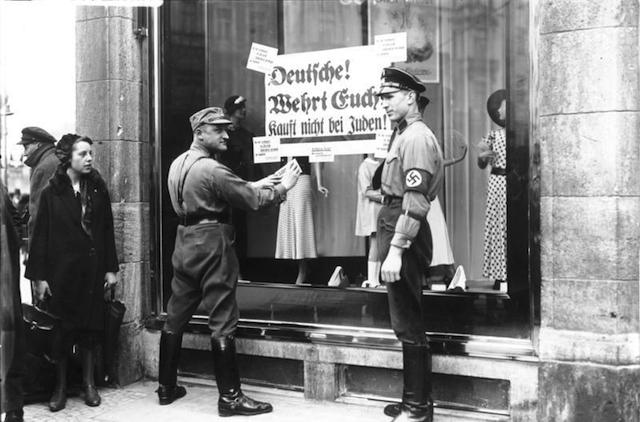
Image of Nazis affixing a sign on a Jewish store to tell shoppers not to buy their products during the early stages of Jewish persecution in Germany
Concentration camps
Note
Minorities including gipsies, homosexuals, beggars, alcoholics, pacifists, Jehovah's Witnesses, criminals and prostitutes were all sent to concentration camps where they were worked to death.
Eugenics
Early in history, many believed that people could inherit mental illness and criminal tendencies. Adolf Hitler was among the supporters of this science, which sought to improve reproduction of the human species through selective mating of individuals free of undesirable characteristics. With his view to make the Aryan race superior, Hitler enforced forced sterilisation.
Among the experiments were using eyedrops to create blue eyes, surgeries without anaesthesia, and injection of prisoners with diseases, which earned him the name Angel of Death.
With WWII ongoing, Josef Mengele, an SS doctor, oversaw the experiments conducted on adult and child twins at Auschwitz.
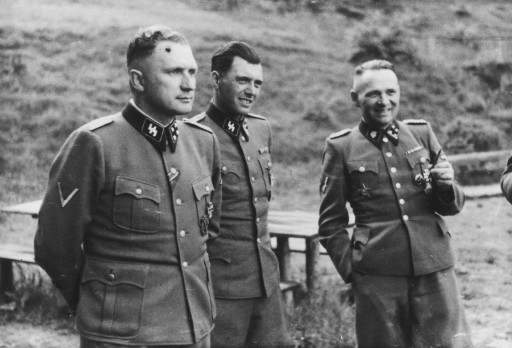
Image of Josef Mengele between two other Nazi officials
Note
Nazi eugenics were inspired by California's forced sterilisation programmes.
Social outsiders were named 'asocial' who were accused of carrying defective genes. They were either subjected to sterilisation or persecution. Moreover, male homosexuality was also declared as a threat to the Aryan race, thus, homosexuals were persecuted.
Tagged as Rhineland bastards, people who were born to German mothers and fathered by French-African soldiers from WWI were also sterilised.
Note
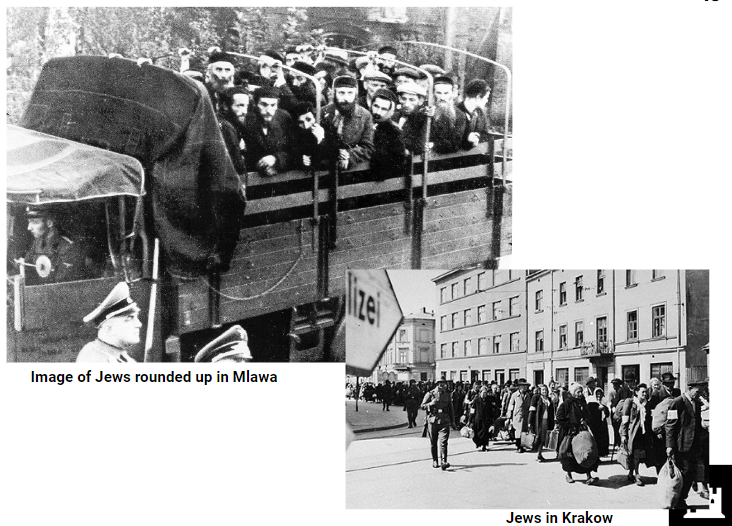
Hitler proliferated anti-Semitism or hatred of Jews across Germany. Germans saw the Jewish race as a threat to the nation. Hitler blamed the Jews for defeat in WWI, the spread of communism, for ideas of democracy, and the failure of the Weimar Republic.
1938
They were not allowed to own property or businesses and were highly restricted with work opportunities. As a result, about 115,000 Jews left Germany, contributing to the 400,000 Jews that had fled come 1933.
Glossary of Terms
Eugenics
A belief and practice of controlled selective breeding of the human population.
Lebensborn
A policy of encouraging pure Aryan women to have children with a pure Aryan member of the SS.
Persecution
An act of discriminating, oppressing and exterminating a group of people based on race, religion, ethnicity etc.
Sterilisation
A process used by Nazi scientists to 'treat' hereditary illness, particularly those disabilities.
Anti-Semitism
Hostile and discriminatory behaviour towards the Jewish people promoted by the Nazis.
Jews
People who believe in the traditional religion of Judaism.
Exam Practise
Task 1: Source Analysis
Note
Using the source and your own knowledge of the historical context, how did the Nazi regime treat German women? To what extent do you agree with Hitler's view? Justify and contextualise your answer.
"As a visible sign of gratitude of the German nation to children-rich mothers, I establish this Cross of Honour of the German Mother."
German translation "Als sichtbares Zeichen des Dankes des Deutschen Volkes an kinderreiche Mütter stifte ich das Ehrenkreuz der Deutschen Mutter"
- Adolf Hitler, 16 December 1938
Task 2: Essay
Note
Given your understanding of the historical context and analysis of the source, write an essay on the role of concentration camps and the fate of 'undesirables' during this period in German history.
...27 January 2005, the sixtieth anniversary of the liberation of Nazi Germany's death camp at Auschwitz-Birkenau, where a combined total of up to 1.5 million Jews, Roma, Poles, Russians and prisoners of various other nationalities, and homosexuals, were murdered, is not only a major occasion for European citizens to remember and condemn the enormous horror and tragedy of the Holocaust, but also for addressing the disturbing rise in anti-Semitism, and especially anti-Semitic incidents, in Europe, and for learning anew the wider lessons about the dangers of victimising people on the basis of race, ethnic origin, religion, social classification, politics or sexual orientation…
- 2005 European Parliament resolution
Task 3: Source Analysis
Note
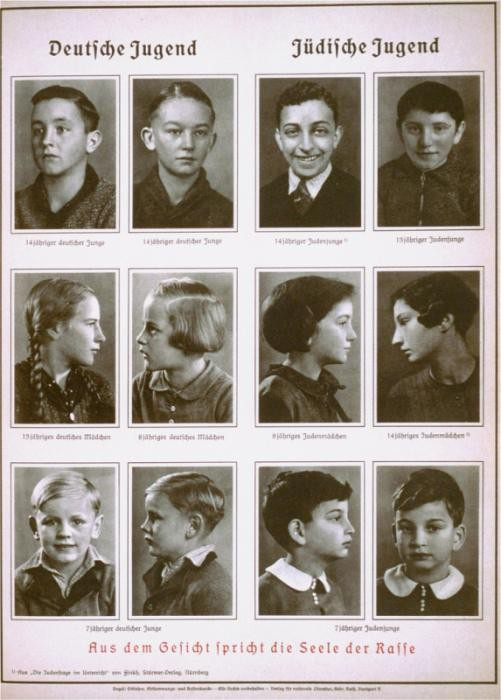
Given the source, how would you describe the Aryan idea of race based on Nazi beliefs? To what extent to do you agree with the Nazi ideology of race? Substantiate your answer.
A 1938 comparative illustration of German Youth and Jewish Youth from Alfred Vogel's text Inheritance and Racial Hygiene with the subtitle "From the face speaks the soul of the race."