The machinery of terror including the SS, the law courts, concentration camps and the Gestapo (OCR GCSE History B (Schools History Project)): Revision Notes
📚Revision Notes
The machinery of terror including the SS, the law courts, concentration camps and the Gestapo
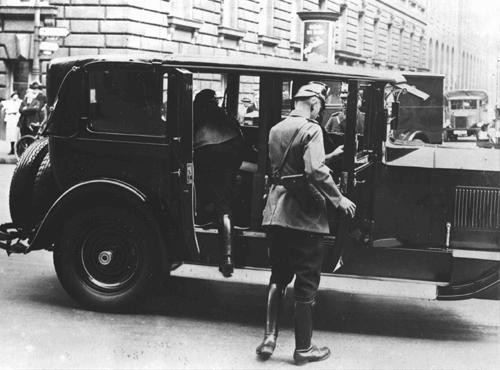
Police search a vehicle for arms, an indication of the suspension of individual freedom
26 APRIL, 1933
The Nazis took control of local government and the police. Moreover, the Gestapo was set up sending thousands of 'undesirables' including Jews and Communists to concentration camps.
MAY 1933
Trade unions were banned. Union leaders were sent to prison, their money was confiscated, and the right to strike was abolished. The German Labour Front became the only existing union.
JANUARY 1934
Hitler issued a law for the reconstruction of the Reich, abolishing elected state assemblies and appointment of state Reich governors. People's courts were established with judges who took an oath of loyalty to
Hitler only.
14 JULY, 1933
Hitler banned other political parties, and only the Nazi Party was allowed to exist. As a result, Germany became a one-state party, destroying the idea of democracy as there could be no source of opposition.
With great control over the police, Hitler ordered door-to-door arrests of political opponents. The SA and Gestapo agents arrested Socialists, Communists, trade union leaders and anyone who spoke against the Nazis. Most were sent to concentration camps while others were murdered. By the summer of 1933, democracy was dead in Germany.
The Nazis established detention camps from old warehouses and abandoned buildings. Prisoners were exposed to harsh conditions including torture and starvation.
THE ORIGINS OF THE GESTAPO AND SS
Gestapo or Geheime Staatspolizei
Note
On 26 April, 1933, Hermann Göring created the Secret Police Office, commonly known as the Gestapo.
- The Gestapo was originally created to intimidate and silence Hitler's political opponents in Berlin and nearby areas.
- Rudolf Diels became the first Gestapo chief. Diels was a member of the Prussian Ministry of the Interior and senior adviser of the police.
- Due to rivalry between Göring and another rising Nazi leader, Heinrich Himmler, the former decided to cede the Gestapo.
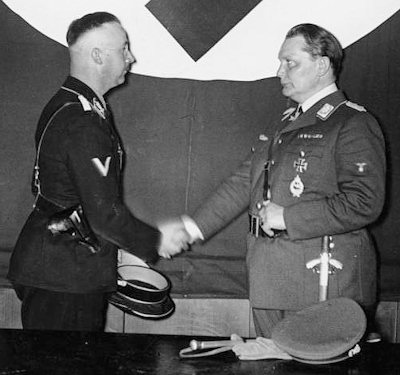
Image of Göring (right) and Himmler (left)
- On 10 February, 1936, under Himmler, the Gestapo Law was passed, which placed them above the law.
- The law included this paragraph, "Neither the instructions nor the affairs of the Gestapo will be open to review by the administrative courts."
- The Gestapo was given the right to arrest, interrogate and execute anybody without any legal procedure.
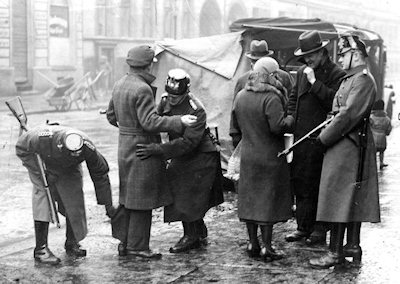
German citizens searched by plain-clothes, 1933
Note
The majority of Gestapo agents worked as spies, while a few were office personnel. Common Germans had no idea if a person was a member of the Gestapo, as they were plain-clothes agents. As a result, most people exercised self-censorship.
Note
In April 1925, Hitler established the Schutzstaffel (SS; 'Protective Echelon'), an elite corps of the Nazi Party answerable only to the Führer. It was a paramilitary division of Hitler's Sturmabteilung (SA; 'Assault Division'), his own private army, established by 1921.
Heinrich Himmler joined the Nazi Party in 1923. As a fervent Nazi loyalist and anti-Semite, he was appointed by Hitler as the new head of the SS in January 1929. Under his leadership, the group's role and size expanded. By the start of the Second World War, the SS was the most important military group in Germany.
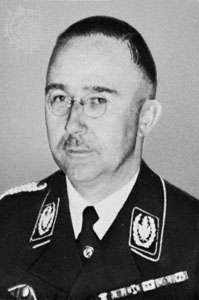
Left: A portrait of Heinrich Himmler, the director of the SS.
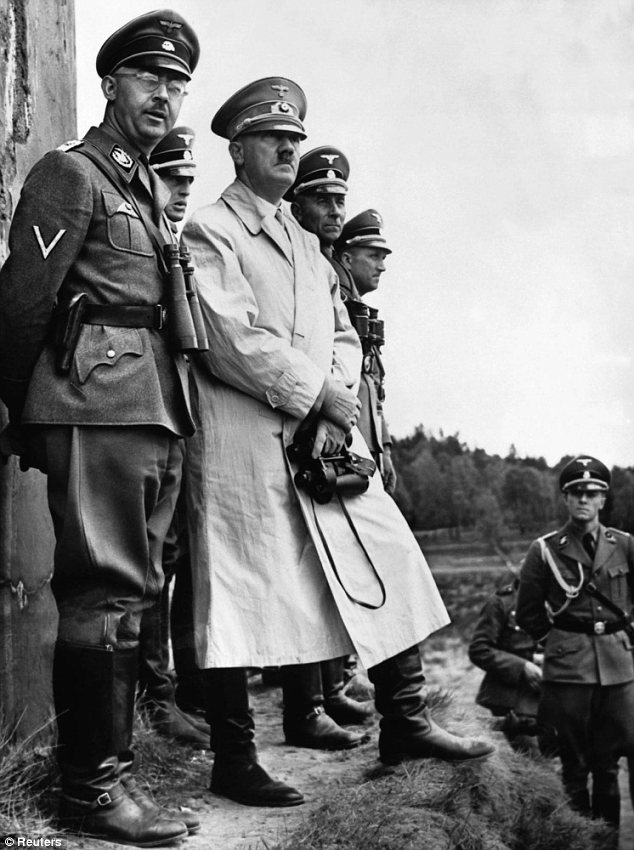
Right: Image of Hitler and Himmler in 1940
In 1931, a special division was created under the SS, the Sicherheitsdienst (SD). Its main task was to serve as a special intelligence agency for the SS. They were tasked with ensuring the safety of Hitler and other top Nazi officials.
It was headed by Reinhard Heydrich, Himmler's right-hand man.
In March 1933, Hitler declared the opening of the first Nazi concentration camp in Dachau, Germany. It was intended as a prison camp for the Nazis' political adversaries and was operated by the SS.
SS Totenkopfverbände
The 'Death's Head Unit' was so named due to its insignia, a Totenkopf (skull). It signified their faithfulness to Hitler until death. Their main task was to operate Hitler's concentration camps.
SS Verfügungstruppen
Known as SS-VT, its members were trained military men who agreed to four-year compulsory terms of service. They were housed in military barracks and were at the disposal of
Hitler.
Note
By 26 April 1933, the Geheime Staatspolizei, commonly known as Gestapo (Secret State Police), was established. It was used to track down and eliminate opposition without due process. Suspected opponents were mainly imprisoned in concentration camps.
Himmler established the Waffen-SS (originally the SS-VT) at the outset of the Second World War. Its members' main task was to terrorise people from the different territories occupied by the Nazis. Moreover, they were also tasked with operating the concentration camps.
Originally, its membership was limited to Germans to maintain Aryan supremacy. Due to the demands of the Third Reich's operations, however, it opened its membership to foreign volunteers and conscripted men from Nazi-occupied territories.
900,000
Estimated members of the Waffen-SS

Concentration camps
Note
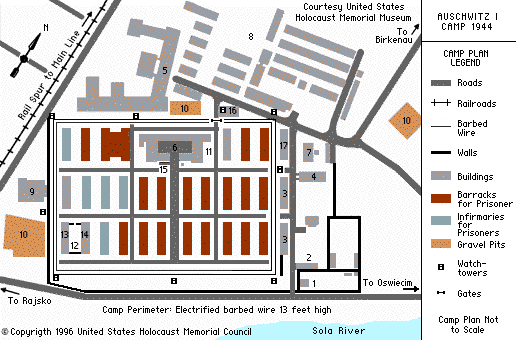
Image of Auschwitz Camp I in 1944
In the spring of 1940, Nazi Germany established the first camp at Auschwitz and the first in Poland, on a site which used to be barracks for the Austro-Hungarian army in Upper Silesia. By June, the first prisoners were transferred to the camp. By early 1941, a synthetic rubber fuel company known as the Petro-Chemical Corporation was established. By the time the Germans invaded the Soviet Union, Auschwitz became a prisoner-of-war camp. Later that same year, Auschwitz II, commonly known as Auschwitz-Birkenau, was built adjacent to the main camp, which occupied a small agricultural community.
Note
Its construction was supervised by Karl Bischoff under the Central Building Authority of the Waffen SS and Police. Initially, the construction was carried out by Soviet prisoners. Soon, many Polish and Jewish prisoners joined them. Compared to the main camp, the camp at Birkenau was made of wooden huts and was originally intended to accommodate 550 prisoners.
After the construction of Birkenau, its function changed to an extermination camp. By the autumn of 1941, gas experiments were carried out. Seeing its effectiveness, additional installations were placed. Immediately in 1942, existing buildings were converted into gas chambers as well, which began to operate the following year.
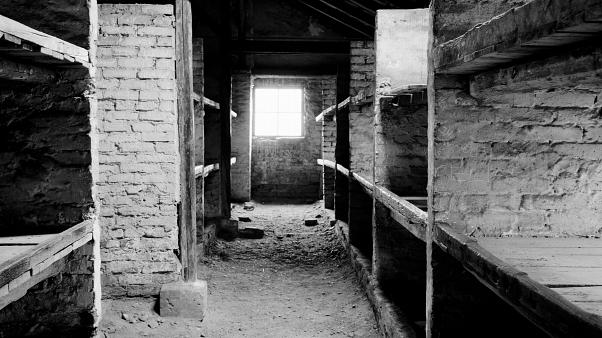
Image of a brick prisoner barracks in the former Auschwitz-Birkenau camp
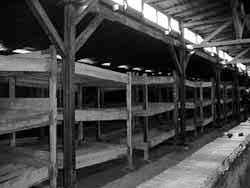
Image of a wooden prisoner barracks in the former Auschwitz-Birkenau camp
Prisoners were fed rations. Those who had less demanding labour assignments were given lesser-calorie meals per day. However, as the days went by, many experienced malnutrition, deterioration and extreme exhaustion, which caused their deaths.
Note
Every day, prisoners worked more than 10 hours. They lined up in long roll-call assemblies for food rations. Under the WVHA decree instituted on 31 March, 1942, prisoners in concentration camps worked at building the camp, digging drainage ditches, and in factories in sub-camps.
About 40 smaller camps or sub-camps were also utilised in Auschwitz. Most used prisoners as slave labour who were worked to death in industrial plants and farms. Some of the sub-camps included Altdorf, Althammer, Babitz, Blechhammer, Bobrek, Budy, Buna, Chelmek, Harmense, Janina Grube, Kobier, Lagischa, Monowitz, Plawy, Tschechowitz, Trzebini and Sosnowitz.
Note
Auschwitz III, or Monowitz, was a forced labour camp that supplied men to the IG Farben plant that produced Zyklon B gas.
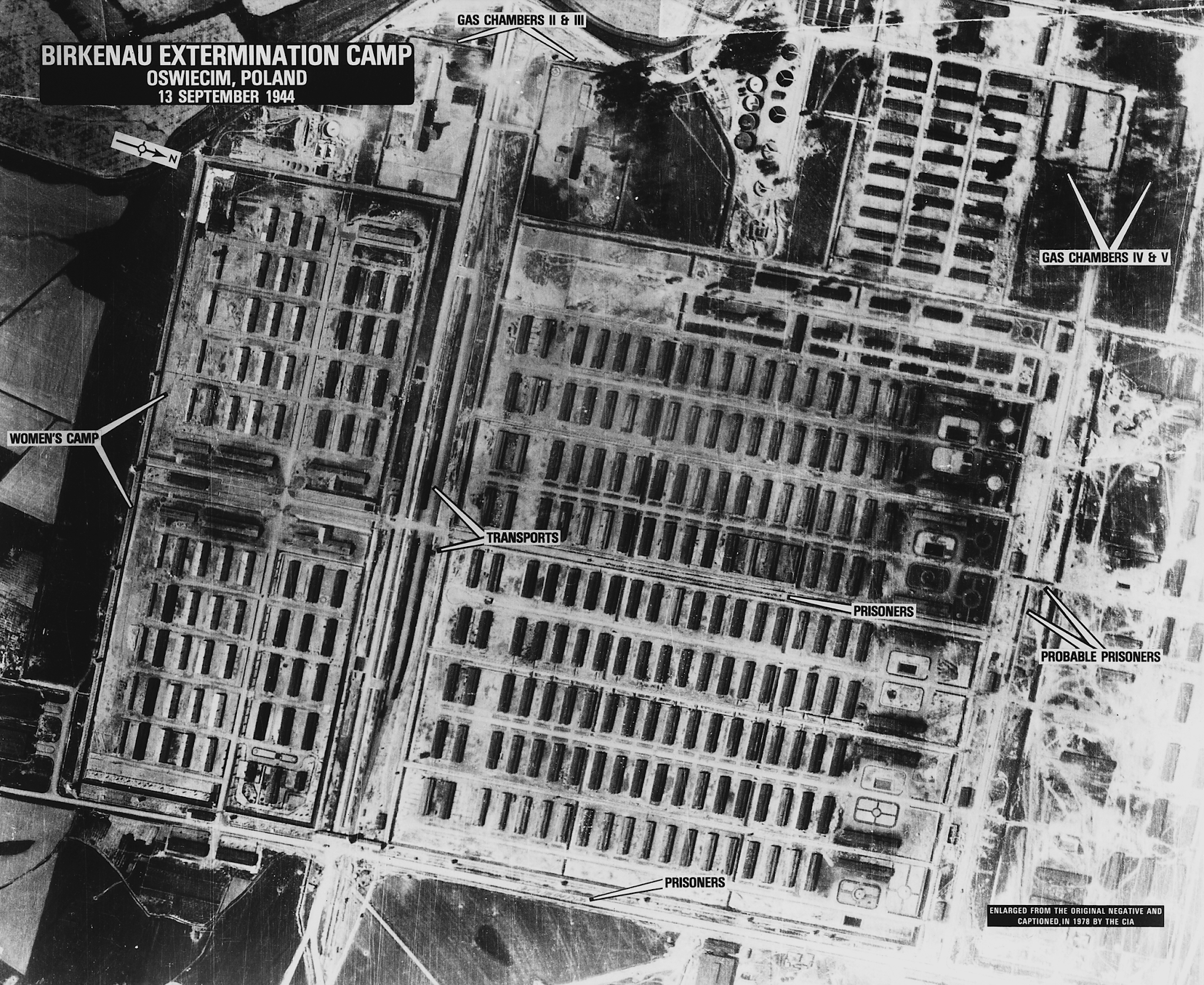
Aerial reconnaissance photograph of Auschwitz taken by the US Army Air Force
Note
When the Third Reich occupied the city of Oswiecim in Poland, the name was changed to Auschwitz. In 1940, the plan for building a concentration camp at Auschwitz began. Major technical drawings of the construction were made by SS draughtsmen, prisoners who were once employed in planning offices, and civilian draughtsmen. Included in the drawings were gas chambers and the crematoria.