The impact of total war on the German people, 1943–1945 (OCR GCSE History B (Schools History Project)): Revision Notes
📚Revision Notes
The impact of total war on the German people, 1943–1945
Note
On 3 September, 1939, WWII broke out when Britain and France reacted to the German invasion of Poland. In around a month, Poland was completely under Nazi control, while Hitler publicly made amends with the Allies. However, Hitler was secretly planning the invasion of France.
Unlike in the First World War, Germans reacted to WWII with resignation. Many still remembered what they lost in the Treaty of Versailles. On the other hand, many signed up to help in the war effort. As a result, they turned into a war economy.
In 1942, the British RAF Bomber Command employed a policy of area bombing, which targeted large industrial cities but not sparing civilian casualties. For the next three years, about 61 German cities were attacked and 25 million people were affected; 3.6 million homes were destroyed; 300-400,000 Germans were killed in the raids; 800,000 wounded; and 7.5 million left homeless. German industrial production continued, however, until just before the war ended.
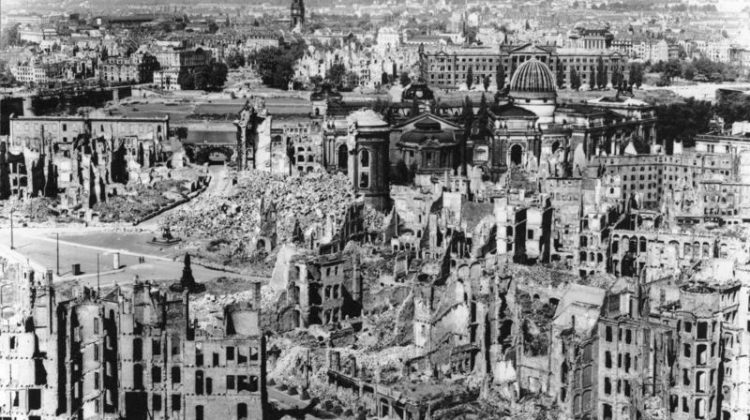
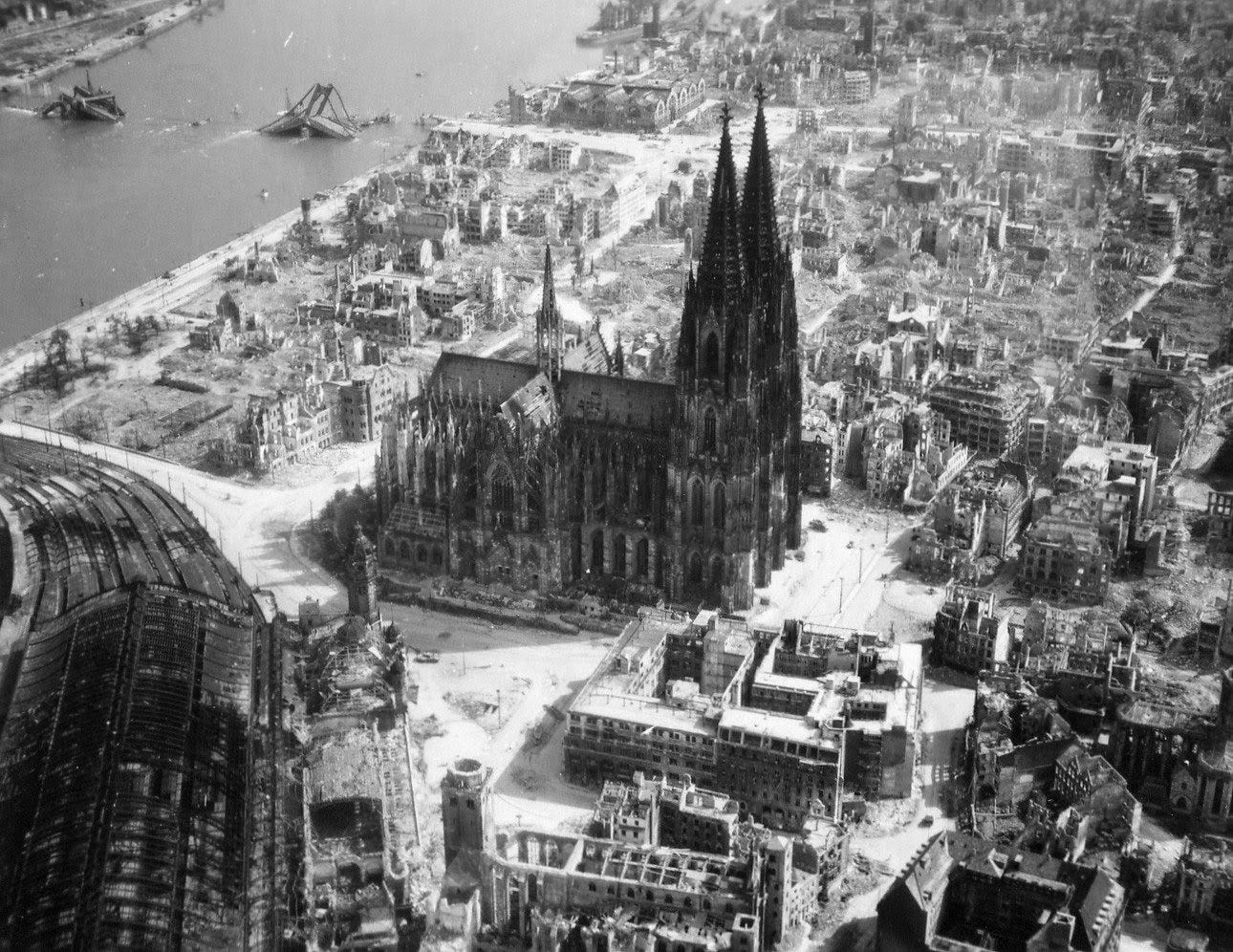
Image of Frankfurt (above) and Dresden (below) in Germany after the British area bombing.
Rationing
On 27 August, 1939, food rationing was introduced, followed by clothing in October. As a result, the German diet was monotonous and composed of bread, potato and preserves. They rarely consumed meat due to a lack of imports from the US and food entitlements depended upon the individual's war effort.



250 grammes/week
125 grammes of butter and 1 egg/week
Note
As a World War I veteran, Hitler was determined that Germany not repeat the same hardships experienced on the home front in WWII. In August 1939, the system of rationing food, soap, clothes and other immediate necessities was introduced. In order to prevent political control, like had happened in WWI, Hitler ordered that rationing be kept to a minimum.
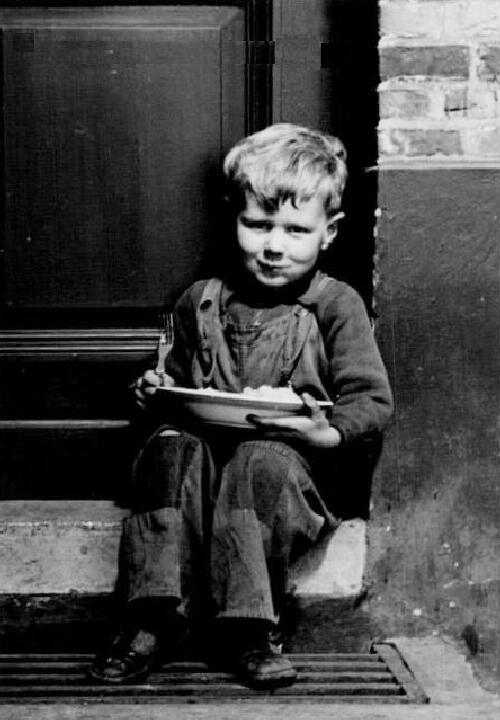
Image of a German boy eating ration food
Note
Home front refers to the civilian population affected by war.
Rationing began in 1939, yet chronic shortages in Germany for consumer goods was only felt in 1944. As an effect of war, they ate a lot of bread, potatoes and preserves. Meat importation from the US was banned, while consumer goods from France also decreased. By 1941, food consumption per individual had dropped by 25%.
Forced Labour
In order to keep the war effort going, the Nazis employed forced labour by transporting prisoners of war to concentration camps in Germany and other parts of Eastern Europe. When the war ended, there were about 8 million slave labourers and refugees in Germany. In addition, about 11 million ethnic Germans were displaced from Eastern European countries.
Note
As a result of intensive British area bombing in 1942, thousands of refugees fled the cities. Moreover, when the Russians went through Poland, many moved westwards to escape the Reds.
Widespread conscription brought 13.7 million German men into the military. However, it resulted in labour shortages on the home front. Like what happened during WWI, large numbers of women entered the workforce in replacement of men. They worked mainly in ammunition factories.
Note
Aside from turning the entire economy to war efforts, the total war also employed mass conscription.
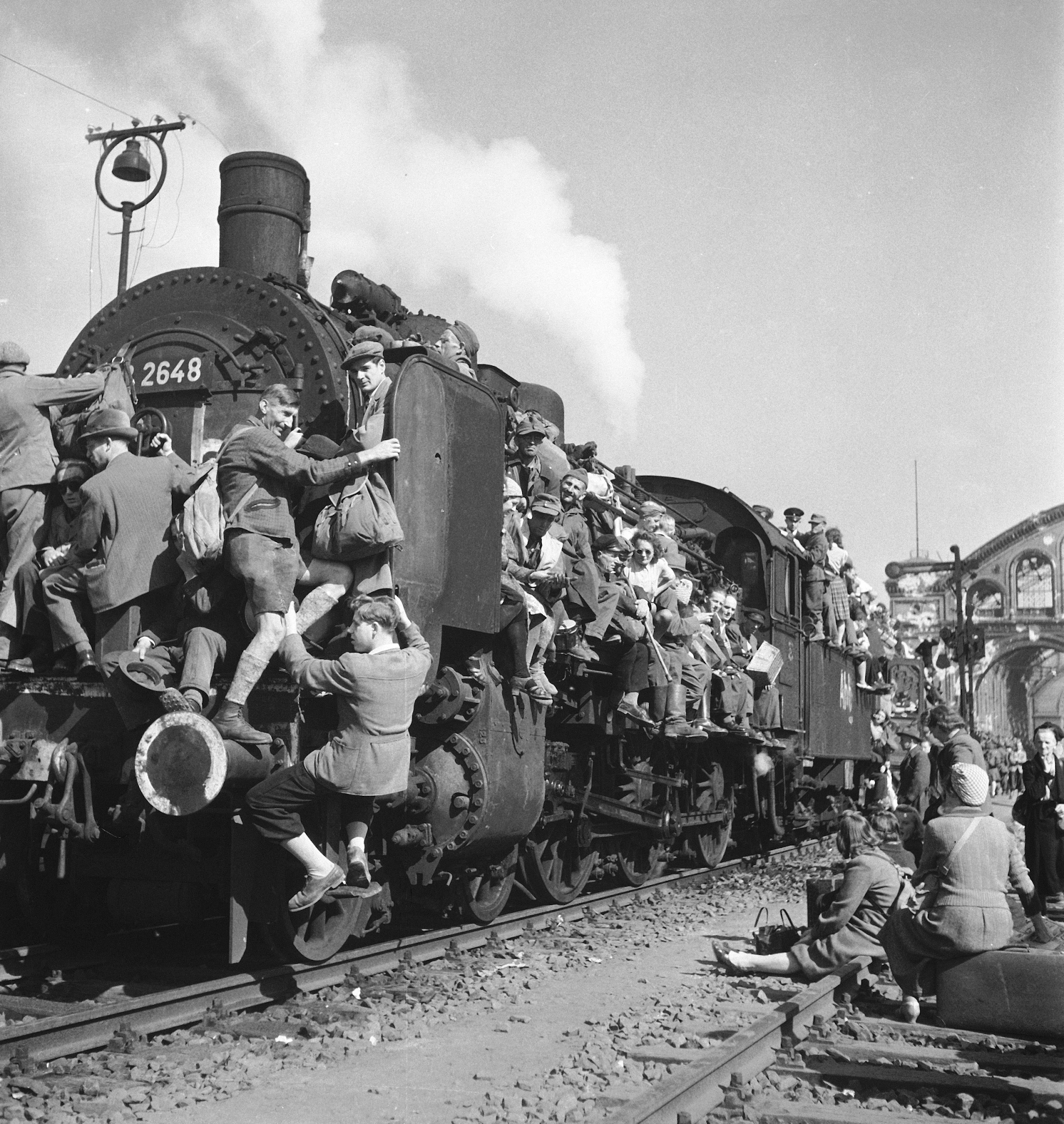
Post-WWII German refugees and displaced persons crowding a train leaving Berlin.
As a result of coal shortages, in the winter of 1939-1940, Germans were only allowed to use warm water twice a week.
Up until the middle of the war, food shortages were tolerable for most on the home front, but famine became severe during the last year of WWII.
Note
Come 1940, almost half of the German workforce was engaged with war production. Ironically, the number of female industrial workers also grew, which contradicted Nazi policies. Armament production was the leading job for both German men and women during the war. By the end of the war, about 7 million non-Aryans were working in Germany.
Note
Every year, Germans on the home front were given 66 coupons to buy new clothes. It was cut to 36 coupons in 1943.
| Item | Men | Women | Children |
|---|---|---|---|
| Raincoat Jacket Trousers Shorts Shoes Underpants Socks | 16 13 8 3 7 3 2 | 15 12 8 3 5 3 2 | 11 8 6 2 3 2 1 |
Table of clothing sold through coupons
Note
Despite the loss of freedom in many aspects of German life, conforming was necessary in order for them to have jobs and wages.
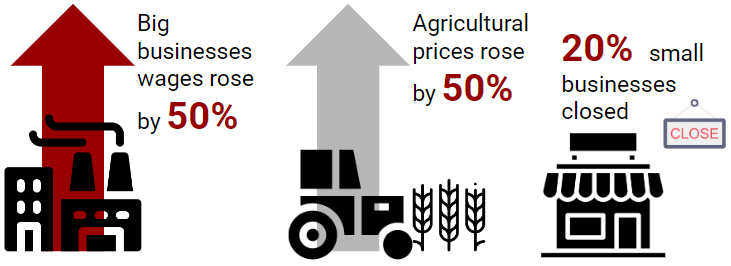
Rules on opening and running small businesses were tightened.
By 1937 monopolies controlled 70% of production. Rearmament from 1935 boosted profits and managers saw their wages rise by 50% between 1933-39.
As farmers brought large electoral support, they benefitted under the Nazis. By 1937, agricultural prices had increased by 20%, and wages rose more quickly than those in industry. And although farmers had greater security, they were also fixed to their land.
Controlling industrial workers required the Nazis to establish the German Labour Front (DAF), Strength Through Joy and the Beauty of Labour.
Note
The German Labour Front (DAF) replaced trade unions, which Hitler had banned. The DAF was almost always in favour of the employer when it came to issues of conditions and wages.
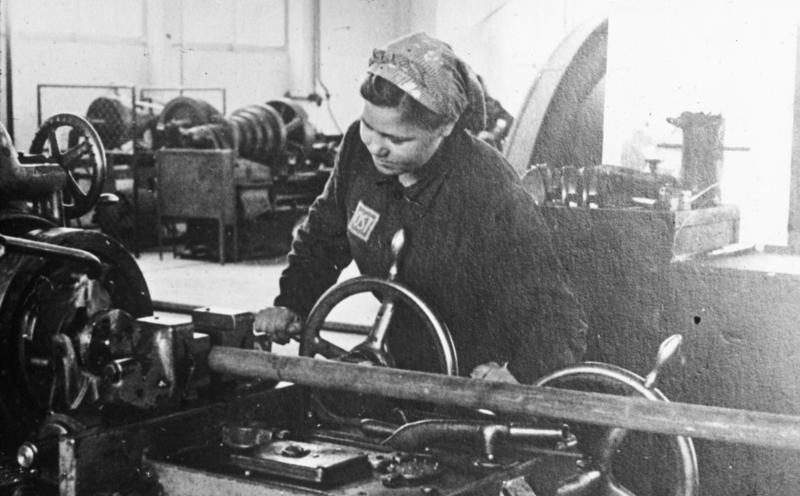
Image of a female industrial worker
Strength Through Joy was a Nazi scheme that sought to incentivise workers in the rearmament industries into greater productivity by giving rewards for workers' efforts including evening classes, trips to the theatre, picnics and holidays.
Beauty of Labour was an organisation whose goal was to influence Germans into believing that work was good, and all able-bodied Germans should work. It encouraged factories to improve conditions for its workers.
Living standards did not really improve for German workers and between 1933-39 wages fell, hours of work rose, serious work accidents increased and employees could be blacklisted if they questioned their working conditions.
Glossary of Terms
RATIONING
A policy employed by the Nazi regime to answer shortages in food, fuel and clothing which allowed a person to have a fixed amount of commodities.
RAD
The National Labour Service or Reichsarbeitsdienst which aimed to eliminate unemployment in Nazi Germany.
AUTOBAHN
A four-lane divided highway without intersections built as part of Hitler's public works programme to reduce unemployment.
AUTARKY
A policy of Hitler which aimed to make Germany economically self-sufficient.
TOTAL WAR
Mobilisation of the whole of society and the economy for war efforts, including armament production.
VALKYRIE
The failed operation to use the reserve army for a coup d'etat to overthrow the Nazi regime.
Exam Practise
Task 1: Source Analysis
Note
Read and analyse the source to answer the questions provided.
-
What is the purpose of the source?
-
How did Hitler view the Jewish race?
-
What was the implication of the source for Nazi's economic policy?
I consider it necessary for the Reichstag to pass the following two laws: 1) A law providing the death penalty for economic sabotage and 2) A law making the whole of Jewry liable for all damage inflicted by individual specimens of this community of criminals upon the German economy, and thus upon the German people.
- Adolf Hitler, Four-Year Plan Memorandum
Task 2: Source Analysis
Note
In his speech, Goebbels attempted to counter Allied reports of German defeat. Now, read, examine and make an inference on the source. What was he trying to convey in his message? If he was addressing the German people, what was his goal?
Do you believe with the Führer and us in the final total victory of the German people? Are you and the German people willing to work, if the Führer orders, 10, 12 and if necessary 14 hours a day and to give everything for victory? Do you want total war? If necessary, do you want a war more total and radical than anything that we can even imagine today?
- Joseph Goebbels at the Nazi rally on 18 February 1943 at the Berlin Sportpalast
Task 3: Essay
Note
Given your understanding of the historical context, write an essay about Nazi Germany's war economy. Be guided by the questions below.
QUESTIONS
-
How significant and effective were the economic policies employed by the Nazis, including rearmament and the public works programme?
-
Did the policies reduce unemployment? To what extent do you agree with this action?
-
What was the impact of total war on the German people, particularly on the home front?