Occupation (OCR GCSE History B (Schools History Project)): Revision Notes
📚Revision Notes
Responses to Nazi rule: collaboration, accommodation and resistance
Note
By the end of 1942, Nazi Germany occupied most of Europe. Territories from Poland, Czechoslovakia, France, Belgium and the Baltic states were incorporated to Greater Germany.
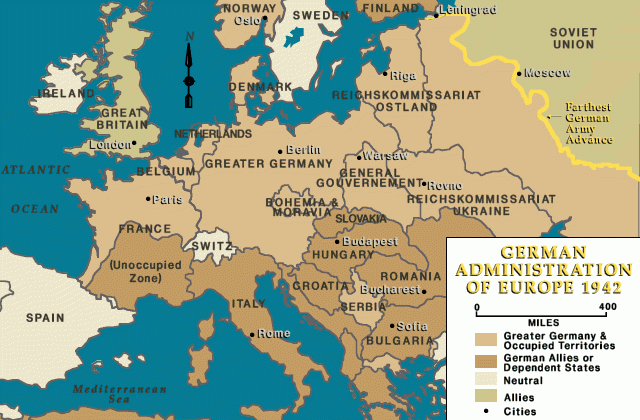
Meanwhile, the countries of Norway, Denmark, northern France, Serbia and northern Greece were occupied by the German military. Moreover, the territories of Hungary, Romania, Croatia, Bulgaria, Finland, Slovakia and Vichy France signed alliances with the Nazi state.
Note
Between 1942 and 1944, territories in southern France, central Italy and Slovakia were invaded by the German military forces.
Collaboration and Accommodation
Note
When the Nazis invaded territories in Europe, several went along with their rule. Collaboration and accommodation of government officials and groups with the Nazis was manifested through the following:

Note
Collaboration was made official with signed alliances. Territories provided troops for the Axis forces. Moreover, they also complied with the Nazi policy of rounding up and deporting Jews to Poland.

Note
The Nazi-occupied territories of Vichy France, Denmark and Norway retained their respective governments but were controlled by the German military.

Note
In the Baltic states of Latvia, Estonia and Lithuania (occupied by the USSR in 1939 under Communism), many joined the Nazis believing that they were liberators. A part of their local population participated in the killings of Muslims, Communists and Jews. Others joined the SS.

Note
Many prisoners of war were brought into forced labour.
Resistance
Note
Across German-occupied Europe, several territories resisted Nazi rule. From passive to armed resistance, local populations attempted to sabotage the Nazi rule.

Note
During the Nazi occupation of France, a rural guerilla band called the Marquis became known for attacking railways and German operations in the Alps. Moreover, they aided escaping Allied airmen and Jews.
Note
Due to Nazi brutality, about 140,000 men in Belorussia in the USSR participated in partisan units. They particularly attacked German supply lines.

Note
In August 1944, the Home Army in Poland showed resistance by attempting to liberate Warsaw. However, their fighting was subdued by the Germans after 63 days.
Note
In May 1942, about 13,000 Czechs were arrested after a failed assasination plot against Nazi leader Reinhard Heydrich. It is believed that resistance groups were supported by British and American special operations.
Forms of resistance
- Non-violent
- Sabotage. Those who were subjected to forced labour, mostly POWs, intentionally worked slower.
- Professional resistance among intelligentsias such as doctors, priests and university students.
- Printing of anti-Nazi propaganda, helping Jews to escape persecution.
- Armed
- Deliberate raid on supply lines and birth registry offices to protect identification of minorities including the Jewry.
- Temporary liberation of cities including Paris and Yugoslavia.
- Uprisings in extermination camps, particularly Sobibor in 1943 and Auschwitz in 1944.
- Guerilla warfare of partisan units.
- Espionage
- Sending of military movements and reports.
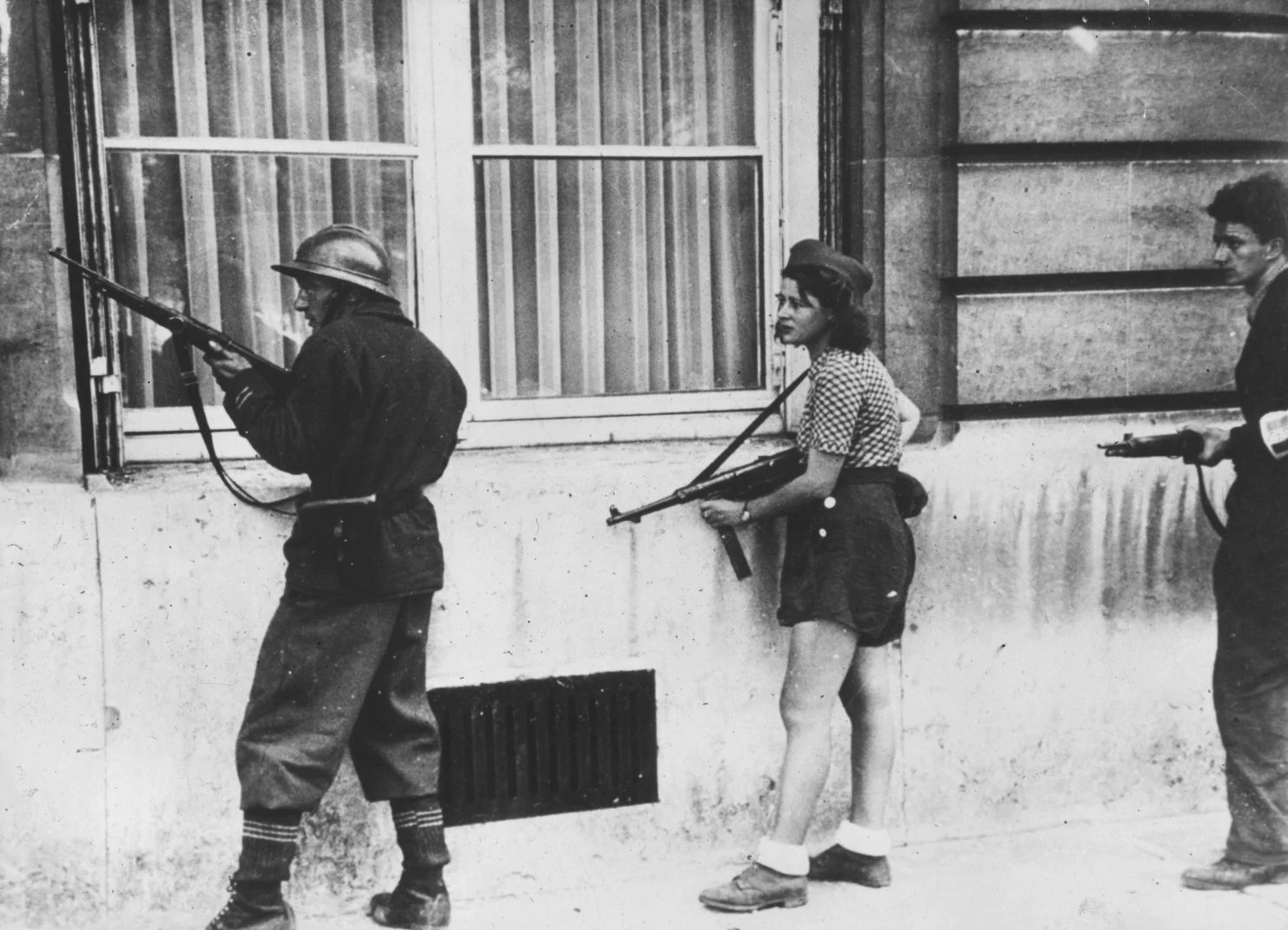
Armed fighters take part in the liberation of Paris
Glossary of Terms
HOLOCAUST
Also known as the Final Solution which killed millions of Jews and other minorities during Nazi rule and WWII.
FINAL SOLUTION
A Nazi policy of exterminating the Jewish population in Europe.
ANSCHLUSS
German invasion of Austria to materialise the Nazi idea of lebensraum.
LEBENSRAUM
Nazi ideology of expanding living space for Germans.
EINSATZGRUPPEN
Schutzstaffel (SS) paramilitary death squad used by the Nazis.
LEBENSBORN
A Nazi belief and policy which ensured the birth of children with pure Aryan genes.
Task 1: Source Analysis
Note
Critically read the sources provided and make an inference on their purpose. Be guided by the following:
- Nature of the statements
- Nazi policy
- Significance of the event
Source A
"Everyone worked so hard, got beaten up…and came back to the camp --the exhaustion alone pushed him to the bunk to lie down and sleep throughout the night and get enough strength so that s/he might be able to do that again tomorrow. …
- Jack Oran, a Holocaust survivor
Source B
"Immediately all the Jews still outside were pushed into the chambers, and the doors were screwed shut. With subsequent transports the difficult individuals were picked out early on and most carefully supervised. At the first signs of unrest, those responsible were unobtrusively led behind the building and killed with a small-calibre gun that was inaudible to the others."
- Rudolf Hoess, Commandant of Auschwitz
Task 2: Essay
Note
Examine the source and write an essay on Hitler's attitudes towards the Jewish population. You may include Nazi racial policies to contextualise your essay.
If the international Jewish financiers in and outside Europe should succeed in plunging the nations once more into a world war, then the result will not be the Bolshevisation of the earth, and thus the victory of Jewry, but the annihilation of the Jewish race in Europe!
— Adolf Hitler, 30 January 1939 Reichstag speech
Task 3: Perspective
Note
Given your understanding of the historical context and examination of the source, how did Paris respond to Nazi rule? In your perspective, discuss the underlined phrase.
"Even today, the French endeavour both to remember and to find ways to forget their country's trials during World War II; their ambivalence stems from the cunning and original arrangement they devised with the Nazis, which was approved by Hitler and assented to by Philipe Petain, the recently appointed head of the Third Republic, that had ended the Battle of France in June of 1940. This treaty — known by all as the Armistice — had entangled France and the French in a web of cooperation, resistance, accommodation, and, later, of defensiveness, forgetfulness, and guilt from which they are still trying to escape."
- Ronald C. Rosbottom on the Nazi occupation of Paris