The journey across Asia Minor: physical challenges and disunity among the leadership (OCR GCSE History B (Schools History Project)): Revision Notes
📚Revision Notes
The journey across Asia Minor: physical challenges and disunity among the leadership
The crusaders' march through Anatolia might have been unopposed, but the journey was difficult as they encountered physical challenges and disunity among their leaders along the way.
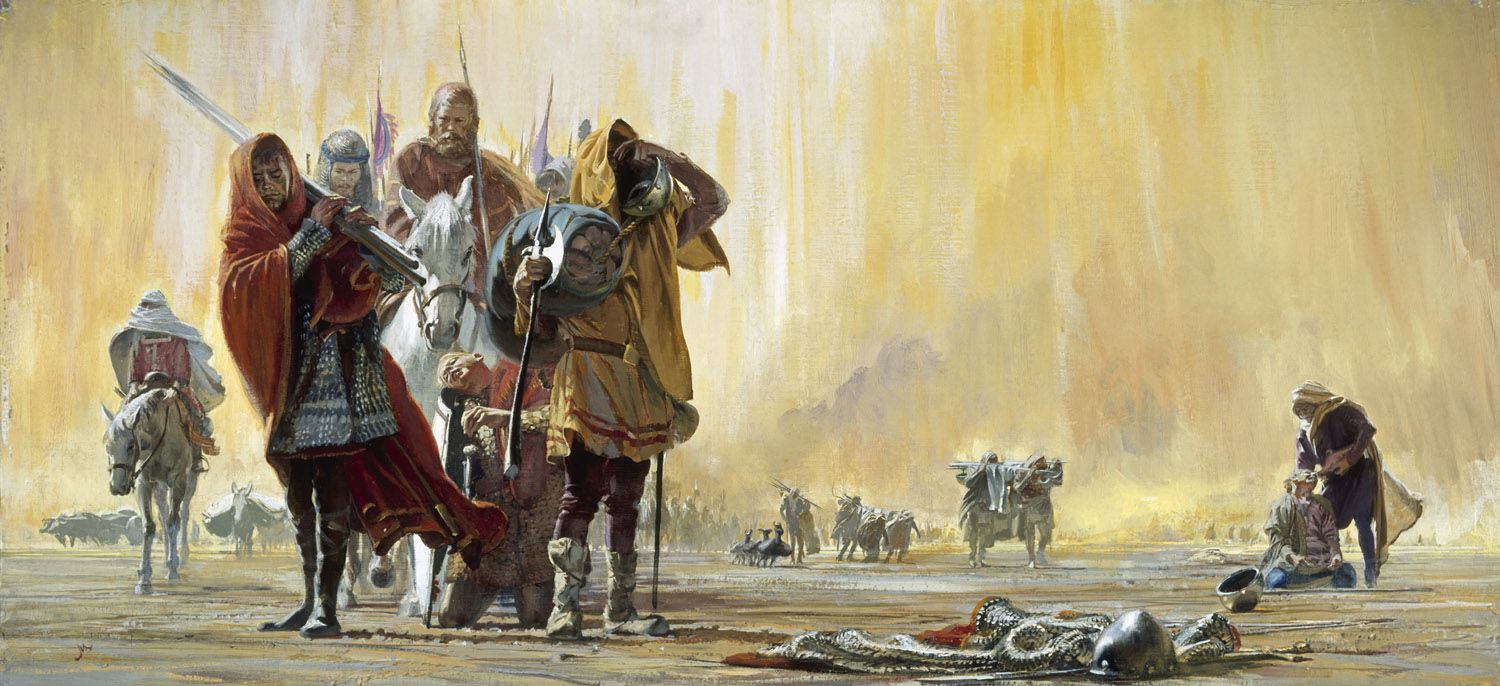
A depiction of crusaders on their difficult journey across Asia Minor
Note
Sultan Kilij Arslan had destroyed everything he left behind, not to mention, the crusaders had a shortage of food and water. Hundreds of men and horses died throughout their journey. Though there were fellow Christians who gifted them food and money, it was still not enough for all of them. Extreme hunger and thirst resulted in some crusaders looting and pillaging whenever there was an opportunity.
The routes taken by the crusaders was also another challenge that they had to face. Across Asia Minor, the crusaders debated and planned rather intensely the routes that they had to follow. Despite the heavy planning with different groups following separate routes, natural calamities were something that they could not have planned ahead.
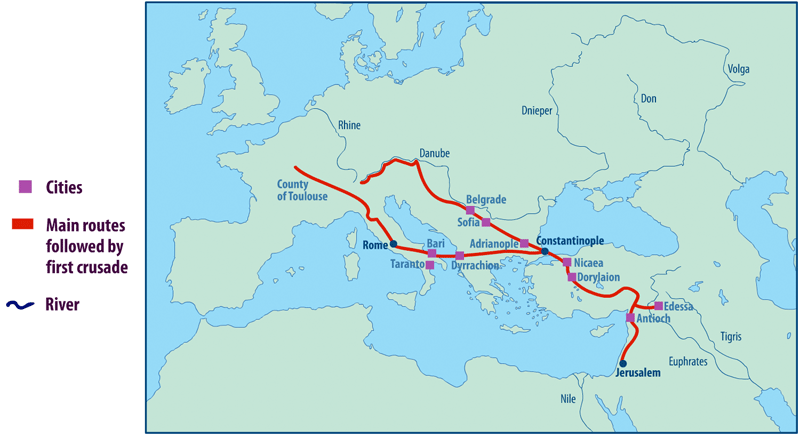
Map showing the routes taken by crusaders during the First Crusade
Note
Their journey from Coxon was the most difficult they had to face as the autumn rains had finally begun. For miles, they had to endure muddy paths leading up steep inclines and skirting precipices. Knights and their horses slipped and fell over the edge. The crusaders lost more lives this way than during their battle with the Turks.
Aside from the shortage of food and water and difficult routes, individual leaders also continued to dispute the overall leadership, despite them not being powerful enough (as Adhemar was always recognised as the spiritual leader) to take command on their own. They quarrelled over ultimate rights and the distribution of conquests.
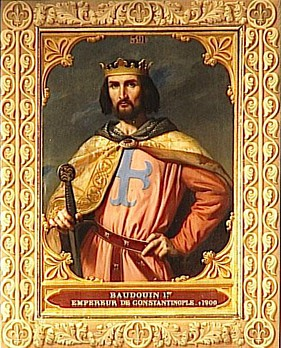
Baldwin of Boulogne
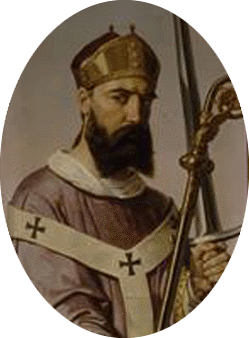
Adhemar de Monteil
Note
Baldwin of Boulogne set off on his own towards the Armenian lands. When his wife died after the battle, he received no incentive to return to Europe. Thus, he resolved to seize a fiefdom for himself in the Holy Land.
Exam Practise
Task 1
Note
Study the source and then answer the question that follows. Using Source A and your own understanding of the historical context, how would you associate the role of the Byzantium in the success of the First Crusade?
...after seeing their countless multitude and having gained experience of their invincible boldness from the battle itself, sent a message to the Turks inside Nicaea, saying "Act for the future in whatever way you think best." For he had known for some time that they would prefer to surrender the city to the Emperor than be captured by the Franks
- Account from the Alexiad of Anna Comnena Book XI: The First Crusade Retrieved from: https://sourcebooks.fordham.edu/basis/AnnaComnena-Alexiad11.asp
Task 2
Note
Critically read the source and explain what the crusaders had to go through along their journey across Asia Minor. Using historical facts, justify why this journey was necessary for the crusaders.
"The journey on from Coxon was the most difficult that the Crusaders had to face. It was now early October, and the autumn rains had begun. The road over the Anti-Taurus was in appalling disrepair; and for miles there was only a muddy path... Horse after horse slipped and fell over the edge; whole lines of baggage animals, roped together, dragged each other down into the abyss. No one dared to ride. The knights, struggling on foot under their heavy accoutrement, eagerly tried to sell their arms to more lightly equipped men, or threw them away in despair. The mountains seemed accursed. They took more lives than ever the Turks had done."
An excerpt from Erenow "THE CAMPAIGN IN ASIA MINOR" (retrieved from https://erenow.net/postclassical/firstcrusade/13.php)
Task 3
Note
Centuries after the birth of the Crusades, Christians and Muslims have opposing interpretations about this event in world history. Study the sources (interpretations) and then answer the question that follows. Use your own knowledge of the historical context to describe and come up with a judgement as to why and how the interpretations differ.
Source A
Many Muslims today forget to consider why Western Christendom acted as it did. They fail to consider that it was Muslim aggression that provoked a response on the part of Christendom. They have conveniently erased from their minds the memory of the Islamic jihad conquests.
The impact of the Islamic jihad conquests on Christendom receives a thorough study in Jean Flori (Paris, 2007)
Source B
The crusades were a form of imperialism, and Islam has suffered from the 'savage hostility' of the 'crusader spirit' from the eleventh century until today.
Sayyid Qutb and Islamic Activism: A Translation of Critical Analysis of Social Justice in Islam by William E. Shepard (Leiden,1996)