The Islamic world, including its diversity and its relations with Christians (OCR GCSE History B (Schools History Project)): Revision Notes
📚Revision Notes
The Islamic world, including its diversity and its relations with Christians
Note
The Crusading movement was a series of military campaigns against the Muslims in West Asia. It's rooted in the act of pilgrimage supported by the Church's Gregorian reforms. Ecclesiastical reforms during the early mediaeval period caused drastic changes in Church governance and its relationship with the imperial sovereign. The rise of Seljuk Turks in Western and Central Asia by the late 10th century and the defeat of the Byzantine Emperor led to the call for the first Crusading movement from European Christians.
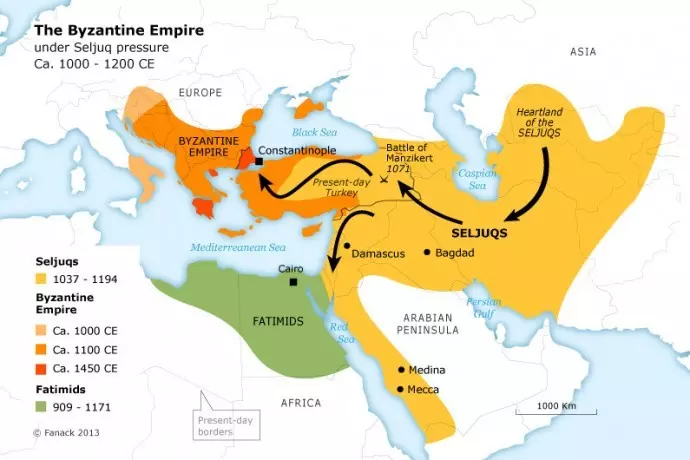
Map showing the conquest of the Seljuk Turks of Byzantine Empire Territory after the Battle of Manzikert in 1071
In 1091, the Byzantine Emperor requested aid from Pope Urban II in battling the Seljuks. Urban II responded and the Crusades began.
Urban II made his speech at the Council of Clermont urging every social class to embark on a righteous war to rescue the Holy Land from the hands of the 'infidels'.
About 60,000 to 100,000 people responded and marched to Jerusalem, known as the First Crusade.
Seljuk Turks were nomadic horsemen from the clan of the Oghuz from the north of the Oxus River in Central Asia. By the 10th century, they began to migrate and embrace Islam under their khan, Seljuk.